- 15 September, 2026

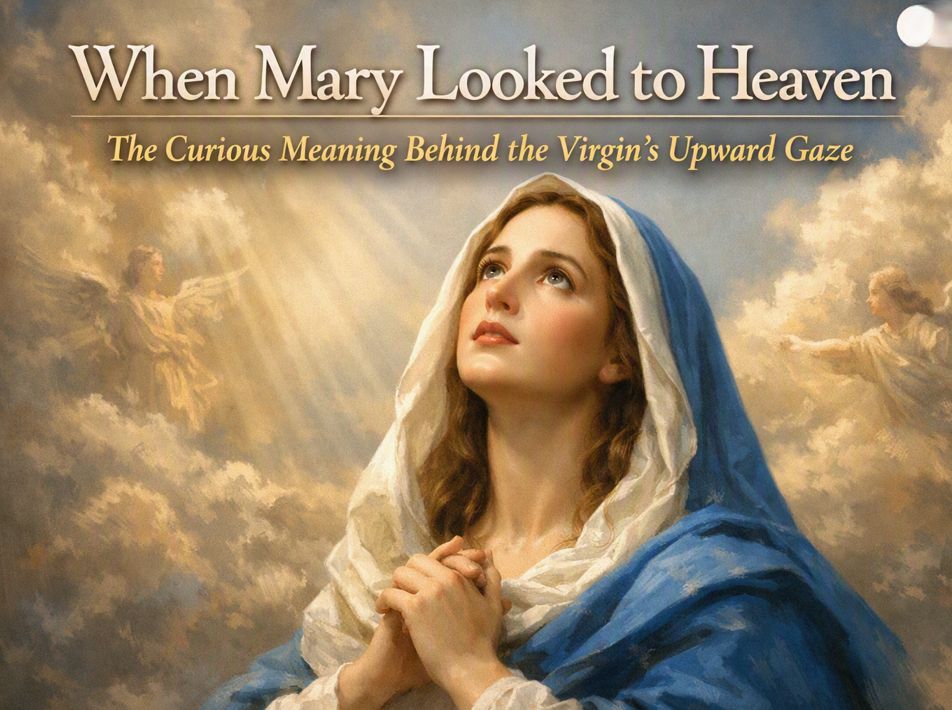
15 September, 2026: Few gestures in Christian art are as emotionally charged as the sight of the Virgin Mary looking towards heaven while mourning Christ.

How artists have used the Virgin Mary’s upward gaze to express grief, prayer, faith and hope
From the Mater Dolorosa to depictions of the Crucifixion and Pietà, artists have repeatedly raised Mary's eyes at moments of profound sorrow. But why?
There is no single prescribed Catholic meaning for Mary's upward gaze. Its significance depends on the particular artwork, period, artist and devotional context.

Yet the gesture can bring together grief, prayer, trust, appeal and hope, creating one of the most moving expressions of Mary's sorrow in Christian art.
Mary's upward gaze can transform personal suffering into an act of prayer. Rather than presenting her as completely consumed by the earthly scene, the artist directs her attention beyond it.
Her expression may evoke questions familiar to anyone facing suffering: Why has this happened? Where can consolation be found? Such questions, however, should be understood as possibilities suggested by the artwork, not as statements about Mary's precise thoughts.
Scripture does not tell us exactly what Mary was thinking at every moment of Christ's Passion.
The artist may nevertheless use her gaze to suggest that sorrow can be brought before God. Mary is grieving, but she may also appear to be turning towards God in faith.
This was particularly powerful in devotional art, where viewers were encouraged not simply to observe Mary's suffering but to meditate upon their own experiences of faith, loss and redemption.
The symbolism becomes especially clear when we consider how Christian art uses space. The area above frequently represents God's transcendence or the hope of heavenly communion. This is an artistic convention, however, rather than Catholic teaching that heaven is simply a physical place above the earth.
In Christian theology, heaven is understood principally in relation to communion with God. Thus, when Mary raises her eyes, the movement can symbolically lead the viewer from Christ’s suffering and death, which, in the light of the Resurrection, are not the final word. towards God's transcendence and the hope of salvation.
The visual progression might therefore be understood as:
Christ's suffering → Mary's grief → God and the hope of Resurrection
The gesture can suggest that earthly suffering is not the end of the story. Within Christianity, the Crucifixion is inseparable from the Resurrection, so an image of profound sorrow can also contain an element of hope.
Interestingly, artists have not always made Mary look upwards. The contrast is revealing.
In Michelangelo's Pietà, Mary's gaze is directed downward towards Christ. Her expression is remarkably calm, and she remains intimately connected with the physical body of her dead Son. Her sorrow is quiet, contemplative and deeply human.
This differs greatly from the dramatic upward gazes found in many later Baroque images. There, Mary's head may tilt backwards, her eyes fill with tears and her face becomes an intense expression of anguish.
The difference demonstrates how strongly an artist's choice of gaze can influence the meaning and emotional character of the scene.
During the Baroque period, artists became particularly interested in intense emotion and spiritual experience. Pain, tears, gestures and dramatic lighting could turn Mary's face into the emotional centre of an image.
Artists such as Guido Reni frequently portrayed the Mater Dolorosa with her eyes raised towards heaven. Her tears remain visible, but she appears to direct her attention beyond the immediate source of her earthly pain.
Is she praying? Appealing? Seeking consolation? Trusting God? A compelling painting can allow several of these interpretations to exist together.
Mary's acceptance of God's will is firmly rooted in Catholic teaching, particularly in her response to the Annunciation and her faithful cooperation with God's plan. Yet this should not be understood as passive resignation or indifference to Christ's suffering. Catholic theology presents Mary as faithfully united with her Son in His Passion, while making clear that her role is entirely dependent upon Christ and His redemptive merits.
Mary's upward gaze is powerful precisely because it does not erase her grief. She can be deeply sorrowful and faithful at the same time.
For Christian viewers, this can suggest that faith does not necessarily remove suffering; it can change how suffering is faced. Depending on the artwork, Mary's eyes may represent mourning for Christ, prayer, trust, appeal or hope beyond death.
Catholic teaching also honors Mary as an intercessor for the Church. Nevertheless, it would be too strong to claim that every painting of the Mater Dolorosa depicts Mary specifically praying for humanity. That interpretation may be invited by some images, but it is not a fixed meaning of the gesture.
The upward gaze continues to fascinate because it holds together two realities: profound earthly anguish and a turning towards something beyond it. Looking beyond oneself in moments of suffering is a recurring human and religious response, though certainly not an experience shared by everyone.
Artists understood the emotional power of that simple movement. By raising Mary's eyes, they could transform her from a mother grieving at the foot of the Cross into a figure suspended between earthly sorrow and heavenly hope.
Perhaps that is the real mystery of Mary's upward gaze. Artists portray her as looking towards heaven not because she is untouched by sorrow, but because she is suffering and still turning towards God. In that single gesture, artists found a way to make grief feel like a question, a prayer, an expression of faith—and perhaps even the beginning of hope.
By Catholic Connect Reporter
Read More:
1) Why Is the Pelican a Symbol of Christ? The Christian Meaning Explained
2) Why Are the Four Gospels Represented by a Man, Lion, Ox and Eagle?
3) Why Is the Rooster a Symbol in Christian Art?
4) Why Do Peacocks Appear in Early Christian Tombs?
5) Why Does a Phoenix Appear in Christian Art?
6) Why Does a Pomegranate Appear in Christian Art?
7) A.M., AM or M? What Do These Mysterious Marian Letters Mean?
8) Why Is Mary Sometimes Shown With a Star?
9) What Does an Anchor Have to Do with Christianity?
10) Why Is a Ship One of Christianity’s Oldest Symbols?
11) Why Does the Grapevine Appear in Christian Art? Its Meaning Explained
12) Why Do Palm Branches Appear in Christian Art?
13) Why Do the Letters “IHS” Appear in Catholic Churches?
14) What is the Chi-Rho (ΧΡ)? The Ancient Symbol for Christ Explained





© 2026 CATHOLIC CONNECT POWERED BY ATCONLINE LLP