- 15 September, 2026

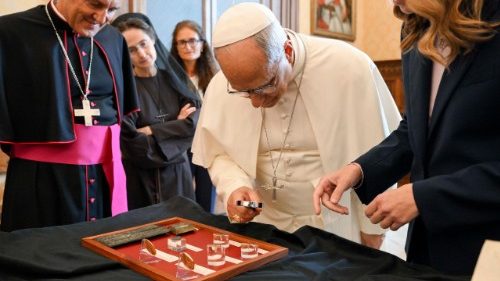
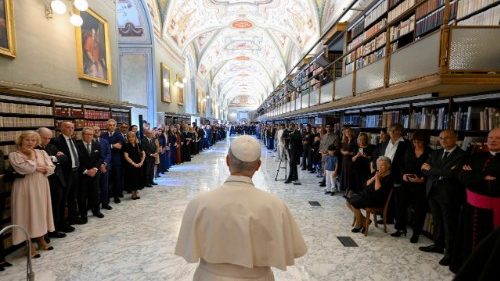
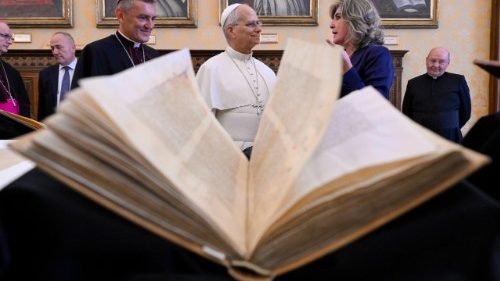
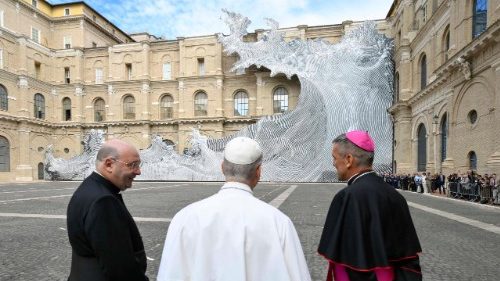
Vatican City, September 15, 2026: Pope Leo XIV inaugurated the “AQVA. Catastrophe and Wonder” exhibition during his visit to the historic Apostolic Archives and Apostolic Library in the Vatican on Monday.

Speaking to the staff of the Library and Archives, Pope Leo highlighted that it was his first visit to the Library as pontiff, “following in the footsteps” of his predecessors.
He expressed his closeness and appreciation for the mission and work of the two institutions, describing them as “at the service of the development and spreading of culture, for the benefit of the Church and all humanity.”

The Vatican Archives and Library preserve and maintain “acts and documents concerning the government of the universal Church”, according to the Apostolic Constitution Praedicate Evangelium No. 242. They also collect and preserve a large patrimony of arts and learning, while making it available to scholars (No. 243).
In search of truth
While a library can be seen as a restful and quiet place, Pope Leo highlighted that a book also “awakens a restlessness, feeding the desire and daring to search.”
Saint Augustine offers an example of this dynamic. Through reading the Letter of Saint Paul, the Bishop of Hippo’s doubt disappeared.
“But not the desire, which became even stronger, driving him to explore the breadth and depth of Sacred Scripture,” the Pope explained. By studying the biblical books, Saint Augustine’s spirit was opened.
In the same way, through study, preservation, and making books of the successor of Peter available, Pope Leo noted, “you help the Church and humanity to reach the depths of desire. Without it, everything withdraws from the living God, the source of truth and love.”
A beating heart
Pope Leo then asked: How can we describe the Pope’s Library?
Using a metaphor, Pope Leo called the Apostolic Library a heart. “A beating heart is a symbol of life, and it results from two opposing movements, systole and diastole: a contraction and a relaxation, a movement towards the centre and another towards the periphery,” he explained.
The Pope’s Library remains alive as long as it maintains its systole and diastole. The systole of the Apostolic Library is that it continues to be a place characterised by quiet, discretion, respect, and care.
Pope Leo expressed his desire that the “monastic atmosphere of the Apostolic Library” be a reminder of a passage from Saint Luke’s Gospel: “If you have to build, if you have to fight, first sit down and study” (14:28-32).
The interior life of the Apostolic Library also stems from the unique and priceless treasure preserved inside.
“While on the one hand it is right to facilitate access to this treasure for study, including through digitization and online access,” he continued, “on the other it is also necessary to preserve and encourage the ancient practice of physically making one’s way to the Library.”
It is not simply a place full of books, but a place built by relationships, exchange, and sharing ideas.
More open to the world
Continuing the metaphor, the Apostolic Library lives through this diastole, or relaxation.
In the room dedicated to his predecessor, Pope Leo XIV remembered the role of Pope Leo XIII during the Industrial Revolution. This included opening the Vatican Archives to scholars around the world and giving wider access to the Library.
The reading room contains literature, theology, botany, zoology, medicine, law, art, and economics, among other topics. Works from across the globe are held in the Library.
Pope Leo highlighted that all of this occurred before it was a universally common practice. “Through this approach, the Apostolic Library bears witness to the Church’s ancient and ever-new cultural openness,” he said.
The inauguration of the current cycle of exhibitions is a confirmation of this tradition. Another example of this cultural openness is the “gentle diplomacy that finds an open path among the documents and books of the Vatican Archives and Library, one of the ‘open pathways to reconciliation’ of which the Encyclical Magnifica Humanitas speaks” (No. 211).
The Pope urged the staff of the Vatican Archives and Library to continue this work and challenged them to be faithful to the past and to the future, to use the languages and means relevant to their work, and to find new ways to achieve reconciliation.
Pope Leo concluded his speech by highlighting a problem the Vatican Archives and Library is currently facing: the need for new space. He announced that he has given instructions to help respond to this need.
“I intend to continue along the path traced by my predecessors, who over the centuries have demonstrated the care the Apostolic See has for the institutions entrusted with preserving and promoting its cultural and administrative memory,” he stressed.
Courtesy: Vatican News

© 2026 CATHOLIC CONNECT POWERED BY ATCONLINE LLP