- 25 July, 2026

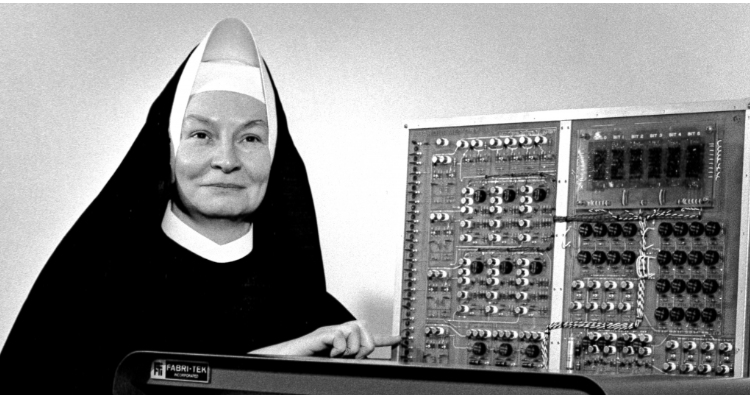
July 25, 2026: When people think of the pioneers of computer science, names like Alan Turing, Bill Gates or Steve Jobs usually come to mind.


Very few would guess that one of the earliest computer scientists was a Catholic nun.
Yet decades before smartphones, artificial intelligence and Silicon Valley became household names, Sister Mary Kenneth Keller was helping shape the future of computing. At a time when computers filled entire rooms and programming was still in its infancy, she was writing algorithms, developing educational software, and dreaming of a future where computers would transform classrooms around the world.
Her story is a powerful reminder that faith and scientific innovation have often gone hand in hand.


Born Evelyn Marie Keller in 1913 in Cleveland, Ohio, she entered the Sisters of Charity of the Blessed Virgin Mary while still a young woman. Alongside her religious vocation, she developed a deep passion for mathematics and education.
In an era when very few women entered scientific fields—and even fewer religious sisters pursued advanced technology—Sister Mary Kenneth Keller believed that knowledge was a gift meant to serve others.
(CLICK HERE to follow Catholic Connect and to stay updated with Catholic News & Content)
Rather than seeing science as separate from her faith, she viewed learning as another way of understanding God's creation and serving humanity.
That conviction would lead her into one of the world's newest academic disciplines.
In the 1950s and early 1960s, computers were rare, expensive machines used mainly by governments, universities and large corporations.
Programming them required patience, mathematical precision and extraordinary problem-solving skills.
Sister Mary Kenneth Keller became one of the first women in the United States to study computer science at an advanced level. She worked with the programming language BASIC, developed at Dartmouth College, which was designed to make computing accessible to students rather than just specialist researchers.
This was a revolutionary idea.
Instead of computers remaining mysterious machines for experts alone, BASIC opened the door for millions of ordinary people to learn programming. Sister Keller contributed to its early development and championed the belief that computers should become educational tools for everyone.
Long before personal computers entered people's homes, she saw their potential to transform education.
In 1965, Sister Mary Kenneth Keller made history by becoming one of the first women in the United States to earn a doctorate in computer science.
This achievement was remarkable in itself.
But it was even more extraordinary because she accomplished it while living a life dedicated to religious service.
At a time when women were often discouraged from pursuing careers in science and technology, Sister Keller quietly proved that intellectual excellence and religious commitment could flourish together.
Her life challenged the stereotype that faith limits scientific curiosity.
Instead, it demonstrated that faith can inspire it.
After completing her doctorate, Sister Keller founded the Computer Science Department at Clarke College in Iowa, where she spent many years teaching and mentoring students.
She believed computers would one day become essential learning tools in every school and university.
Today, when digital classrooms, online learning and artificial intelligence have become part of everyday life, her vision seems remarkably prophetic.
She argued that technology should never replace human relationships or wisdom. Instead, it should free people from repetitive tasks so they could devote more time to creativity, learning and serving others.
That philosophy remains strikingly relevant in today's age of AI.
Sister Mary Kenneth Keller never saw a contradiction between her religious vocation and her scientific work.
For her, education was a ministry.
Technology was a tool for human flourishing.
Knowledge was a gift to be shared.
Her life reflects a long tradition within the Catholic Church of encouraging scholarship, preserving knowledge and advancing scientific discovery. Like Gregor Mendel in genetics and Georges Lemaître in cosmology, Sister Keller showed that faith and reason are not rivals but partners in the search for truth.
Every time we open a laptop, write a line of code or use technology to learn something new, we benefit from the vision of pioneers who believed computing could change the world.
One of those pioneers wore not a lab coat, but a religious habit.
Long before Silicon Valley became the centre of technological innovation, Sister Mary Kenneth Keller was helping lay the foundations of the digital age. Her story reminds us that some of history's greatest innovators are not always the most famous—and that a life devoted to God can also help shape the future of humanity.
By Catholic Connect Reporter



© 2026 CATHOLIC CONNECT POWERED BY ATCONLINE LLP