
- 11 October, 2026

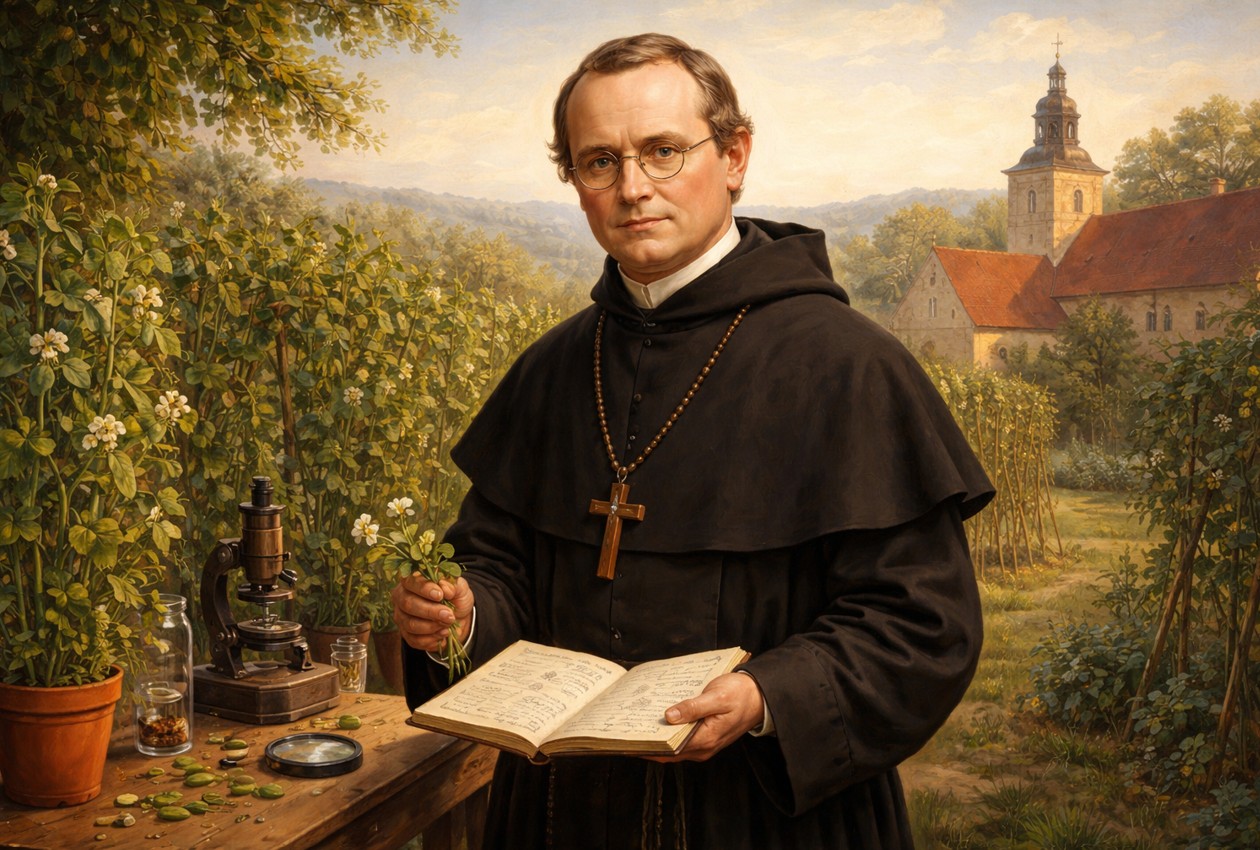
Czech Republic, 1865 : In a quiet Augustinian monastery, far removed from the grand universities of Europe, a monk stood among rows of pea plants—patiently observing, recording, and counting. There were no high-tech instruments, no global recognition, and no sense that history was being made.



Yet in that stillness, modern genetics was born.
The man tending that garden was Gregor Mendel—a humble monk with a sharp scientific mind and a relentless curiosity about how traits pass from one generation to the next.
At a time when most believed that inheritance was a simple blending of characteristics, Mendel questioned everything. Why did some traits disappear, only to reappear later? Why were patterns so consistent across generations?
Instead of speculating, he chose to experiment.
Between 1856 and 1863, Gregor Mendel cultivated and studied thousands of pea plants within the monastery grounds. He selected pea plants because they were easy to grow and showed clear, contrasting traits—such as tall vs. short stems, or yellow vs. green seeds.
But what set Mendel apart was not just his choice of plant—it was his method.
With extraordinary discipline, he tracked how traits were passed down through generations, recording results with mathematical precision. In total, he analyzed tens of thousands of plants, uncovering patterns no one had seen before.
In the silence of a monastery garden, he discovered that inheritance follows laws.
Mendel’s findings revealed something revolutionary:
Traits are not blended—they are inherited as distinct units.
He identified principles that today form the foundation of genetics:
Though he had no knowledge of DNA, Mendel had essentially discovered the concept of genes—decades before science could physically observe them.
In 1865, Gregor Mendel presented his groundbreaking work.
The response?
Silence.
His research was published but largely ignored by the scientific community of his time. Without recognition or support, he eventually returned to his duties as abbot, setting aside his experiments.
He died in 1884, never knowing that he had unlocked one of the greatest scientific truths in history.
It wasn’t until the early 20th century that scientists revisited Mendel’s work and realized its significance. By then, the world was ready.
His principles became the backbone of a new scientific field: genetics.
Today, his discoveries influence everything from:
From a monastery garden came insights that now shape the future of humanity.
What makes this story especially powerful is the setting in which it unfolded.
For Gregor Mendel, monastic life was not a barrier to science—it was an enabler.
The monastery offered:
His faith did not compete with his scientific work. It nurtured a worldview in which nature was orderly, intelligible, and worthy of careful study.
Today, Gregor Mendel is rightly called the father of modern genetics.
Yet his story is not just about scientific brilliance—it’s about quiet perseverance, intellectual humility, and the unexpected places where truth can be found.
In an age where science and faith are often portrayed as opposites, Mendel’s life tells a different story.
It reminds us that:
Sometimes, they begin in a garden.
He never saw a gene.
He never heard of DNA.
But in a monastery garden, a monk uncovered the hidden language of life.
And the world is still reading it today.
By Catholic Connect Reporter







© 2026 CATHOLIC CONNECT POWERED BY ATCONLINE LLP