
- 20 August, 2026

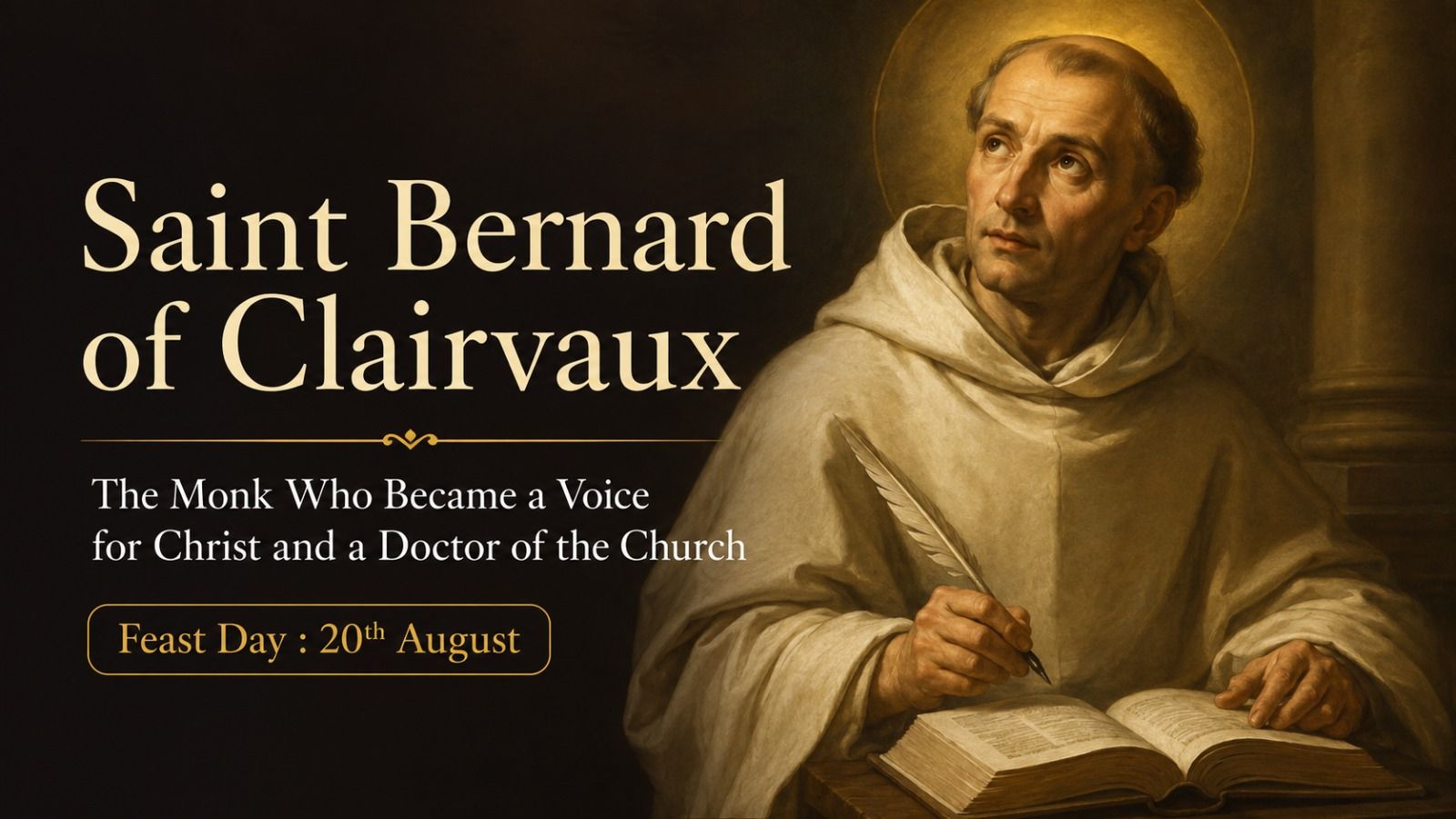
August 20, 2026: Why is Saint Bernard of Clairvaux remembered as one of the greatest spiritual teachers of the Middle Ages? Discover the remarkable story of the Cistercian monk who transformed Clairvaux into a centre of holiness, preached throughout Europe, defended the faith, promoted devotion to Mary, and became known as the “Doctor Mellifluus” — the Honey-Sweet Doctor.


Feast Day: 20 August
Born: 1090, Fontaines, France
Died: 21 August 1153, Clairvaux, France
Religious Order: Cistercian


Canonized: 1174 by Pope Alexander III
Doctor of the Church: Proclaimed by Pope Pius VIII
Known For: Cistercian renewal, mystical theology, preaching, devotion to the Blessed Virgin Mary, and service to the Church
Title: Abbot and Doctor of the Church; “Doctor Mellifluus”
Saint Bernard of Clairvaux desired a life of silence, prayer, and contemplation.
Yet God called him far beyond the walls of his monastery.
CLICK HERE to follow Catholic Connect and to stay updated with Catholic News & Content)
Born into a noble family in Burgundy, Bernard entered the newly established Cistercian monastery at Cîteaux as a young man. His decision would eventually make him one of the most influential religious figures of twelfth-century Europe.
Pope Benedict XVI described Bernard as a great Doctor of the Church whose contemplative life did not prevent him from undertaking intense apostolic work.
Around the age of twenty, Bernard entered Cîteaux together with a group of companions.
The Cistercians sought a stricter observance of the Rule of Saint Benedict, emphasizing prayer, simplicity, work, and separation from worldly distractions.
Bernard embraced this demanding way of life with extraordinary seriousness.
In 1115, he was sent to establish a new monastery in the Valley of Absinthe. He named it Clairvaux, meaning “clear valley,” and became its abbot.
Clairvaux soon attracted numerous disciples.
Bernard's reputation for holiness and spiritual wisdom spread rapidly, and the monastery eventually became the source of many new Cistercian foundations across Europe.
Yet Bernard's influence extended far beyond monastic life.
Popes, bishops, rulers, and ordinary Christians sought his counsel.
Although he loved solitude, obedience repeatedly called him away from his monastery.
Bernard became involved in major controversies affecting the Church of his time.
He travelled extensively, defended Church teaching, advised popes and rulers, and worked to restore unity during periods of ecclesial division.
He also preached the Second Crusade in Europe.
His public ministry demonstrated an important truth: contemplation does not mean escaping responsibility.
For Bernard, prayer gave strength for service.
Bernard's greatest legacy may be found in his spiritual writings.
His sermons on the Song of Songs explored the relationship between God and the human soul using the language of love.
Pope Benedict XVI emphasized that Bernard's theology communicated the truths of faith with clarity and persuasive spiritual depth.
For Bernard, love stood at the centre of Christian life.
God loves humanity, and the Christian response is to return that love through conversion, prayer, and holiness.
Saint Bernard possessed an extraordinary devotion to the Blessed Virgin Mary.
He saw Mary as a model of Christian discipleship and frequently encouraged Christians to turn to her with confidence. Pope Benedict XVI noted Bernard's profound Marian devotion and described him as a teacher of Mary's essential role in Christian life.
His Marian writings helped shape Catholic spirituality for centuries.
Bernard became known as Doctor Mellifluus, the “Honey-Sweet Doctor,” because of the beauty and spiritual sweetness of his preaching and writings.
He was canonized in 1174 and later proclaimed a Doctor of the Church by Pope Pius VIII.
His writings continue to nourish Christians seeking a deeper relationship with Christ.
Saint Bernard teaches that prayer and action belong together.
He reminds Christians that genuine contemplation should produce love, courage, humility, and service.
His life also teaches the importance of recognizing our weaknesses. Pope Benedict XVI highlighted Bernard's struggle to control his temperament and his humility in acknowledging his own limitations.
Saint Bernard lived in a turbulent age, yet his message remains remarkably relevant.
He teaches Christians to seek silence without becoming indifferent, to defend truth without abandoning charity, and to place Christ at the centre of every aspect of life.
His spirituality was deeply Christ-centred, Marian, contemplative, and rooted in divine love.
Saint Bernard's message remains clear: seek God in prayer, love Christ deeply, trust Mary, remain humble, and allow contemplation to become a life of service.
To know about more saints please visit the spiritual section.
By Catholic Connect Reporter
Saint Bernard of Clairvaux, Saint Bernard feast day, August 20 feast day, Saint Bernard biography, Bernard of Clairvaux, Cistercian saints, Cistercian Order, Doctor of the Church, Doctor Mellifluus, Honey-Sweet Doctor, Catholic saints, medieval saints, Saint Bernard and Mary, Marian saints, Song of Songs, Cistercian monks, Catholic mystics, mystical theology, saints of August, Christian spirituality





© 2026 CATHOLIC CONNECT POWERED BY ATCONLINE LLP