- 22 October, 2026
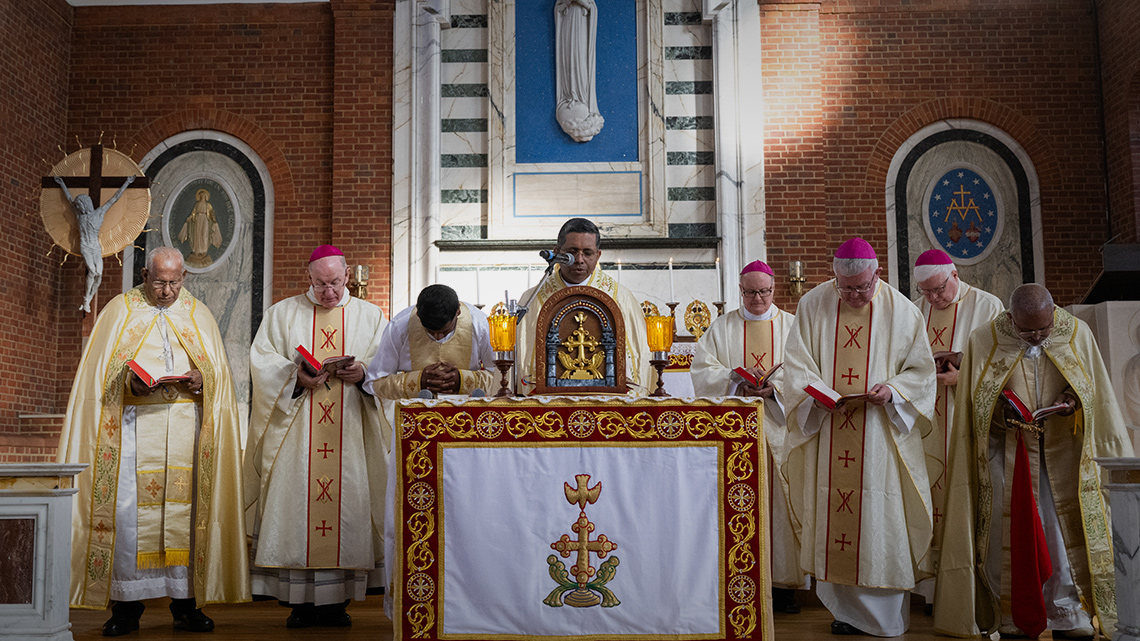
LONDON, October 22, 2026: Cardinal George Jacob Koovakad, Prefect of the Vatican’s Dicastery for Interreligious Dialogue, joined representatives of major world religions in London on October 17 to sign a pledge committing themselves to building a more just, peaceful and fraternal world through dialogue, mutual respect and recognition of the dignity of every human person.


The gathering, titled “Religions as Builders of Peace in the Spirit of Assisi”, took place at Westminster Cathedral Hall and brought together religious leaders and representatives from Hinduism, Islam, Christianity, the Bahá’í Faith, Zoroastrianism, Jainism, Judaism, Buddhism and Sikhism.
The event was held ahead of the 40th anniversary of the 1986 Assisi gathering for peace and reflected on the responsibility of religious communities to promote peace, human solidarity, social friendship and the common good.
Cardinal Koovakad attended the event after joining the UK’s Syro-Malabar Catholic community to celebrate the tenth anniversary of its Eparchy of Great Britain.
Cardinal Nichols highlights dialogue and respect for differences
Cardinal Vincent Nichols, retired Archbishop of Westminster, delivered an address exploring the relationship between religious identity, territory and the opportunities created through dialogue over time.
Reflecting on the historic 1986 gathering in Assisi, Cardinal Nichols recalled the distinction that religious leaders had not come to pray together but had come together to pray. He explained that this approach respected the differences between religious traditions while recognising the common ground found in shared humanity.
He highlighted the importance of honouring diversity, sharing visions and cooperating in joint efforts to build peace. Referring to the need for dialogue, he drew on the example of St Francis of Assisi’s encounter with Sultan al-Kamil in Egypt in 1219, during the Fifth Crusade.
Cardinal Nichols reflected on the courage shown by both men in stepping beyond familiar and secure spaces to encounter one another. He connected this encounter with Pope Francis’ principle that “time is greater than space”, which emphasises the importance of patient processes and long-term progress rather than the immediate preservation of power or territory.
He invited religious communities to examine how they respond to change and difference, asking whether they see them as a threat or an opportunity. He also stressed that religious communities can contribute to peace by remaining open to one another, respecting different traditions and customs, and working together with humility and generosity.
Nine faith traditions offer prayers for peace
Following Cardinal Nichols’ address, representatives of nine faith traditions offered reflections and prayers for peace. A period of shared silence followed, during which the pledge was signed.
Radhika Kadaba, Chair of the Hindu Council of Wales, reflected on the Hindu principle “Vasudhaiva Kutumbakam”, meaning “The whole world is one family”. She emphasised the dignity, kindness and care owed to every person and called for people to listen respectfully, stand alongside those who suffer and build bridges across differences.
Shaykh Ibrahim Mogra, Muslim Co-Chair of the Christian Muslim Forum, reflected on Al-Salam, one of the names of God meaning “The Giver of Peace”. Drawing on the teachings of the Prophet Muhammad, he highlighted how greeting one another with peace can foster love and strengthen relationships.
Dr James Roberts, Head of St Paul’s Cathedral Institute, reflected on Jesus’ words from the Gospel of Matthew: “Blessed are the peacemakers, for they shall be called children of God.” He explained that peacemaking requires active efforts to share God’s love, uphold justice and work for reconciliation, sustained by faith and hope.
Padideh Sabeti, Director of the UK Bahá’í Office of Public Affairs, spoke of the need for transformation within individuals, communities and nations for peace to become a reality. Drawing on the teachings of Bahá’u’lláh, she highlighted unity, integrity, justice, care for the poor and support for people experiencing suffering and oppression.
Malcolm Deboo, President of the Zoroastrian Trust Funds of Europe, offered a prayer invoking Ahura Mazda, the Creator, asking that truth, righteousness and the Good Mind bring peace and happiness to the world. The prayer expressed the hope that peace would triumph over discord, charity over stinginess and devotion over contempt.
The gathering also included Dr Mehool Sanghrajka MBE, Director of the Institute of Jainology; Brenda Dinsdale, Honorary Life President of Newcastle Reformed Synagogue; Dr Desmond Biddulph CBE, President of The Buddhist Society; and Professor Bhai Sahib Mohinder Singh Ahluwalia OBE, KSG, spiritual leader and chairman of Guru Nanak Nishkam Sewak Jatha. They represented Jain, Jewish, Buddhist and Sikh traditions respectively in the gathering’s reflections and prayers for peace.
Cardinal Koovakad calls religions to become builders of peace
After the pledge was signed, Cardinal Koovakad read it aloud and delivered an address reflecting on the Catholic Church’s commitment to interreligious dialogue and peacebuilding.
He expressed gratitude to the Catholic Bishops’ Conference of England and Wales for organising the gathering and said he hoped the meeting would strengthen the resolve of religious communities to work for peace and harmony through social friendship, human solidarity, the common good and collaboration.
Referring to the Second Vatican Council, Cardinal Koovakad highlighted the Catholic Church’s efforts to promote mutual understanding, acceptance and collaboration among followers of different religions in everyday life.
He recalled the contributions of Popes Paul VI, John Paul II, Benedict XVI and Francis to the Church’s engagement with peace and interreligious dialogue. He particularly highlighted the “spirit of Assisi”, associated with the 1986 Prayer for Peace gathering convened by Pope John Paul II, and the call for peace to be built through truth, justice, love and freedom.
Cardinal Koovakad also referred to Pope Benedict XVI’s understanding of peace as both a gift from God and a task that remains unfinished. He emphasised that peace requires the purification and conversion of hearts, minds and actions, alongside respect for human dignity.
Reflecting on the teachings of Pope Francis, he said religions must encourage their followers not to weaponise faith in conflicts. He also highlighted the principle that unity is greater than conflict and the importance of overcoming differences rooted in political thinking, language, culture and religion.
Cardinal Koovakad noted that the Catholic Church had worked consistently over the past four decades to sustain the spirit of Assisi by promoting authentic peace, social friendship, human solidarity, the common good, interreligious dialogue and collaboration among people.
Explaining the significance of religion in peacebuilding, he referred to the Latin word religare, meaning “to bind”. He said that religions, through their relationship with the Divine or a transcendent reality, are bound to peace, love and justice, which he described as core virtues of religious traditions.
He expressed hope that religions would give greater visibility to peacemaking activities and peacebuilding initiatives, serving as instruments of peace, harmony and the common good.
Pledge commits faith leaders to justice and peaceful coexistence
The Pledge for Peace affirmed that building peace begins with recognising the dignity of every human person and loving one’s neighbour according to the Golden Rule: “Do to others as you would have them do to you.”
The signatories committed themselves to rejecting violence, terrorism and hatred, and condemned attempts to invoke God or religion to justify violence or war. They also pledged to address conditions that give rise to hatred, extremism and conflict.
The declaration called for present and future generations to be educated in mutual respect, understanding and friendship, fostering peaceful coexistence among people of every ethnicity, culture and religious tradition.
It further committed the signatories to strengthening dialogue through attentive listening, honest conversation and mutual trust; defending the equal dignity and fundamental rights of every person; and engaging across religious differences with honesty, humility and patience.
The pledge also acknowledged the need to confront past and present failures, prejudices and injustices, seek forgiveness where necessary and work towards reconciliation, recognising that lasting peace cannot exist without justice.
The religious leaders pledged to stand alongside the poor, vulnerable, displaced and those suffering from war, persecution, discrimination or neglect. They also committed themselves to encouraging political, civic and religious leaders to uphold justice, protect human dignity and fundamental freedoms, and strengthen cooperation among nations.
The declaration concluded by affirming that peace and justice are inseparable and that lasting security, genuine freedom and authentic peace cannot be secured by force alone. Instead, they must be built through dialogue, solidarity, shared responsibility and recognition of the human family.
The gathering reaffirmed the shared responsibility of religious communities to work for peace while respecting their distinct traditions and convictions.
Courtesy: Catholic Church England and Wales
© 2026 CATHOLIC CONNECT POWERED BY ATCONLINE LLP