- 30 August, 2026

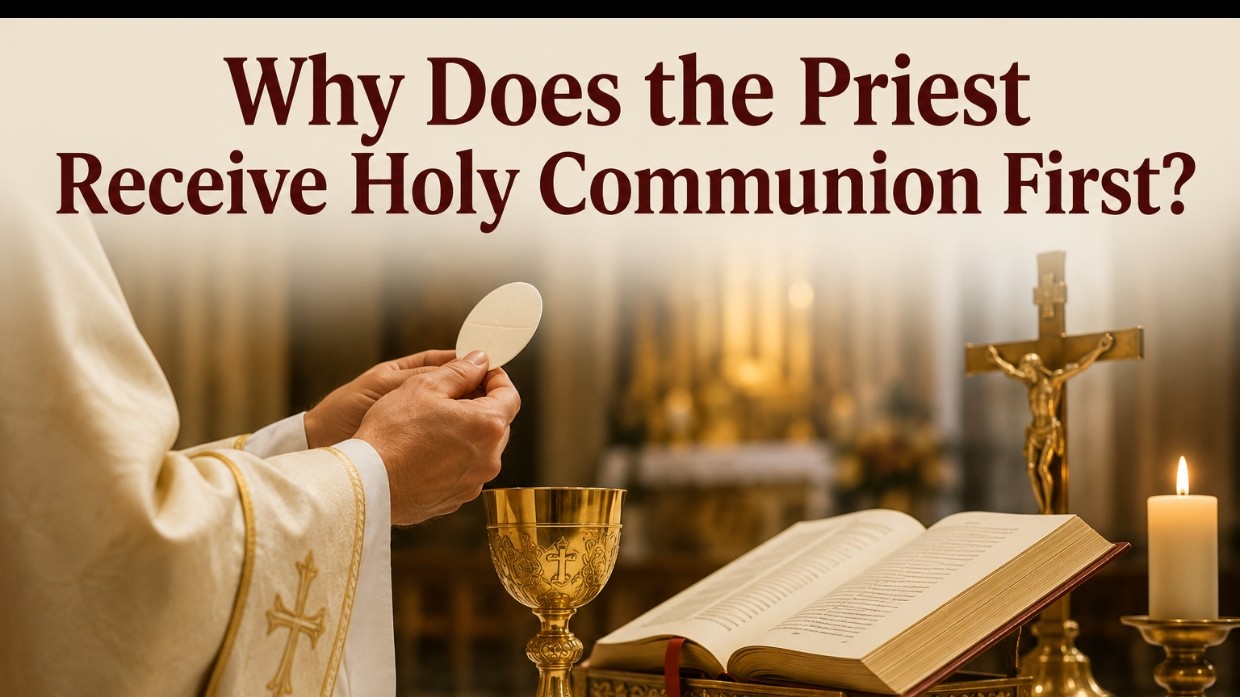
August 30, 2026: At Mass, have you ever noticed that the priest receives Holy Communion before it is distributed to the congregation? After the Eucharistic Prayer and the breaking of the bread, the priest receives the consecrated Host and, when he does so, the Precious Blood. Only then does Communion begin for the faithful.

Why this particular order?
It is part of the Church’s liturgical order
The priest’s Communion is not an optional custom. The Roman Missal places the priest celebrant’s Communion before the distribution of Communion to the faithful. Concelebrating priests likewise receive Communion before it is distributed to the congregation.


(Click here to follow Catholic Connect for regular News and Content)
Before receiving, the priest says a prayer silently, asking that the Body and Blood of Christ may bring him to eternal life and that he may receive the sacrament fruitfully.
The order therefore belongs to the structure of the Eucharistic celebration itself.
The priest receives before he distributes
There is also an important liturgical movement here. The priest presides at the celebration of the Eucharist and, through his ordained ministry, acts in the person of Christ the Head. Having participated in the Eucharistic sacrifice, he receives the Eucharist and then proceeds to distribute Communion to the faithful.
This makes clear that the priest is not simply someone who distributes Communion to others. He too approaches the Eucharist as one who receives Christ.
The Church distinguishes the ministerial priesthood from the common priesthood of all the baptized. Both participate in Christ’s priesthood, but in different ways. The priest’s particular role is to preside over the Eucharistic celebration, while the faithful participate in it according to their baptismal calling.
A practice rooted in tradition
The order also has a long history in the Church’s liturgical tradition. The celebrant’s Communion has traditionally preceded the distribution of Communion to the rest of the assembly.
What we see at Mass, therefore, is not simply a practical arrangement of who goes first. The sequence expresses the order of the Eucharistic rite and the distinct ministries within the celebration.
The same Christ is received
There is no different Eucharist for the priest and the faithful. The same Jesus Christ is truly and fully present in the Eucharist and is received by every communicant.
The Church encourages the faithful, when possible, to receive hosts consecrated at the same Mass, because this more clearly expresses their participation in the sacrifice being celebrated. Communion under both kinds, when permitted, can also express more fully the sign of the Eucharistic banquet. Nevertheless, Christ, whole and entire, is received under either species.
Why does it matter?
The priest receiving first points to the movement of the Eucharistic celebration: the sacrifice is offered, the celebrant receives, and Communion is then shared with the faithful.
The order helps make visible the different ways in which priest and people participate in the one Eucharist. At the altar, they are not competing roles but complementary ones, united around the same Lord.
So the next time the priest receives Communion before the congregation, it can be seen not merely as a sequence to follow, but as a small detail that reveals the Church’s understanding of the Eucharist, the priesthood and the communion of the whole Church.
By Catholic Connect Reporter
Read more:
The Priest’s Prayer for Deliverance from Evil at Mass: Explained
Why Do We Say “Lamb of God” Three Times Before Holy Communion?
When Does the Bread and Wine Become the Body and Blood of Christ at Mass?
Why Do Catholics Ring Bells During Mass?
What Happens When We Sing “Holy, Holy, Holy” at Every Mass?
Why Does the Priest Wash His Hands During Mass?
Why Did Jesus Choose Bread and Wine for the Eucharist?
Why Does the Church Pray for the Whole World at Mass?
Why Do Catholics Say the Creed After the Homily?
Why Can’t We Skip the Homily at Sunday Mass?
Three Little Crosses Before the Gospel — But What Do They Mean?
Why Do Catholics Sit for the Readings but Stand for the Gospel?
Why Is There a Psalm Between the Readings?
Why Are There Usually Three Readings at Sunday Mass?
Why Does the Priest Say “The Lord Be with You” So Often at Mass?
Why Do We Keep Saying “Amen” at Mass? What Are We Really Saying?
The Prayer After “Let Us Pray” Changes at Mass—Do You Know Why?
Why Do Catholics Sing the Gloria—but Not at Every Mass?
Why Do We Confess Our Sins at the Start of Mass? The Deeper Meaning Explained
Why Does the Priest Kiss the Altar at Mass?
Why Does Mass Begin and End with the Sign of the Cross?
What Makes the Catholic Mass Different from Other Christian Worship Services?
If God Made the Seventh Day Holy, Why Do Catholics Worship on Sunday?
Four Parts, One Beautiful Story: Understanding the Flow of the Mass
Why Does the Mass Follow the Same Order Every Time? The Church's Timeless Wisdom
Why Do Catholics Call It the Mass? The Answer Begins with Three Latin Words
How the Mass Developed Over 2,000 Years: A Journey Through History and Worship
If God Made the Seventh Day Holy, Why Do Catholics Worship on Sunday?
Continue Reading on Catholic Connect App
Get access to exclusive news articles & more.
© 2026 CATHOLIC CONNECT POWERED BY ATCONLINE LLP