- 26 September, 2026

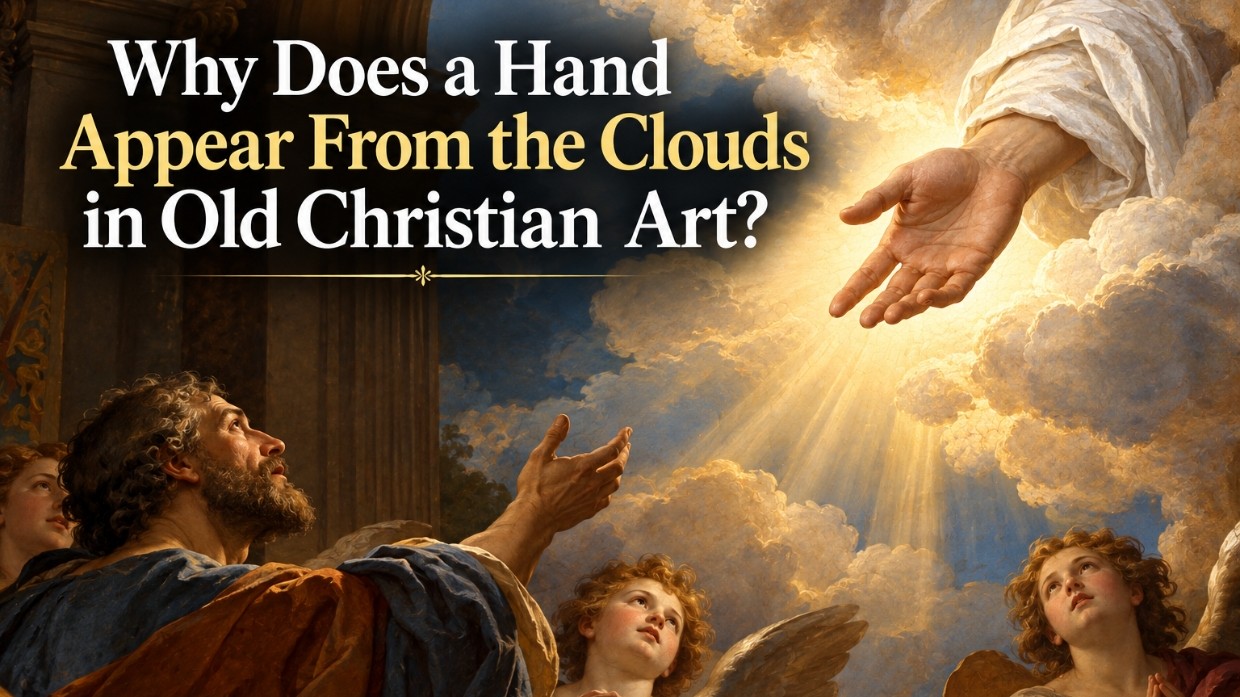
September 26, 2026: If you have ever looked closely at an old Christian painting, you may have noticed something rather unusual: a human hand emerging from a cloud, seemingly reaching down from heaven.


At first glance, it can look almost literal. Does the hand actually represent God? Why only a hand? And why does it so often appear among clouds?
The answer lies in a fascinating meeting point between Scripture, Jewish artistic tradition and Christian theology.

A biblical language made visible
The Bible frequently speaks of God's "hand" or "outstretched arm". In Exodus, for example, Israel's deliverance from Egypt is described in terms of God's mighty hand and outstretched arm. These expressions do not suggest that God possesses a physical human body. They are biblical ways of describing God's power acting in history.
(CLICK HERE to follow Catholic Connect and to stay updated with Catholic News & Content)
Artists eventually turned this language into a visual symbol.
A hand appearing from above could therefore communicate: God is acting here. God is commanding, blessing, protecting, delivering or judging.
The image could also represent God's authoritative voice or command. Rather than painting an invisible God as a complete human figure, the artist could indicate His presence through a single gesture.
Its roots are even older than Christianity
This artistic convention did not begin in medieval Christian Europe. One remarkable example comes from the third-century synagogue at Dura-Europos in Syria, whose walls contained extensive paintings of biblical scenes. The synagogue demonstrates that Jewish artists of Late Antiquity could use visual representations to communicate God's intervention without attempting to portray His divine essence.
Early Christian art developed within this wider biblical and Jewish visual world.
The hand is sometimes called Manus Dei ("Hand of God") or, particularly when it is the right hand, Dextera Dei ("Right Hand of God"). The right hand has a particularly rich biblical meaning: it is associated with power, authority, victory and blessing. Hence the gesture itself could carry theological meaning.
Why the clouds?
The cloud is not merely a dramatic background.
Throughout Scripture, clouds accompany manifestations of God's presence: at Sinai, in the wilderness, at the dedication of the Temple and at the Transfiguration. The cloud suggests something that is truly present yet hidden from ordinary sight.
The symbolism becomes especially striking in Christian theology. At Christ's Ascension, Scripture speaks of a cloud, and the Catechism describes the cloud as symbolising Christ's entry into divine glory.
Thus, the cloud and the hand together can communicate something like:
God is here. God is acting. Yet God remains beyond what human eyes can fully see.
But isn't God invisible?
Exactly.
This is where the image becomes theologically interesting.
The hand is not a portrait of what God the Father physically looks like. It is a visual sign pointing towards an invisible reality.
Catholic theology makes an important distinction here. The Father, in His divine nature, cannot simply be photographed or physically reproduced. But Christianity also professes something extraordinary: the invisible God became visible in Jesus Christ.
Because the Son truly became human, Christ can be represented in sacred art. The Catechism explicitly connects the legitimacy of Christian images with the Incarnation: in Christ, the invisible God became visible.
That is why a symbolic hand can be appropriate when an artwork refers to the Father's action, while Christ can be depicted with an actual human face and body.
More than decoration
So the mysterious hand emerging from the clouds is not an attempt by an artist to imagine God's anatomy.
It is a visual shorthand for divine action: a biblical metaphor transformed into sacred art.
And that is one of the great purposes of Christian imagery. As the Catechism explains, sacred images are intended to awaken faith and lead the viewer towards contemplation of the mystery they signify.
The hand points beyond itself.
It says, in effect: the God whom you cannot see is nevertheless present, acting, speaking and revealing Himself in the story before you.
By Catholic Connect Reporter
Read more:
1) Why Is the Pelican a Symbol of Christ? The Christian Meaning Explained
2) Why Are the Four Gospels Represented by a Man, Lion, Ox and Eagle?
3) Why Is the Rooster a Symbol in Christian Art?
4) Why Do Peacocks Appear in Early Christian Tombs?
5) Why Does a Phoenix Appear in Christian Art?
6) Why Does a Pomegranate Appear in Christian Art?
7) A.M., AM or M? What Do These Mysterious Marian Letters Mean?
8) Why Is Mary Sometimes Shown With a Star?
9) What Does an Anchor Have to Do with Christianity?
10) Why Is a Ship One of Christianity’s Oldest Symbols?
11) Why Does the Grapevine Appear in Christian Art? Its Meaning Explained
12) Why Do Palm Branches Appear in Christian Art?
13) Why Do the Letters “IHS” Appear in Catholic Churches?
14) What is the Chi-Rho (ΧΡ)? The Ancient Symbol for Christ Explained
15) When Mary Looked to Heaven: The Curious Meaning Behind the Virgin’s Upward Gaze
16) Why Do Alpha and Omega Appear in Christian Art?
17) What Does the Eye Inside a Triangle Mean in Christian Art?
18) The Strange ‘Weapons’ of Christ: Why the Instruments of His Passion Appear Together
19) Why Does a Unicorn Appear in Medieval Christian Art?
20) The Mystery Behind Mary’s Enclosed Garden
21) Why Does a Scroll Appear in So Many Christian Images?
22) Why Does Jacob’s Ladder Appear in Christian Art? The Heavenly Stairway That Points to Christ
22) Why Does an Olive Branch Appear in Christian Art? The Biblical Symbol of Peace and Hope
Continue Reading on Catholic Connect App
Get access to exclusive news articles & more.



© 2026 CATHOLIC CONNECT POWERED BY ATCONLINE LLP