- 26 September, 2026
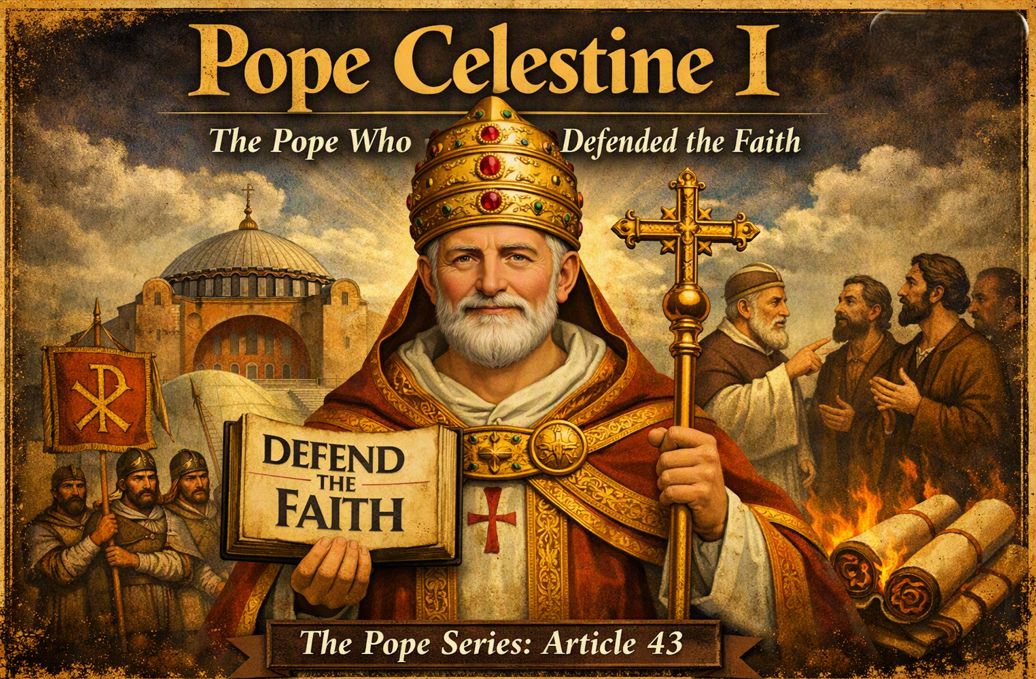
September 26, 2026: Pope Celestine I led the Catholic Church from 422 to 432, during a period when questions about Christian doctrine, Church authority and the unity of the faithful were becoming increasingly important. Remembered especially for his opposition to Pelagianism and Nestorianism, Celestine played an important role in some of the major theological debates of the fifth century. He is the forty-third successor of St. Peter, led the Catholic Church


(CLICK HERE to follow Catholic Connect and to stay updated with Catholic News & Content)
Celestine I became pope on 10 September 422, succeeding Pope Boniface I. Unlike the disputed election that had marked the beginning of Boniface's pontificate, Celestine's election was peaceful.

His ten-year pontificate was marked by a strong defence of Church teaching. He became particularly involved in two major controversies: Pelagianism, which concerned human freedom, sin and God's grace, and Nestorianism, which involved how Christians understood the person of Jesus Christ.
His leadership also helped strengthen Rome's involvement in the wider Church, particularly in Gaul, Africa and Britain.
Very little is known about Celestine's childhood. Historical sources associate him with Campania and identify his father as Priscus.
He later became part of the Roman clergy and served as a deacon. He was already known to important Church figures before becoming pope, including St. Augustine of Hippo.
His experience as a Church leader prepared him for a pontificate in which theological disagreements increasingly crossed regional boundaries.
Following the death of Pope Boniface I in 422, Celestine was elected Bishop of Rome.
His election took place without the serious dispute that had surrounded the previous papal succession. This gave him an opportunity to concentrate on the theological and pastoral challenges facing the Church.
Celestine lived during a period when the Roman Empire was changing and Christianity was becoming increasingly established within imperial society.
These circumstances required Church leaders to defend doctrine while maintaining unity among different Christian communities.
One of Celestine's most important contributions was his response to the teachings associated with Nestorius, the Patriarch of Constantinople.
Celestine held a synod at Rome in 430 which condemned Nestorius' teachings. He then worked closely with St. Cyril of Alexandria, who became a leading defender of the Catholic understanding of Christ.
The controversy eventually led to the Council of Ephesus in 431. Celestine sent representatives to the council, and its decisions confirmed the teaching that the Church defended concerning Christ and Mary, including the title Theotokos, meaning "God-bearer".
Celestine also continued the Church's opposition to Pelagianism, a movement associated with teachings that placed particular emphasis on human moral ability and were judged by the Church to minimise the necessity of divine grace.
Celestine supported the theological position associated with St. Augustine and took steps against Pelagian teaching in the West.
He also sent missionaries and Church representatives to Britain, helping strengthen opposition to Pelagian ideas there.
Celestine's pontificate was also significant for the growth of Christianity beyond continental Europe.
In 431, he consecrated Palladius and sent him to Ireland. This made Celestine an important figure in the early history of the Church in Ireland.
Celestine is remembered as a determined and doctrinally committed pope.
His spirituality centred on:
Rather than remaining focused only on Rome, he took an active interest in Christian communities across different regions.
Celestine's firm approach to theological disputes was not without opposition.
His interventions in disputes involving African and Gallican bishops raised questions about the extent of Roman authority. Some bishops resisted attempts by Rome to intervene in matters they considered local.
The controversies surrounding Nestorius also contributed to tensions between different Christian traditions, showing how difficult it could be to maintain unity while resolving major doctrinal disagreements.
Celestine's surviving letters reflect his strong concern for preserving the faith handed down by the Church.
A fitting lesson from his pontificate is: Faith must be defended with conviction while the unity of the Church remains a constant concern.
Pope Celestine I is honoured as a saint in the Catholic Church.
He is also honoured as a saint in Eastern Christian traditions, although different traditions observe his feast on different dates.
Celestine I left a legacy of firm leadership during a period of serious theological disagreement.
His role in the controversy surrounding Nestorius connected the See of Rome with the Council of Ephesus.
His opposition to Pelagianism demonstrated the importance he placed on the Church's teaching about grace.
His support for missions in Britain and Ireland also showed that the Church's mission was extending far beyond Rome.
Why does Pope Celestine I matter today?
For the Church, his pontificate demonstrates the importance of preserving unity while addressing serious disagreements.
For Christian leaders, his life highlights the responsibility of defending core teachings with courage and consistency.
For believers, his support for evangelisation reminds Christians that the faith is not meant to remain confined to one community or country.
Pope Celestine I died in Rome in 432 after a decade of leadership. His legacy continues through the structured life of the Church today, carried forward by his successors.
To know more about the previous Popes, click here
By Catholic Connect Reporter
Pope Celestine I, Pope Celestine I biography, Pope Celestine I 422–432, Saint Celestine I, Pope Celestine I history, Pope Celestine and Nestorius, Pope Celestine and Council of Ephesus, Pope Celestine and Pelagianism, Pope Celestine and St Augustine, Pope Celestine Ireland, Pope Celestine Britain, early Catholic popes, history of the papacy, Catholic Church history, 43rd Pope, Pope Celestine I feast day




© 2026 CATHOLIC CONNECT POWERED BY ATCONLINE LLP