- 20 June, 2026
By Special Correspondent


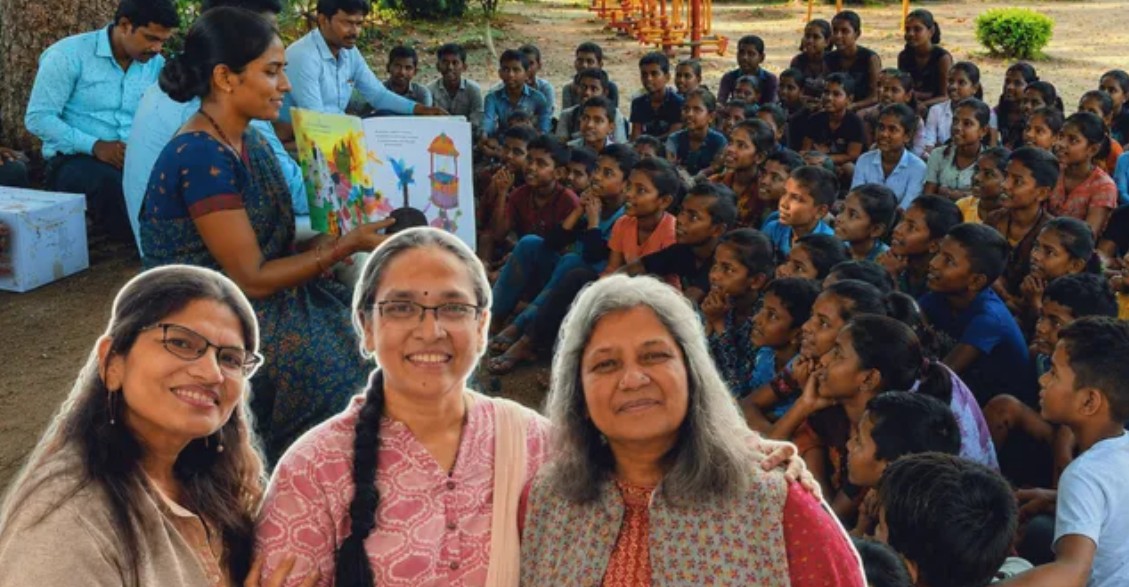
June 20, 2026: In a modest classroom tucked away in the tribal heartland of Madhya Pradesh, a quiet revolution is unfolding. Children who once fidgeted through lessons, ignored books, or wandered out of classrooms now sit eagerly awaiting story sessions. Their eyes light up as pages turn, and their imaginations travel far beyond the boundaries of their villages.
For teachers who have witnessed the transformation, it feels nothing short of remarkable.
“Some children used to throw books around or walk away when reading activities began,” recalls one teacher. “Today, they ask when the next story session will be held.”


Behind this change is the Turning Pages Foundation, a non-profit initiative founded by three women—sisters Bunty Pai and Madhuri Pai, and their cousin Nayana Pai—whose shared love for books has grown into a movement that is touching the lives of nearly 8,000 children across India.
Their vision is deceptively simple: help children discover that reading is not merely a school requirement but a source of joy, wonder and personal growth.
Reading Beyond the Textbook
India has made significant strides in expanding access to education, yet concerns about foundational literacy continue to challenge educators. Many children advance through school without developing strong reading skills, limiting both their academic progress and self-confidence.
The founders of Turning Pages Foundation believe the problem goes deeper than literacy itself.
“Children naturally love stories,” says co-founder Madhuri Pai. “The challenge is that reading often becomes associated with tests, corrections and pressure instead of curiosity and enjoyment.”
This conviction shapes the foundation’s philosophy. Before children can become proficient readers, they must first become enthusiastic readers. Reading must be experienced not as a task but as an adventure.
To achieve this, the organisation works to cultivate what it calls a “whole-school reading culture,” where books become an integral and enjoyable part of everyday life.
(CLICK HERE to follow Catholic Connect for regular News and Content)
A Childhood Love Story with Books
The roots of Turning Pages Foundation stretch back to the founders’ own childhood in Mangaluru.
Growing up together, Bunty, Madhuri and Nayana were surrounded by books that filled their home with stories, conversations and shared experiences.
“Reading was never treated like homework,” recalls Bunty Pai. “It was associated with comfort, joy and family time.”
Though life eventually took them in different professional directions, their love for books remained constant.
Bunty pursued journalism before moving into education and developing story-based learning programmes. Madhuri spent 25 years in the corporate world in business management. Nayana built a career in software engineering before becoming actively involved in children's reading initiatives after motherhood.
The spark that led to the foundation came in 2017 when Nayana launched a structured reading programme in a Mumbai school. The enthusiastic response from children convinced the trio that the idea could make a difference on a much larger scale.
Three years later, amid the uncertainty of the COVID-19 pandemic, Turning Pages Foundation was formally established.
“At a time when the world was moving online, we were talking about physical books and reading culture,” Bunty says. “Yet we felt more strongly than ever that children needed stories.”
Creating Readers, Not Just Libraries
One of the distinguishing features of the foundation’s work is that it does not simply donate books.
Before entering a school, the team studies its infrastructure, student demographics, reading habits and existing resources. Programmes are then tailored to suit local needs.
The foundation has helped establish classroom libraries and placed nearly 15,000 books in schools that previously had little or no access to children's literature.
Yet the founders insist that books alone cannot create readers.
“You cannot build a reading culture by merely putting books on shelves,” Madhuri explains. “The entire ecosystem matters.”
That ecosystem includes teachers, parents, school leadership and the emotional environment in which children learn.
Schools participating in the programme introduce regular reading practices, including daily “Drop Everything and Read” sessions and dedicated periods for storytelling and recreational reading.
The result is that books become woven into the rhythm of school life rather than remaining occasional resources.
Empowering Teachers as Storytellers
At the heart of the initiative lies an unwavering belief in teachers.
Instead of relying on outside facilitators, Turning Pages Foundation equips educators to lead reading programmes themselves.
Teachers receive training in storytelling techniques, voice modulation, expression and classroom engagement. They learn how to transform stories into interactive experiences where children ask questions, discuss characters and explore alternative endings.
“Our aim is to make storytelling joyful and manageable, not another burden for teachers,” says mentor Veda Venkatesh.
This shift has changed classroom dynamics significantly.
“Earlier, reading sessions were largely one-way communication,” says teacher Amalorpavamary. “Today, students constantly ask questions and share their thoughts.”
In these classrooms, children are no longer passive listeners; they become active participants in the storytelling process.
Helping Every Child Find a Voice
The impact has been particularly significant for children who struggle in conventional learning environments.
For children with learning difficulties, developmental challenges or limited reading abilities, stories offer alternative pathways to participation. Through discussion, drama, drawing and imagination, they find opportunities to engage and express themselves.
One child, despite struggling to read independently, became deeply attached to a particular storybook. While unable to decode every word, he memorised the story and confidently narrated it to others, explaining why it had become his favourite.
For the foundation, such moments represent success in its truest form.
The objective is not only to improve reading scores but to nurture confidence, curiosity and a sense of belonging.
When Stories Travel Home
The influence of the programme does not end when the school day is over.
Children increasingly take books home, share stories with siblings and parents, and introduce reading into households where books were once rare.
At JES School in Mumbai, parent Kankuben noticed a dramatic change in her daughter Mishika.
“She comes home excited and tells us every story she has heard,” she says.
In many communities, parents who never experienced a reading culture themselves are gradually becoming involved in their children's literary journeys.
The ripple effect is creating a broader culture of reading that extends beyond classrooms into homes and neighbourhoods.
A Vision for Lasting Change
Today, Turning Pages Foundation works across 12 schools in Maharashtra, Karnataka, Tamil Nadu and Madhya Pradesh. Thousands of children who once viewed books with indifference now eagerly await reading sessions, discuss stories with enthusiasm and explore worlds beyond their immediate realities.
For the founders, however, the ultimate goal is sustainability.
They envision schools where reading becomes so deeply embedded in the culture that external support is no longer necessary.
“We want schools to eventually say, ‘This is simply how we function now,’” says Bunty.
One Book at a Time
The story of Turning Pages Foundation demonstrates that meaningful educational change does not always require expensive technology or complex interventions.
Sometimes transformation begins with a storyteller, a teacher willing to listen, and a child discovering the magic hidden within the pages of a book.
Through the dedication of three women and the enthusiasm of thousands of young readers, a quiet movement is reshaping classrooms across India.
In these schools, children are not merely learning to read.
They are learning to imagine, to question, to connect—and above all, to dream.
Source: Adapted from a report published by The Better India.
© 2026 CATHOLIC CONNECT POWERED BY ATCONLINE LLP