- 27 July, 2026

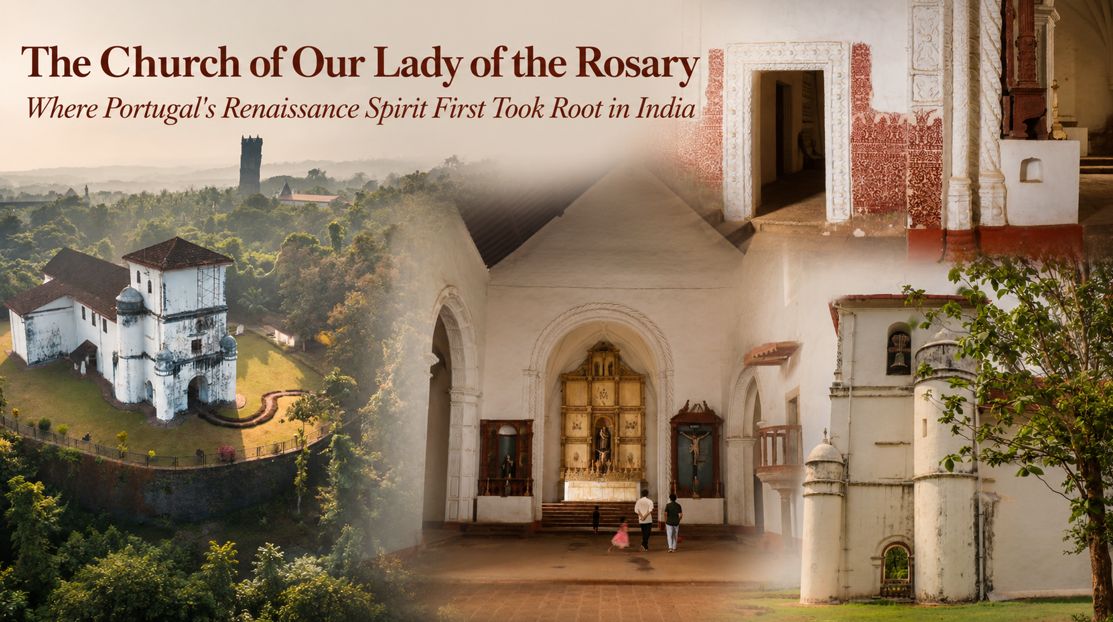
Goa, July 27, 2026: High on a gentle hill overlooking the ruins of Old Goa stands a church that has quietly witnessed nearly five centuries of history. Unlike the grand Baroque basilicas that would later make Goa famous, the Church of Our Lady of the Rosary possesses a simpler, more intimate beauty. Its weathered white walls, fortress-like towers, and peaceful surroundings speak of an earlier chapter in Christianity's story in India—a time when Portuguese explorers first brought the architectural ideals of the Renaissance to the shores of the Indian Ocean.


Built between 1543 and 1547, the Church of Our Lady of the Rosary is one of the oldest surviving churches in Goa and among the earliest examples of Portuguese Renaissance architecture in Asia. Today, it forms part of the UNESCO World Heritage ensemble of the Churches and Convents of Goa. Yet beyond its historical importance, this church offers something far more precious: an opportunity to experience a sacred space where European artistry and Indian landscapes come together in remarkable harmony.
Walking toward the church, one quickly realizes that its beauty lies not in lavish ornamentation but in quiet dignity. Every stone seems to whisper stories of explorers, missionaries, and generations of faithful believers who have climbed this hill to pray beneath its ancient roof.


The church occupies one of the most picturesque locations in Old Goa. Standing on Monte Santo (Holy Hill), it overlooks the lush Mandovi River and the remains of what was once one of Asia's most prosperous colonial capitals.
The climb toward the church is peaceful. Coconut palms sway gently in the tropical breeze, birds circle overhead, and the sounds of modern life gradually fade away. As the whitewashed structure comes into view, it appears almost timeless against the deep blue Goan sky.
Unlike many European cathedrals crowded by city streets, the Church of Our Lady of the Rosary enjoys space and silence. Its elevated position creates an atmosphere of retreat, inviting visitors to leave behind distraction and prepare for quiet reflection.
(Click here to follow Catholic Connect for regular News and Content)
It is easy to imagine early Portuguese sailors pausing here after months at sea, offering prayers of thanksgiving upon reaching India's shores.
At first glance, the church seems surprisingly different from the richly decorated churches for which Goa is famous. Its design combines the elegance of the Portuguese Renaissance with the sturdy appearance of a medieval fortress.
The simple white façade is flanked by cylindrical towers crowned with small domes, giving the building an almost castle-like appearance. Battlement-like details along the roofline hint at a period when places of worship also needed to symbolize strength and security in unfamiliar lands.
The entrance is framed by graceful Renaissance arches and delicate stone carvings that soften the building's defensive character. Here, simplicity becomes its own form of beauty. Without excessive ornamentation, the architecture speaks through balanced proportions, clean lines, and quiet confidence.
The church reflects a fascinating moment in architectural history, when European Renaissance ideals were first being adapted to the climate, materials, and cultural setting of India.
Stepping inside, visitors are greeted not by overwhelming grandeur but by gentle serenity.
The single nave feels warm and welcoming, its whitewashed walls reflecting the tropical sunlight that filters softly through the windows. The atmosphere encourages silence rather than spectacle.
At the far end stands the high altar dedicated to Our Lady of the Rosary, its elegant design drawing the eye naturally toward the sanctuary. The graceful arches, wooden ceiling, and restrained decoration remind visitors that beauty does not always require extravagance. Sometimes the greatest sense of the sacred is found in simplicity.
Unlike later Goan churches filled with elaborate gilded carvings, this interior preserves the quieter spirit of the Renaissance, where harmony, proportion, and light were considered reflections of divine order.
Here, architecture gently guides the soul toward contemplation.
One of the church's most remarkable treasures lies not in its architecture alone but in the history embedded within its walls.
According to tradition, the church was commissioned by Afonso de Albuquerque, the Portuguese commander who conquered Goa in 1510. It is believed that he vowed to build a church dedicated to Our Lady after his victory, expressing gratitude for what he believed was divine assistance.
Inside the church are several historic tombs, including those of prominent Portuguese nobles and benefactors. Their beautifully carved memorials serve as reminders that this sanctuary has long been a place where history and faith meet.
Over the centuries, countless missionaries, traders, pilgrims, and local Christians have prayed within these walls. The building has witnessed the rise of Portuguese Goa, the flourishing of Christianity in the region, and the passing of empires, yet it continues to fulfill the purpose for which it was built—a house of prayer.
Perhaps the greatest beauty of the Church of Our Lady of the Rosary lies in the way it bridges two worlds.
Its Renaissance arches, fortress-like towers, and Portuguese craftsmanship speak of Europe, while its tropical setting, warm sunlight, and surrounding palms root it firmly in India. Together they create a unique architectural identity that belongs fully to neither continent yet beautifully honors both.
This harmony reflects the broader story of Christianity in Goa, where cultures met, traditions blended, and sacred architecture evolved into something entirely distinctive.
Every weathered stone bears witness to this remarkable encounter, proving that faith has the power to transcend geography, language, and culture.
While visitors often flock to Old Goa's magnificent Basilica of Bom Jesus or the imposing Sé Cathedral, the Church of Our Lady of the Rosary offers a quieter, more intimate encounter with the region's Christian heritage.
Standing beneath its ancient arches as warm Goan sunlight fills the sanctuary, one senses the peaceful rhythm of a church that has remained faithful to its mission for nearly five hundred years. There are no dazzling mosaics or towering Gothic vaults demanding attention. Instead, there is simplicity, balance, and an atmosphere of profound peace.
The Church of Our Lady of the Rosary reminds us that sacred architecture need not be monumental to be inspiring. Sometimes the most enduring witness to faith is found in a modest hilltop church where Renaissance elegance meets Indian beauty, where silence speaks more eloquently than ornament, and where every visitor is invited to discover that true grandeur often resides in quiet devotion.
By Catholic Connect Reporter
Read more on Must-Visit Catholic Architectural and Historical Wonders:
Mont-Saint-Michel Abbey: France's Timeless Wonder Between Heaven and the Sea
The Story Behind the White Basilica That Watches Over Paris
Church of Válega, Portugal: The Colourful Church Wrapped in Thousands of Hand-Painted Tiles
The Blue Church of Bratislava: The Inspiring Story Behind Slovakia's Iconic Landmark
The Church of the Carmel: Porto's Blue-and-White Masterpiece That Tells a Story in Stone and Tile
Ōura Church, Nagasaki: The Church Where Japan's Hidden Christians Emerged
How a Tiny Statue Inspired Brazil's National Shrine Basilica of Our Lady Aparecida
Basilica of Our Lady of Guadalupe: The Shrine That Draws 20 Million Pilgrims Each Year
Notre-Dame du Haut: The Chapel That Redefined Sacred Architecture
How Did the Holy Family's House End Up in Italy?
Sumela Monastery: Where Faith Finds a Home on the Cliffs
Sanctuary of Monte Sant'Angelo: Descending into the Cave Where Heaven Touched Earth
The Church Where Heaven Touched Earth: Mount Tabor's Basilica of the Transfiguration
Meteora: The Monasteries That Seem to Hang Between Heaven and Earth
Monastery of Alcobaça: Portugal's Treasure of Love and Legacy
Las Lajas Sanctuary: Colombia's Breathtaking Church Between Cliffs and Sky
Church of Saint George, Lalibela: The Astonishing Church Carved from a Single Rock
Archbasilica of St John Lateran: Inside the Highest-Ranking Church in the Catholic Church
Saint Catherine's Monastery: The World's Oldest Living Christian Monastery
The Church of the Holy Sepulchre: Walking Through the Sacred Heart of Christianity
Inside St. Mark's Basilica: The Church That Glows Like Heaven
Notre-Dame Cathedral: The Gothic Masterpiece That Rose from the Ashes to Inspire the World
Milan Cathedral: Italy's Crown of Marble Reaching Towards Heaven
Chartres Cathedral: Where Stone, Light, and Heaven Meet
Montserrat Monastery: A 1,000-Year-Old Architectural Marvel in the Mountains
Inside the Sagrada Família: The Incredible Story of Gaudí's Greatest Masterpiece



© 2026 CATHOLIC CONNECT POWERED BY ATCONLINE LLP