- 27 July, 2026

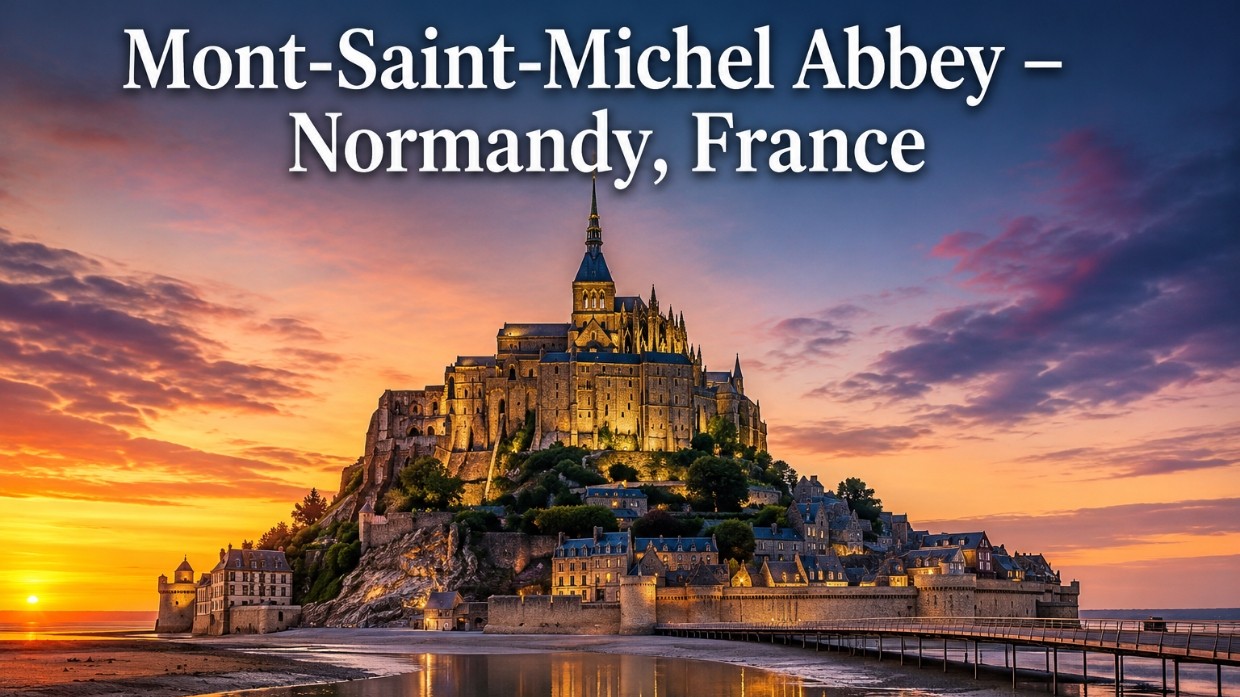
France, July 27, 2026: Standing majestically on a rocky tidal island off the coast of Normandy, France, Mont-Saint-Michel Abbey is one of the world's most breathtaking Christian landmarks. Crowned by a magnificent medieval abbey that seems to soar towards the heavens, the island transforms with the rhythm of the tides, creating one of the most spectacular natural and architectural sights in Europe. Recognised as a UNESCO World Heritage Site since 1979, Mont-Saint-Michel welcomes millions of visitors every year and remains one of France's most treasured monuments.


A Sanctuary Inspired by St. Michael the Archangel
The origins of Mont-Saint-Michel date back to AD 708, when Saint Aubert, Bishop of Avranches, is said to have received three visions of St. Michael the Archangel, instructing him to build a sanctuary on the isolated granite island. After initially hesitating, tradition says St. Michael left the mark of his finger on the bishop's skull as a sign to obey God's call. A small oratory was soon built, laying the foundation for what would become one of Christianity's greatest pilgrimage destinations.
(Click here to follow Catholic Connect for regular News and Content)


During the Middle Ages, pilgrims from across Europe undertook the challenging journey across the dangerous tidal flats, seeking the protection and intercession of St Michael. The pilgrimage became known as one of the most important in medieval Christendom.
A Masterpiece of Medieval Architecture
Construction of the abbey continued for nearly 1,000 years, resulting in an extraordinary blend of Romanesque and Gothic architecture. Built layer upon layer upon the granite rock, the complex includes soaring towers, elegant cloisters, grand refectories, vaulted crypts, peaceful chapels, and the famous Gothic monastery known as "La Merveille" (The Marvel)—a stunning achievement of medieval engineering.
At the summit stands the abbey church, crowned by a gilded statue of St. Michael the Archangel triumphantly defeating evil, a powerful symbol of faith that can be seen from miles away.
A Fortress That Defied Invaders
Mont-Saint-Michel served not only as a monastery but also as an impregnable fortress. During the Hundred Years' War (1337–1453), its formidable walls successfully resisted repeated English attacks, making it one of the few major French strongholds never captured. The abbey became a lasting symbol of perseverance, courage, and national unity.
Following the French Revolution, the monastery was converted into a prison before being restored in the 19th century. Today, careful conservation efforts continue to preserve its remarkable heritage for future generations.
Where Nature and Faith Meet
One of Mont-Saint-Michel's greatest wonders is the dramatic rise and fall of the surrounding tides, among the highest in Europe. At high tide, the island appears to float above the sea; at low tide, vast stretches of shimmering sand emerge, revealing an ever-changing landscape that has fascinated visitors for centuries.
Inside the abbey, silence and prayer still echo through ancient stone corridors, offering pilgrims and visitors a place of reflection amid one of the world's most extraordinary settings.
A Living Legacy
Although it is one of France's most popular tourist attractions, Mont-Saint-Michel remains an active place of Christian worship, where religious communities continue a centuries-old tradition of prayer. Every stone of the abbey tells a story of faith, perseverance, and devotion, while its breathtaking beauty continues to inspire believers, historians, architects, and travellers from around the globe.
Blending spiritual significance, medieval history, and awe-inspiring architecture, Mont-Saint-Michel Abbey stands as one of Christianity's greatest treasures—a timeless monument where faith, history, and nature come together in breathtaking harmony.
By Catholic Connect Reporter
Read more on Must-Visit Catholic Architectural and Historical Wonders:
The Story Behind the White Basilica That Watches Over Paris
Church of Válega, Portugal: The Colourful Church Wrapped in Thousands of Hand-Painted Tiles
The Blue Church of Bratislava: The Inspiring Story Behind Slovakia's Iconic Landmark
The Church of the Carmel: Porto's Blue-and-White Masterpiece That Tells a Story in Stone and Tile
Ōura Church, Nagasaki: The Church Where Japan's Hidden Christians Emerged
How a Tiny Statue Inspired Brazil's National Shrine Basilica of Our Lady Aparecida
Basilica of Our Lady of Guadalupe: The Shrine That Draws 20 Million Pilgrims Each Year
Notre-Dame du Haut: The Chapel That Redefined Sacred Architecture
How Did the Holy Family's House End Up in Italy?
Sumela Monastery: Where Faith Finds a Home on the Cliffs
Sanctuary of Monte Sant'Angelo: Descending into the Cave Where Heaven Touched Earth
The Church Where Heaven Touched Earth: Mount Tabor's Basilica of the Transfiguration
Meteora: The Monasteries That Seem to Hang Between Heaven and Earth
Monastery of Alcobaça: Portugal's Treasure of Love and Legacy
Las Lajas Sanctuary: Colombia's Breathtaking Church Between Cliffs and Sky
Church of Saint George, Lalibela: The Astonishing Church Carved from a Single Rock
Archbasilica of St John Lateran: Inside the Highest-Ranking Church in the Catholic Church
Saint Catherine's Monastery: The World's Oldest Living Christian Monastery
The Church of the Holy Sepulchre: Walking Through the Sacred Heart of Christianity
Inside St. Mark's Basilica: The Church That Glows Like Heaven
Notre-Dame Cathedral: The Gothic Masterpiece That Rose from the Ashes to Inspire the World
Milan Cathedral: Italy's Crown of Marble Reaching Towards Heaven
Chartres Cathedral: Where Stone, Light, and Heaven Meet
Montserrat Monastery: A 1,000-Year-Old Architectural Marvel in the Mountains
Inside the Sagrada Família: The Incredible Story of Gaudí's Greatest Masterpiece
Continue Reading on Catholic Connect App
Get access to exclusive news articles & more.


© 2026 CATHOLIC CONNECT POWERED BY ATCONLINE LLP