- 01 May, 2026
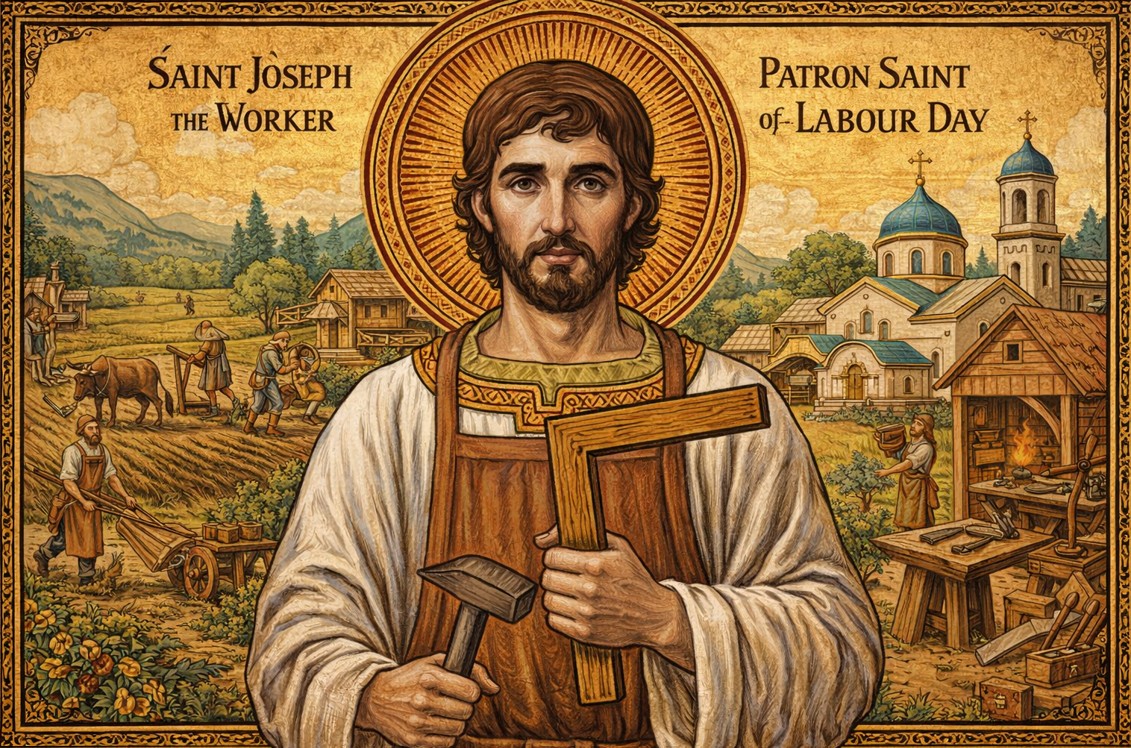
Vatican, May 1, 2026 — As the world observes Labour Day, the Catholic Church turns its attention to Saint Joseph under his title “St. Joseph the Worker,” presenting him not only as a humble carpenter of Nazareth but as a profound spiritual model for all who labour. This feast, established in 1955 by Pope Pius XII, intentionally coincides with International Workers’ Day to give a deeper Christian meaning to human work and dignity.

Unlike secular interpretations that often view labour purely in economic or political terms, the Church teaches that work is part of God’s plan. Through St. Joseph—who worked as a carpenter and provided for the Holy Family—Catholics are reminded that daily labour can be sanctified and transformed into an offering to God. His life reveals that even the simplest tasks, when done with love and responsibility, participate in God’s creative work.
The decision to link St. Joseph with Labour Day was not accidental. At a time when labour movements were often influenced by materialist ideologies, Pope Pius XII sought to restore the spiritual dimension of work. He presented St. Joseph as a model who worked not for wealth or power, but for love—supporting his family and fulfilling God’s will.


The Church emphasizes that work is not merely a means of survival but a path to holiness. As later highlighted by Pope John Paul II, work expresses the dignity of the human person and must always respect the rights and worth of workers. In this light, Labour Day becomes more than a public holiday—it becomes a moment of reflection on justice, fairness, and the sacred value of human effort.
For Catholics, St. Joseph is not a distant figure but a practical guide for daily living. His life, though quiet and hidden, offers powerful lessons for modern society.
First, St. Joseph teaches the dignity of honest work. Whether one is a labourer, professional, or homemaker, every form of work has value when done with integrity. Catholics are called to approach their responsibilities with dedication, seeing their work as a vocation rather than a burden.
Second, he embodies silent faith and trust in God. The Gospels record no spoken words of St. Joseph, yet his actions speak volumes. He obeyed God’s will without hesitation, even in uncertainty. In a fast-paced world filled with noise and distraction, his example invites believers to cultivate interior silence and deep trust in God’s plan.
Third, St. Joseph is a model of family responsibility and sacrifice. As the protector of Mary and Jesus, he placed their needs above his own. Catholics are encouraged to prioritize family life, uphold commitments, and practice selfless love within their homes.
Fourth, he reminds us of humility and simplicity. Despite his crucial role in salvation history, Joseph lived without recognition or status. His life challenges modern culture’s obsession with success and recognition, encouraging believers to find fulfillment in faithfulness rather than fame.
In a time marked by economic uncertainty, unemployment, and exploitation, the message of St. Joseph the Worker remains deeply relevant. The Church continues to advocate for fair wages, humane working conditions, and respect for every worker’s dignity.
St. Joseph’s life ultimately reveals that holiness is not confined to extraordinary acts but is found in ordinary work done with extraordinary love. As Catholics celebrate Labour Day, they are invited to rediscover work as a path to grace, service, and communion with God.
In following St. Joseph, believers learn that true success lies not in wealth or recognition, but in faithful service—quietly building a life rooted in faith, responsibility, and love.
By Catholic Connect Reporter




© 2026 CATHOLIC CONNECT POWERED BY ATCONLINE LLP