- 03 June, 2026
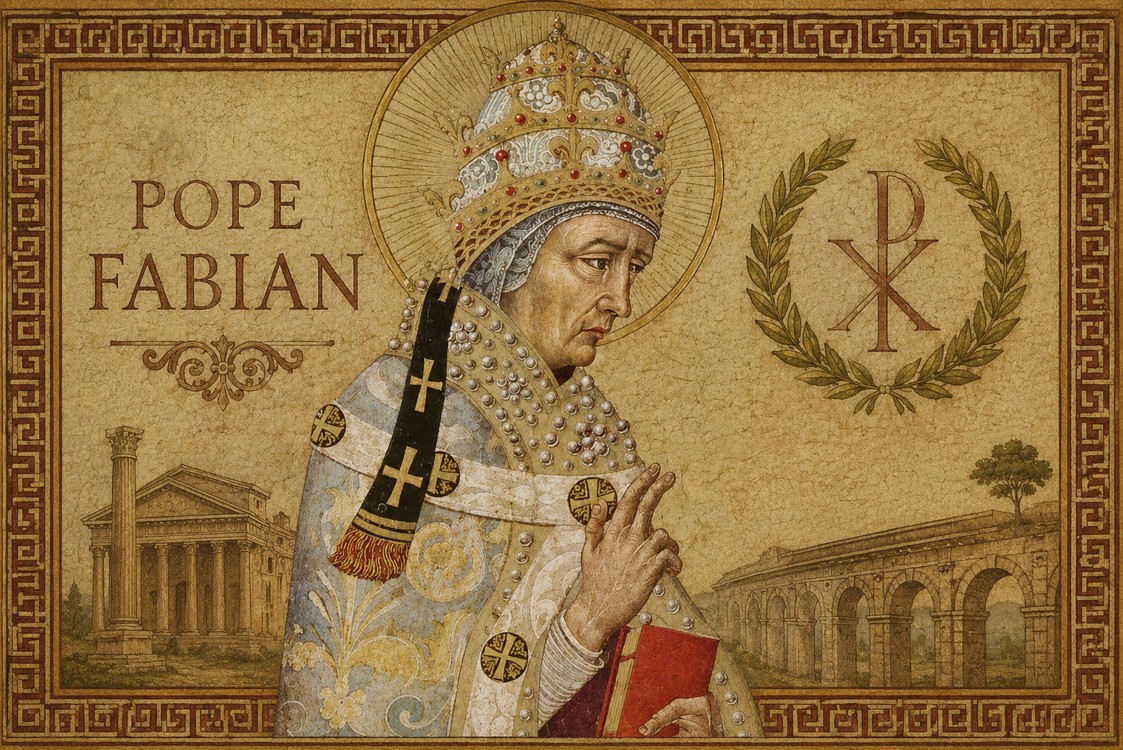
St. Fabian, the twentieth successor of Saint Peter, is remembered as one of the most remarkable leaders of the early Church. His election to the papacy is surrounded by one of the most famous stories in Church history: according to tradition, a dove descended and rested upon his head, leading the Christian community to recognise him as God's chosen shepherd. During his fourteen-year papacy, Fabian strengthened Church organisation, expanded missionary efforts, and ultimately gave his life for the faith.


Can an ordinary believer become an extraordinary leader?
When Fabian arrived in Rome following the death of Pope Anterus, he was reportedly a layman with no expectation of becoming pope. Yet his election would mark the beginning of one of the most influential pontificates of the third century, helping prepare the Church for both growth and persecution.


Very little is known about Fabian's early years. Historical sources suggest he came from a Christian family and was respected within the Roman community. Before his election, he was not among the leading candidates for the papacy.
According to the Church historian Eusebius, while the faithful gathered to elect a new bishop of Rome, a dove suddenly descended and settled on Fabian's head. The assembly interpreted this as a sign of the Holy Spirit, and Fabian was unanimously chosen as pope.
Fabian succeeded Pope Anterus in 236 AD. His election surprised many, but his leadership soon proved wise and effective.
What began as an unexpected choice became one of the longest and most productive papacies of the early Church.
Fabian led the Church during a period of relative peace before the outbreak of severe persecution.
This period allowed the Church to strengthen its internal structures and missionary outreach.
Fabian made several lasting contributions:
These reforms helped transform Christianity from a small movement into a more organised and resilient Church.
Fabian is remembered for:
His spirituality reflected trust in God's guidance and dedication to the Church's mission.
Fabian's peaceful years ended abruptly when Emperor Decius launched one of the most severe persecutions in Roman history.
Christian leaders became primary targets. Rather than flee, Fabian remained with his flock and was arrested. In January 250 AD, he was martyred for refusing to renounce his faith.
His death marked the beginning of a difficult chapter for the Church but also inspired countless believers to remain faithful.
Although no writings of Fabian survive, his life proclaims a timeless message: God often calls ordinary people to accomplish extraordinary things.
Fabian was honoured as a martyr almost immediately after his death.
His tomb was later discovered in the Catacomb of Callixtus, confirming the deep respect early Christians held for him.
Why does St. Fabian matter today?
His legacy continues through the life of the Church today, carried forward by his successors.
To know more about the previous Popes, click here
By Catholic Connect Reporter
St. Fabian, Pope Fabian biography, Pope Fabian chosen by a dove, twentieth pope Catholic Church, early Catholic popes, Decian persecution, Catholic Church history, Christian martyrs, apostolic succession, Pope Fabian facts
© 2026 CATHOLIC CONNECT POWERED BY ATCONLINE LLP