- 30 April, 2026
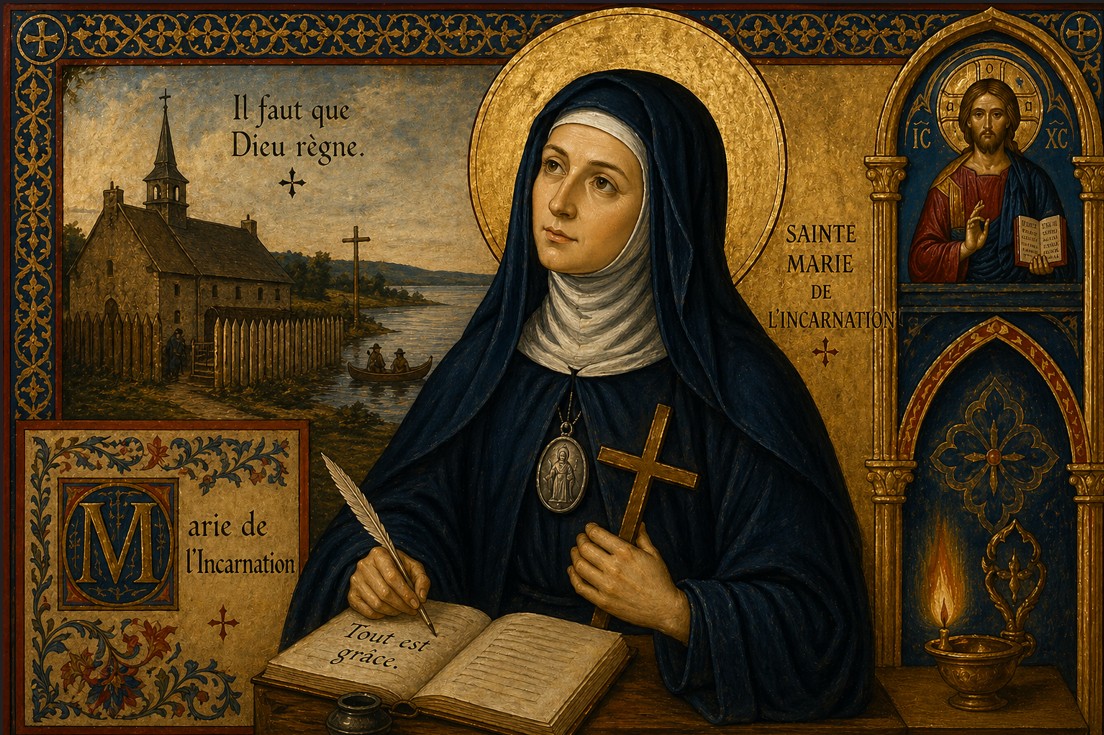
Canada, April 30, 2026: Discover Saint Marie of the Incarnation, the missionary who left everything to bring the Catholic faith to Canada. Learn about her April 30 feast day, visions, and lasting legacy in Catholic education.

Feast Day: April 30
Born: October 28, 1599, Tours, France
Died: April 30, 1672, Quebec City, Canada
Known for: Missionary work, founding Ursulines in Canada, mystical visions


Patron of: (Commonly associated with Catholic education and missionaries in Canada)
Title: Foundress of the Ursuline Order in New France
What kind of faith does it take to leave your own child behind?
Saint Marie of the Incarnation made a decision that still shocks readers centuries later.
She walked away from her only son—not out of neglect, but out of a radical call to serve God.
And that choice helped shape the Catholic Church in North America.
Born as Marie Guyart in France, her spiritual life began early.
At just seven years old, she experienced a vision of Christ and gave her life completely to Him.
Even as a child, she sensed she was meant for something greater than ordinary life.
But her path would not be easy.
Despite her desire for religious life, Marie obeyed her parents and married at 17.
Within two years, she became a widow—with a baby son in her arms.
For years, she worked to support her family.
But the call to God only grew stronger.
Finally, at age 32, she made the most painful decision of her life:
She entered the Ursuline convent—leaving her young son behind in the care of relatives.
This sacrifice defined her legacy.
While in religious life, Marie received a powerful vision.
She saw a distant land—and believed God was calling her there.
That land was Canada.
In 1639, she crossed the Atlantic to what was then called New France—a dangerous and uncertain mission field.
What she accomplished next changed history.
In Quebec, she:
Founded the first Ursuline convent
Established one of the first schools for girls in the New World
Educated both French and Indigenous children
Her work laid the foundation for Catholic education in North America.
Marie didn’t just teach—she immersed herself in the cultures around her.
She learned Indigenous languages including:
Algonquin
Iroquois
Huron
She even created dictionaries and catechisms to share the faith more effectively.
This level of dedication was extraordinary for her time.
Despite her active missionary life, Marie remained deeply mystical.
She experienced:
Visions of God
Periods of spiritual dryness
Profound union with Christ
Her writings and letters provide one of the most detailed accounts of early Catholic life in Canada.
Saint Marie of the Incarnation died in 1672—but her mission never ended.
She was canonized in 2014 by Pope Francis.
Today, she is remembered as:
A founder of the Church in Canada
A pioneer of women’s education
A model of radical trust in God
Her life challenges modern believers in powerful ways:
True faith requires sacrifice
God’s call may demand everything
Education can be a path to evangelization
Holiness often involves both action and contemplation
In a world that values comfort and security, her life offers a striking contrast:
She embraced uncertainty
She crossed cultures
She gave up everything to follow God
Her courage raises a difficult question:
What are we holding onto that God is asking us to surrender?
Saint Marie of the Incarnation did not choose the easy path.
She chose the faithful one.
From a widow in France to a missionary in Canada, her life became a bridge between worlds—spiritually, culturally, and historically.
This April 30, her story invites us to consider:
What would we be willing to sacrifice if God called us to something greater?
To know about more saints please visit the spiritual section.
By Catholic Connect Reporter
_______________________________
Saint Marie of the Incarnation, April 30 feast day saint, Catholic missionaries Canada, Ursuline saints, Catholic saints in New France, female Catholic mystics, Catholic education saints, Canadian Catholic saints
© 2026 CATHOLIC CONNECT POWERED BY ATCONLINE LLP