- 13 July, 2026

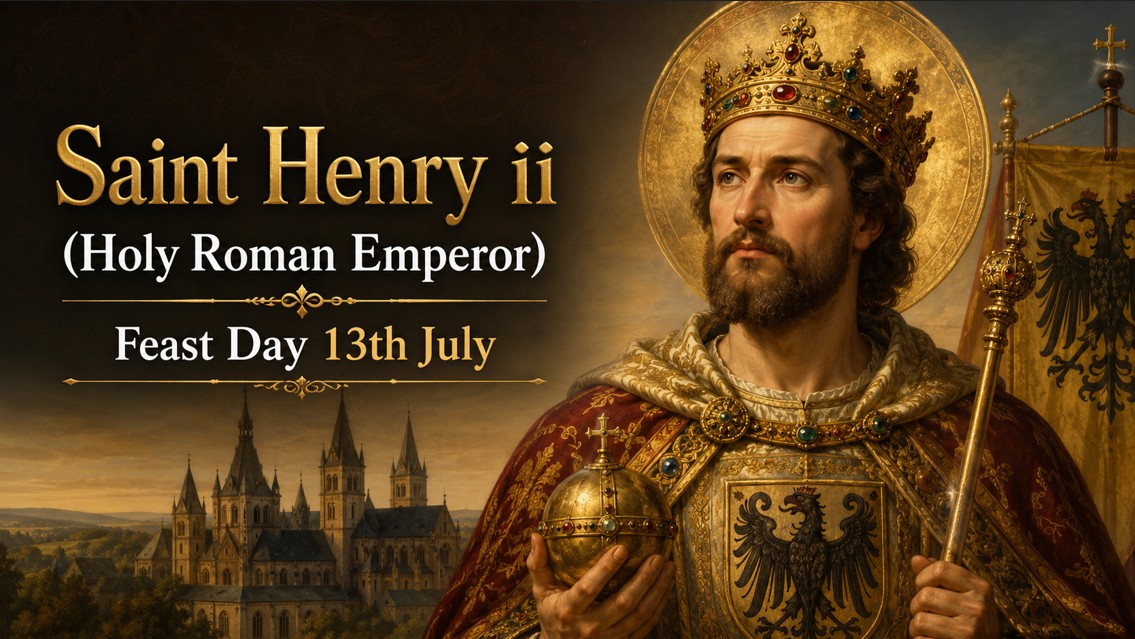
Germany, July 13, 2026: Why is Saint Henry II the only Holy Roman Emperor to be canonized? Discover the remarkable story of the medieval ruler who governed with wisdom and humility, strengthened the Church, promoted peace and justice, and demonstrated that political leadership can become a path to holiness.


Feast Day: 13 July
Born: 6 May 973, Hildesheim, Duchy of Bavaria (present-day Germany)
Died: 13 July 1024, Grona Palace, Göttingen, Germany
Canonized: 1146 by Pope Eugene III


Patron of: Childless couples, the disabled, rulers, and the Benedictine Oblates
Known For: Holy Roman Emperor, promoting Church reform, founding the Diocese of Bamberg, supporting monasteries, and ruling with justice and piety
Title: Emperor
History remembers many kings and emperors for their military victories and political achievements.
Saint Henry II is remembered for something far greater—his holiness.
As Holy Roman Emperor, Henry possessed immense authority over much of Europe. Yet instead of pursuing personal glory, he sought to govern according to the Gospel, believing that every ruler is ultimately accountable to God.
His reign became a model of Christian leadership, marked by justice, generosity, humility, and deep devotion to the Church.
More than a thousand years later, Saint Henry remains a powerful example that public office can be a genuine vocation to holiness.
Henry was born on 6 May 973 into the royal Ottonian dynasty of Germany.
From an early age, he received both a noble education and strong Christian formation.
He was entrusted to the care of the clergy at the cathedral school of Hildesheim, where he studied Scripture, theology, and the responsibilities of Christian leadership.
These formative years shaped his conviction that rulers must govern not for personal gain but for the common good.
Henry became Duke of Bavaria before ascending to the German throne in 1002.
In 1014, Pope Benedict VIII crowned him Holy Roman Emperor in Rome.
His wife, Saint Cunigunde of Luxembourg, was crowned empress alongside him.
Together they became one of the most admired royal couples in Christian history, supporting the Church through charity, prayer, and generous patronage.
Although they had no children, their marriage was remembered for its mutual devotion and shared commitment to God's service.
Henry viewed his imperial office as a sacred responsibility.
He worked tirelessly to establish peace among rival nobles, defend the rights of the poor, and ensure fair administration throughout his kingdom.
Rather than ruling through fear alone, he sought to govern with wisdom and integrity.
His decisions reflected his belief that earthly authority should always serve God's justice.
This earned him widespread respect among both clergy and ordinary people.
One of Henry's greatest contributions was his unwavering support for the Catholic Church.
He encouraged the reform of monasteries, promoted worthy bishops, and defended the independence of the Church from corruption.
Believing that strong Christian communities strengthened society, he invested significant resources in building churches and monasteries across his empire.
His close collaboration with Church leaders helped lay the groundwork for future ecclesiastical reforms.
Among Henry's most enduring achievements was the establishment of the Diocese of Bamberg in 1007.
He envisioned Bamberg as a center of evangelization, education, and pastoral care.
Together with Saint Cunigunde, he richly endowed the new diocese with churches, schools, libraries, and charitable institutions.
The magnificent Bamberg Cathedral later became the burial place of both Henry and Cunigunde and remains an important pilgrimage destination today.
Despite the demands of governing a vast empire, Henry remained deeply committed to prayer.
He regularly attended Mass, supported monastic communities, and sought spiritual guidance before making important decisions.
He believed that successful leadership required humility before God.
His devotion to the Benedictine tradition greatly influenced his personal spirituality and his vision for Christian society.
Henry never forgot the needs of the vulnerable.
He generously supported hospitals, monasteries, and charitable institutions that cared for the poor, the sick, widows, and orphans.
His generosity reflected Christ's teaching that rulers should serve rather than dominate.
He regarded wealth not as personal property but as a gift entrusted to him for the benefit of God's people.
After more than two decades of faithful rule, Henry's health began to decline.
He continued governing diligently until his death on 13 July 1024.
His passing was widely mourned throughout the empire.
He was buried beside Saint Cunigunde in Bamberg Cathedral, where pilgrims continue to honor their witness of Christian leadership and holy marriage.
Henry's reputation for holiness endured long after his death.
In 1146, Pope Eugene III canonized him, making him the only Holy Roman Emperor officially recognized as a saint by the Catholic Church.
His wife, Saint Cunigunde, was canonized several decades later.
Together they remain enduring examples of sanctity within married life and public service.
The life of Saint Henry II offers timeless lessons:
His example reminds Christians that true greatness comes through faithful service rather than worldly success.
More than a thousand years after his death, Saint Henry II continues to inspire rulers, public servants, and all who seek to live their faith with integrity.
He was an emperor who governed with humility, a husband who shared his mission with a holy spouse, and a servant of God who understood that earthly power finds its highest purpose in serving Christ.
From the imperial courts of medieval Europe to modern societies searching for ethical leadership, Saint Henry's life proclaims a timeless truth:
The greatest ruler is not the one who possesses the most power, but the one who uses every gift and responsibility to glorify God and serve others.
To know about more saints please visit the spiritual section.
By Catholic Connect Reporter
Saint Henry II, Saint Henry II feast day, Holy Roman Emperor saint, Saint Henry biography, Saint Cunigunde, Diocese of Bamberg, Bamberg Cathedral, Catholic kings and queens, medieval saints, Catholic rulers, German saints, July saints, Benedictine spirituality, Christian leadership, Saint Henry Emperor


© 2026 CATHOLIC CONNECT POWERED BY ATCONLINE LLP