- 14 September, 2026
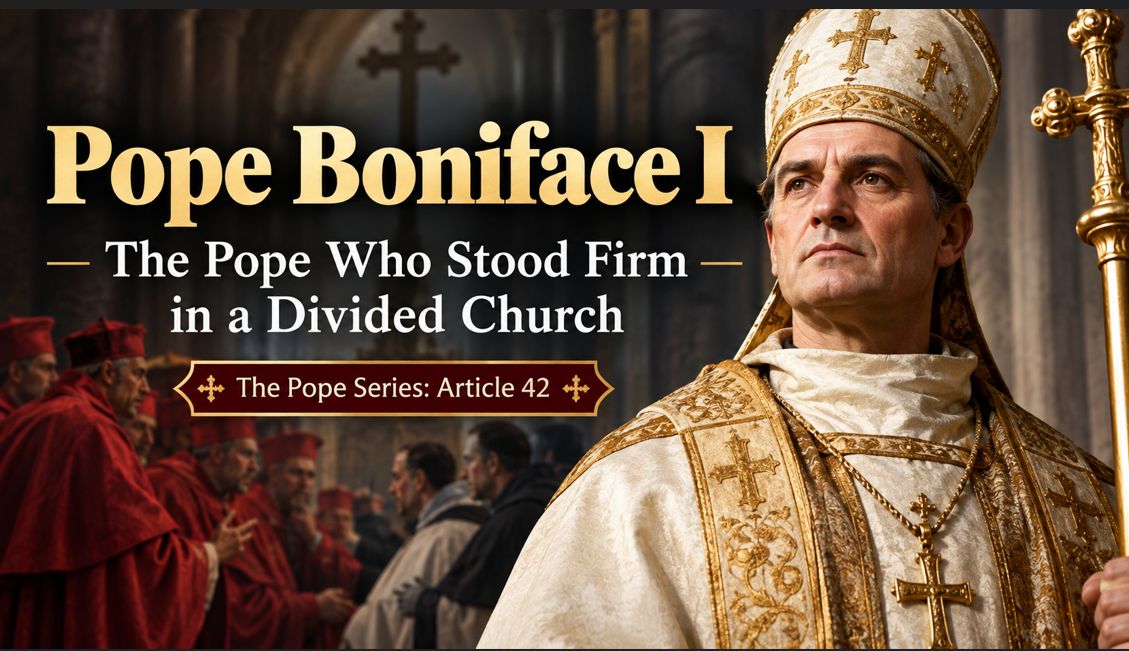
September 14, 2026: Pope Boniface I, the forty-second successor of St. Peter, led the Catholic Church from 418 to 422 AD. His pontificate began with one of the most serious disputed papal elections of the early Church, placing him at the centre of a struggle that involved rival clergy, political authorities and competing claims to the See of Rome.

Yet Boniface's four-year pontificate became about much more than the dispute over his election. He worked to strengthen Church discipline, supported St. Augustine in the fight against Pelagianism and defended the authority of Rome in disputes involving churches in Gaul, Africa and Illyricum.
What happens when two men are elected to lead the Church of Rome at the same time?

That was the extraordinary situation inherited by Pope Boniface I.
(CLICK HERE to follow Catholic Connect and to stay updated with Catholic News & Content)
Following the death of Pope Zosimus, one group elected the deacon Eulalius, while another chose Boniface. The dispute developed into a major conflict involving the Roman clergy and the imperial authorities. Eventually, Emperor Honorius recognised Boniface as the legitimate pope.
His difficult beginning did not prevent Boniface from becoming an active and determined Church leader.
Very little is known about Boniface's early years. The Liber Pontificalis identifies him as a Roman and gives his father's name as Jocundus, a priest.
Boniface is traditionally believed to have been ordained during the pontificate of Pope Damasus I. Before becoming pope, he served the Church in important diplomatic roles and is believed to have represented Pope Innocent I at Constantinople.
This experience gave him valuable knowledge of Church affairs beyond Rome.
After Pope Zosimus died in December 418, the Roman Church became divided.
A group of clergy elected the archdeacon Eulalius, while another group elected Boniface. Both claimed the papacy, creating what became known as the Eulalian schism.
The dispute became so serious that the Roman authorities and Emperor Honorius became involved. Both candidates were temporarily ordered away from Rome while the matter was investigated.
Eventually, Eulalius lost imperial support after entering Rome against instructions. Boniface was recognised as pope and returned to the city.
The episode demonstrated how political authority could influence Church affairs during the late Roman Empire.
Boniface served during a period of major change.
The Church therefore needed leaders capable of maintaining unity while respecting the established structures of local churches.
Boniface strongly supported St. Augustine of Hippo in the struggle against Pelagianism.
He received accusations made against Augustine by Pelagian supporters and forwarded their writings to him. Augustine responded by preparing his work Against Two Letters of the Pelagians, which he dedicated to Boniface.
Boniface's support helped reinforce the Church's rejection of teachings that were considered incompatible with its understanding of original sin and divine grace.
Boniface worked to maintain proper discipline among bishops and clergy. He was concerned that Church authority should be exercised according to established structures rather than concentrated unnecessarily in individual bishops.
He therefore reversed some of the extraordinary powers that his predecessor had granted to the Bishop of Arles, restoring greater authority to other metropolitan bishops in Gaul.
Boniface also defended Roman interests in Illyricum, a region where Constantinople was attempting to expand its ecclesiastical influence.
His actions demonstrated the increasingly important role Rome claimed in maintaining unity and order among Western Christian communities.
Boniface was respected for his:
His election crisis could easily have consumed his pontificate. Instead, he focused on the wider needs of the Church.
His life suggests that Christian leadership requires patience and determination, particularly when unity is threatened.
The disputed election remained the defining controversy of Boniface's early pontificate.
He also faced disagreements with bishops in Africa concerning appeals to Rome and encountered resistance over Roman jurisdiction in various regions.
These disputes reveal that the authority of the pope, although growing, was still being negotiated within the wider Church. Boniface's pontificate therefore forms an important chapter in the gradual development of papal authority.
Boniface left no famous theological statement comparable to later popes, but his life offers a meaningful lesson: True leadership seeks unity without abandoning truth or discipline.
Pope Boniface I is honoured as a saint in the Catholic Church.
He is remembered for his defence of Church discipline, support for St. Augustine and efforts to preserve the authority and unity of the Church.
Why does Pope Boniface I matter today?
For the Church, his pontificate shows that unity can be difficult to achieve when competing interests and personalities are involved.
For leaders, his experience teaches the importance of patience, discipline and perseverance during conflict.
For believers, his support for St. Augustine reminds us of the value of standing beside those who defend the faith.
Pope Boniface I died in Rome on 4 September 422 after four challenging years as Bishop of Rome. His legacy continues through the structured life of the Church today, carried forward by his successors.
To know more about the previous Popes, click here
By Catholic Connect Reporter
Pope Boniface I, Pope Boniface I biography, Pope Boniface I 418–422, Saint Boniface I, Pope Boniface history, Pope Boniface and St Augustine, Pope Boniface and Pelagianism, Eulalian schism, disputed papal election, 42nd Pope, early Catholic popes, Catholic Church history, ancient popes, history of the papacy, Pope Boniface I feast day



© 2026 CATHOLIC CONNECT POWERED BY ATCONLINE LLP