- 22 April, 2026

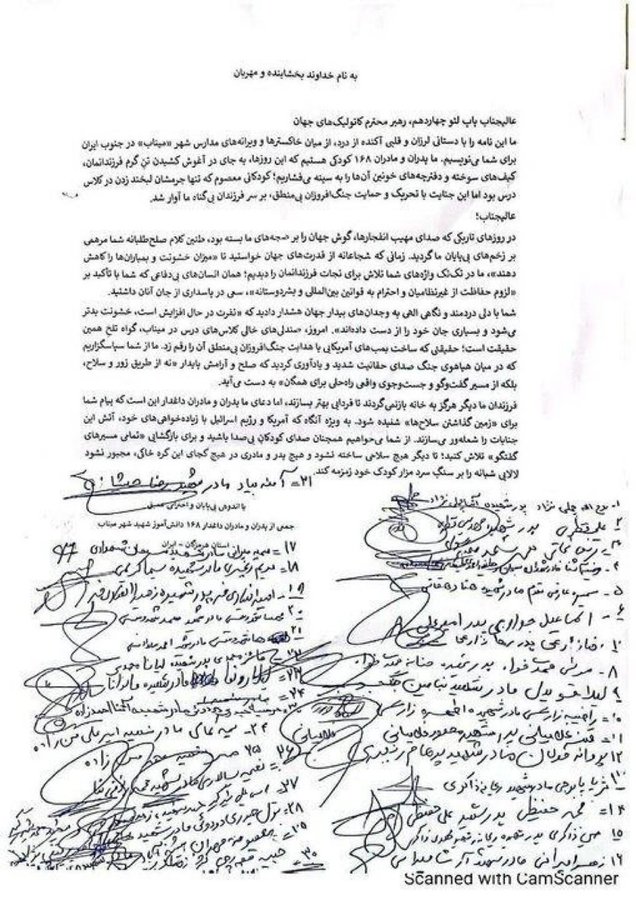
Minab, 22nd April, 2026: In a deeply moving and reflective appeal, grieving families from Minab—who lost their children in a devastating airstrike earlier this year—have written a heartfelt letter to Pope Leo XIV, thanking him for his consistent call for peace and urging him to remain “the voice of the voiceless children.” The letter, written in the aftermath of the February 28 bombing of an elementary school, has drawn global attention not only for its emotional depth but also for what it reveals about the broader human and geopolitical crisis surrounding the incident.

The tragedy at the Shajarah Tayyebeh elementary school, where over 100 children were killed along with teachers and parents, has become a symbol of the devastating cost of modern warfare on civilians. Preliminary findings indicated the involvement of the United States military in the strike, carried out in the early phase of escalating conflict involving Iran and its regional adversaries. While investigations continue and responsibility remains politically contested, the humanitarian consequences have been undeniable.
In their letter, the parents describe unimaginable grief—holding “burned bags and bloody notebooks” instead of their children. Yet amid this pain, they expressed gratitude to Pope Leo XIV, whose public condemnation of war and emphasis on dialogue resonated deeply with them. His insistence that peace cannot be achieved through violence, but through understanding and diplomacy, has positioned him as a moral voice in a highly polarized global landscape.


Beyond its emotional power, the Minab tragedy invites a deeper analysis of the root causes that led to such an event. At its core lies the long-standing geopolitical tension between Iran, the United States, and allied powers, often exacerbated by regional conflicts and proxy confrontations. The strategic importance of areas like Hormozgan Province—close to vital maritime routes such as the Strait of Hormuz—has made them highly sensitive zones, where military actions can escalate rapidly with devastating consequences.
The February 28 strike appears to reflect the dangerous intersection of military strategy and intelligence failure. In modern warfare, especially involving aerial strikes, the margin for error can be tragically small. Whether due to flawed intelligence, misidentification of targets, or the pressures of rapid escalation, civilian infrastructure—including schools—can become unintended victims. However, critics argue that such incidents are not merely accidents but point to systemic issues in how military operations are conducted, particularly in densely populated areas.
Another significant factor is the erosion of international norms and accountability mechanisms. Although frameworks like the Geneva Conventions exist to protect civilians and prohibit attacks on non-military targets, enforcement often depends on political will. In this case, the absence of a formal acknowledgment or apology has intensified anger and mistrust, both within Iran and globally. Human rights organizations have called for independent investigations, with some describing the incident as a potential war crime.
The reaction of the Minab families also reflects a broader pattern: in times of crisis, affected communities increasingly turn to moral and spiritual leaders when political systems fail to deliver justice or reassurance. Pope Leo XIV’s role in this context is particularly significant. As a global religious leader without direct political power, his influence lies in shaping conscience and advocating for universal values. His firm stance against war—even in the face of criticism from figures such as Donald Trump—has reinforced his credibility as a voice for peace.
The letter from the parents is not just an expression of gratitude; it is also a plea for continued advocacy. They ask the Pope to help ensure that “no parent anywhere on the planet” experiences such loss again. This appeal highlights the gap between political rhetoric and lived reality, where ordinary families bear the consequences of decisions made far beyond their control.
The Minab tragedy also underscores the psychological and societal impact of war, particularly on children. Schools, traditionally seen as safe spaces, becoming sites of violence represents a profound rupture in social trust. The long-term effects—trauma, fear, and disruption of education—extend far beyond the immediate loss of life, affecting entire communities and future generations.
As the world reflects on this incident, it raises urgent questions about the ethics of modern warfare, the protection of civilians, and the responsibility of global powers. It also calls for renewed commitment to dialogue, diplomacy, and conflict resolution—principles consistently emphasized by Pope Leo XIV.
In the end, the voices of the Minab parents cut through political narratives with a simple yet powerful truth: behind every statistic is a human life, a family, and a future lost. Their letter serves as both a tribute to their children and a challenge to the world—to listen, to act, and to choose peace over destruction.
By Catholic Connect Reporter

© 2026 CATHOLIC CONNECT POWERED BY ATCONLINE LLP