- 23 August, 2026

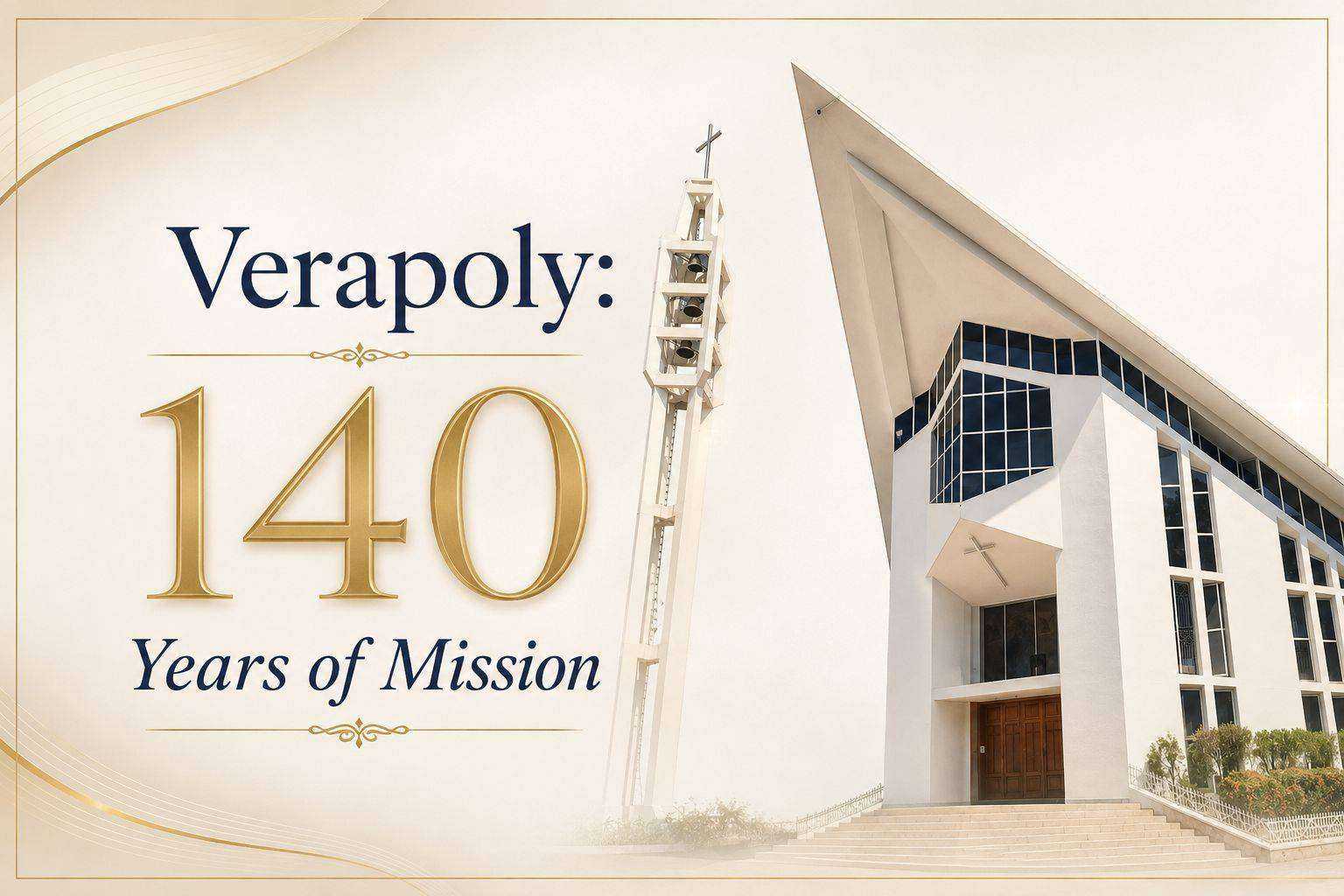
On 1 September 2026, the Church in India commemorates 140 years, since Pope Leo XIII issued the landmark Apostolic Constitution Humanae Salutis Auctor on 1 September 1886. This historic decree established a permanent episcopal hierarchy in the territories entrusted to the Sacred Congregation for the Propagation of the Faith (Propaganda Fide). The story of these 140 years is far more than a record of institutional development—it is a narrative of transition from early apostolic proclamation to missionary expansion, from provisional territories to self-sustaining dioceses, and from European missionaries to indigenous Indian shepherds. Ultimately, it charts the evolution of a Church that once received foreign missioners into a Church actively sending its own workers to the world.


To understand the decisive impact of 1886, one must look back to the origins of Catholic governance in India. Following the ancient apostolic foundations attributed to St. Thomas and St. Bartholomew, as well as medieval missionary efforts by pioneers such as Monte Corvino, Jordan Catalani, Odoric of Pordenone, Giovanni de' Marignolli, and later St. Francis Xavier, missionary activity expanded rapidly. However, political shifts eventually complicated this work. As Portuguese dominance waned, the Padroado system—the patronage agreement between the Holy See and the Portuguese Crown— struggled to sustain the growing missions.
In response, Pope Gregory XV established the Congregation for the Propagation of the Faith (Propaganda Fide) on 6 January 1622 to coordinate global Catholic evangelization. To bypass political impasses, the Holy See began erecting Apostolic Vicariates directly under papal authority, starting with the Vicariate Apostolic of Deccan in 1637 (later the Archdiocese of Bombay) and the Vicariate Apostolic of Malabar in 1659 (later the Archdiocese of Verapoly). For over two centuries, Catholic governance remained divided between the Padroado jurisdictions and the Propaganda Fide vicariates, leading to frequent administrative confusion.


The promulgation of Humanae Salutis Auctor in 1886 brought canonical stability by converting provisional mission territories into permanent ecclesiastical sees under ordinary jurisdiction. Pope Leo XIII elevated six Sees to Metropolitan Archdioceses—Agra, Bombay, Calcutta, Madras, Pondicherry, and Verapoly—and established or restored ten suffragan dioceses: Allahabad, Coimbatore, Hyderabad, Krishnagar, Mangalore, Mysore, Pune, Quilon, Tiruchirappalli, and Visakhapatnam, while Patna continued as an Apostolic Vicariate. Alongside the Padroado Sees of Goa, Cochin, and Mylapore, this newly elevated structure under Propaganda Fide marked a decisive leap toward ecclesial maturity.
Recognizing that structural organization was only the first step, Pope Leo XIII championed the formation of local clergy. In his prophetic 1893 encyclical Ad Extremas, he emphasized that the future of the Indian Church depended on an indigenous priesthood formed from among the local people. Over the next century, this vision transformed the Church's Clergy. European missionary bishops and religious congregations gradually handed pastoral responsibility to Indian priests, formators, and religious. Local congregations flourished, Indian bishops assumed leadership of dioceses, and lay leaders took on increasingly active roles within parish life and social ministries.
Among the historical Sees elevated in 1886, the Archdiocese of Verapoly holds a unique place as the "Mother of Dioceses" in South India. Originally established in 1659 as the Vicariate of Malabar, its vast original jurisdiction spanned central and northern Kerala into parts of modern-day Tamil Nadu and Karnataka. Over decades of growth, Verapoly nurtured and birthed numerous modern Latin and Syro-Malabar jurisdictions, including Vijayapuram, Kottapuram, and early Syro-Malabar vicariates. Managed primarily by Discalced Carmelite (OCD) missionaries alongside local clergy, Verapoly pioneered early parish schools (Pallikkoppam Pallikkoodam), seminaries like Puthenpally, printing presses such as St. Joseph’s Press, and early healthcare institutions. Today, Verapoly continues to excel through extensive higher educational networks, specialized hospitals, and social service initiatives like ESSS that empower coastal and laboring communities.
As the Church in India reflects on 140 years of hierarchical history, the core lesson remains clear: administrative structure exists solely to serve mission. Looking toward the future, the Church is called to move from simple institutional maintenance to active evangelization. In a rapidly changing modern India marked by urbanization, technological shifts, and religious pluralism, the Church must remain a listening, accompanying, and synodal body. By walking together—bishops, clergy, religious, and laity—the Catholic Church in India honors its grateful past while stepping forward into a hopeful future of faithful service and mission.
The archdiocese is currently structured into eight foranes or deaneries, through which it oversees a vast network of educational, healthcare, and social institutions. Its academic infrastructure ranges from early childhood to higher education, encompassing 69 lower primary schools, 64 kindergartens and nursery schools, 41 upper primary schools, 24 high schools, and 17 higher secondary schools. In higher education, the archdiocese manages 15 colleges specializing in arts and science, engineering, maritime studies, management, teacher training, and nursing including St. Albert's College (Autonomous), St. Paul's College, and the Albertian Institute of Science and Technology -AISAT (Autonomous), Albertian Institute of Management (AIM), Alberts Maritime Institute(AMI)and Lourdes College of Nursing . Notably, it is home to the Little Flower Engineering Institute, recognized as one of the premier technical institutes in India.
In the healthcare and social welfare sectors, the archdiocese plays a vital role in community support. It operates four hospitals, Lourdes Hospital and Kristu Jayanti Hospital at Vypin along with eight dispensaries specifically serving the underprivileged. Its social welfare initiatives include 19 general hostels, 12 hostels dedicated to disadvantaged children, eight boardings, six homes for the aged, and three rehabilitation centers. Community outreach is spearheaded by the Ernakulam Social Service Society (ESSS), an organization committed to uplifting socially and economically disadvantaged populations.
Additionally, the archdiocese serves as a major spiritual hub, housing several renowned pilgrimage centers. Key sites include the National Shrine Basilica of Our Lady of Ransom in Vallarpadam, St. Antony's Shrine in Kaloor, and St. Philomena’s Church and Shrine of St. Kuriakose Elias Chavara in Koonammavu. It is also home to the Shrine of Our Lady of Perpetual Succour, located at the St. Francis Assisi Cathedral in Ernakulam also named as kappal palli.
By Fr Rajan Kizhavana, USA


© 2026 CATHOLIC CONNECT POWERED BY ATCONLINE LLP