- 22 August, 2026

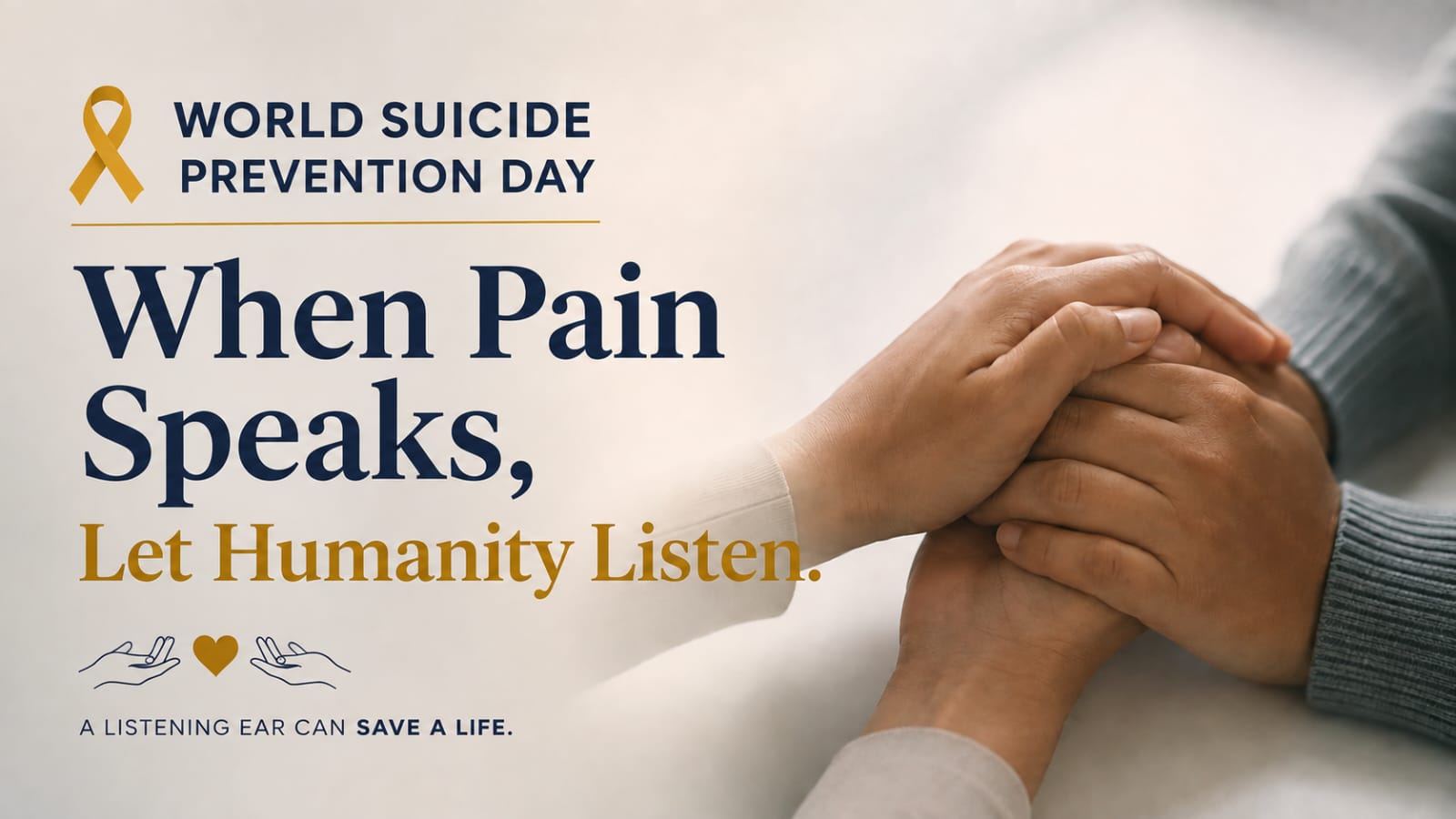
August 22, 2026: Why suicide prevention begins with one person choosing to stay? There are moments when life can feel unbearably heavy. A relationship breaks. A student fails an examination. A job is lost. A family falls apart. Debt, illness, loneliness, humiliation or prolonged emotional distress can make tomorrow appear impossible.


And then comes a sentence that should never be ignored: “I cannot go on anymore.”
It may sound like a statement about death. But often, beneath those words lies another cry: “I cannot bear this pain anymore.”


That distinction matters. Because pain can change. Circumstances can change. Help can arrive. Hope can return. A life should never be lost because of a moment, however dark, that may not last forever.
Behind every statistic is a human story
More than 720,000 people die by suicide globally every year, according to the World Health Organization, and suicide remains among the leading causes of death among people aged 15–29.
But statistics cannot tell the whole story.
Behind every number is a person—with a name, a family, relationships, memories, dreams and possibilities. Behind every death are people left asking questions that may never have answers: Did we miss the signs? Could we have done something? Why did we not notice sooner?
That is why suicide prevention cannot be reduced to statistics, programmes or clinical interventions. At its heart, it is about recognising the human being behind the pain.
Sometimes the cry for death is a cry for relief
People experiencing suicidal thoughts may feel trapped in circumstances from which they can see no escape. Family conflict, broken relationships, failure, rejection, financial hardship, violence, addiction or illness can narrow a person’s world until hope seems to disappear.
At such a moment, the answer is not judgment.
It is presence.
A person may need someone who will sit beside them without rushing to offer solutions and simply say: “Tell me what you are going through. I am here to listen.”
Listening does not solve every problem. But it can break the frightening isolation in which despair grows.
The life-saving power of listening
Consider a student who gradually becomes withdrawn, stops interacting with friends and repeatedly says, “Nobody needs me.”
A teacher notices the change. Instead of reprimanding the student or asking about academic performance, the teacher sits beside him and asks gently, “What happened? I am ready to listen.”
There is no lecture. No accusation. No hurried advice.
There is simply listening.
The student begins to cry. The tears become words. The words reveal the pain. And the pain finally finds help.
Later, the student says, “Because you listened to me that day, I am alive today.”
Whether or not such moments make headlines, they happen every day in homes, schools, workplaces, parishes and communities. They remind us that sometimes the first response to a person in emotional crisis is not a solution but a safe space in which to speak.
Notice what silence may be saying
Suicidal distress does not always announce itself clearly. A person may suddenly withdraw from family and friends, express hopelessness, lose interest in activities once enjoyed, speak about being a burden or show significant changes in mood and behaviour.
Such signs should not be dismissed.
The response need not be complicated. Move closer. Ask. Listen. Stay with the person when safety is a concern. Involve trusted family members or others who can provide support, and connect the person with qualified mental health professionals when needed.
Asking directly about suicide does not create suicidal thoughts. What matters is asking calmly, compassionately and without judgment.
A simple question can open a door:
“How are you, really?”
Beyond “How are you?”
We ask “How are you?” countless times. Often, it is merely a greeting.
But what happens when we actually wait for the answer?
A parent may notice that a child is unusually quiet. A teacher may see a student struggling beyond the examination results. A friend may recognise that someone who was once energetic has begun withdrawing. A colleague may notice that a familiar smile has disappeared.
These moments call for attention.
Look beyond marks to the student. Beyond performance to the person. Beyond outward behaviour to the possibility of hidden pain.
A phone call, a visit, an embrace, a kind word or a few minutes of patient listening may appear insignificant. Yet for someone who feels completely alone, that small gesture may become a lifeline.
We do not have to save the whole world.
Sometimes, saving one world beside us is enough.
When one life is lost, many lives are wounded
Suicide leaves an absence that cannot easily be described.
A mother loses a son. A father loses a daughter. Children lose a parent. Friends lose someone whose memories remain painfully present. Families carry grief, unanswered questions and, at times, guilt.
The loss also represents possibilities that will never unfold—love that will not be expressed, work that will not be completed, relationships that will not mature, and contributions that will never be made.
A failed examination can be attempted again. A lost job can be replaced. Financial difficulties can sometimes be overcome. A broken relationship can heal or give way to a new beginning.
Life itself cannot be repeated.
That is why we must learn to notice pain while there is still time.
Do not mistake one painful chapter for the whole story
One of the most dangerous things despair can do is convince a person that the present moment is permanent.
It is not.
A failure today does not define an entire life. Rejection does not determine a person’s worth. Unemployment does not erase human dignity. A painful relationship does not mean that love has ended forever.
The person struggling today may become a source of strength for others tomorrow. The student who fails today may become an excellent teacher. The unemployed person may one day create opportunities for others. The person who feels rejected today may discover relationships and possibilities they cannot yet imagine.
A bad day is not a bad life. A painful chapter is not the whole story.
Hope, however, must not remain an abstract idea. It must become something we offer one another through presence, patience and practical help.
Suicide prevention is everyone's responsibility
Suicide prevention is not the responsibility of mental health professionals alone.
It begins in families. It happens in classrooms. It belongs in workplaces, neighbourhoods, parishes and communities.
It can begin with a mother who notices. A father who listens. A teacher who cares beyond academic results. A friend who refuses to disappear when things become difficult. A priest or pastoral worker who creates a safe space for conversation. A counsellor who helps a person rediscover possibilities.
We may not be able to remove another person's pain. But we can ensure that they do not have to carry it alone.
The question, therefore, is not simply, “What is wrong with this person?”
It is also:
“What is happening to this person, and how can I stand beside them?”
When another person's pain becomes our concern, prevention becomes an expression of humanity.
A pledge to notice, listen and act
Every person has a role to play.
When someone is struggling, let us not walk away. Let us notice. Let us listen. Let us reach out. Let us resist the temptation to judge or minimise another person's pain.
And when the situation calls for professional intervention, let us help the person reach appropriate care.
Most importantly, let us communicate a message that can restore connection:
“You are not alone. I am with you.”
That assurance must become more than words. It must become a commitment.
Give tomorrow one more chance
To anyone who is overwhelmed by pain today, the message is simple: do not make a final decision in the middle of a temporary crisis.
Pause. Tell someone. Stay with someone. Seek professional help. Take the next safe step.
Tomorrow may not solve everything, but it may bring something that today cannot yet see—a conversation, a new opportunity, a different perspective, a relationship, treatment, reconciliation or simply a little more strength.
Your story is not necessarily finished because this chapter is painful.
And for everyone around a person who is struggling, the call is equally clear: do not wait for certainty before reaching out.
Let us notice before regret.
Let us listen before silence deepens.
Let us reach out before isolation grows.
Let us connect people with help before hope disappears.
A small light does not need permission from darkness to shine.
A phone call can be a light. A visit can be a light. A listening ear can be a light. Compassion can be a light.
We may never know which small act changed the course of someone's life.
But perhaps that is precisely why we should keep doing them.
Let us choose life. Let us help others choose life. Let us become, for someone in darkness, the human presence that says: “You are not alone.”
Because every person carries within them a world that no one else can replace.
To save one life is to save an entire world.
By Fr. J. Francis Xavier Nelson
Regional Director, Catholic Mental Health Ministry
Tamil Nadu & Puducherry
Director, Counseling Ministry, Diocese of Kottar


© 2026 CATHOLIC CONNECT POWERED BY ATCONLINE LLP