- 22 August, 2026

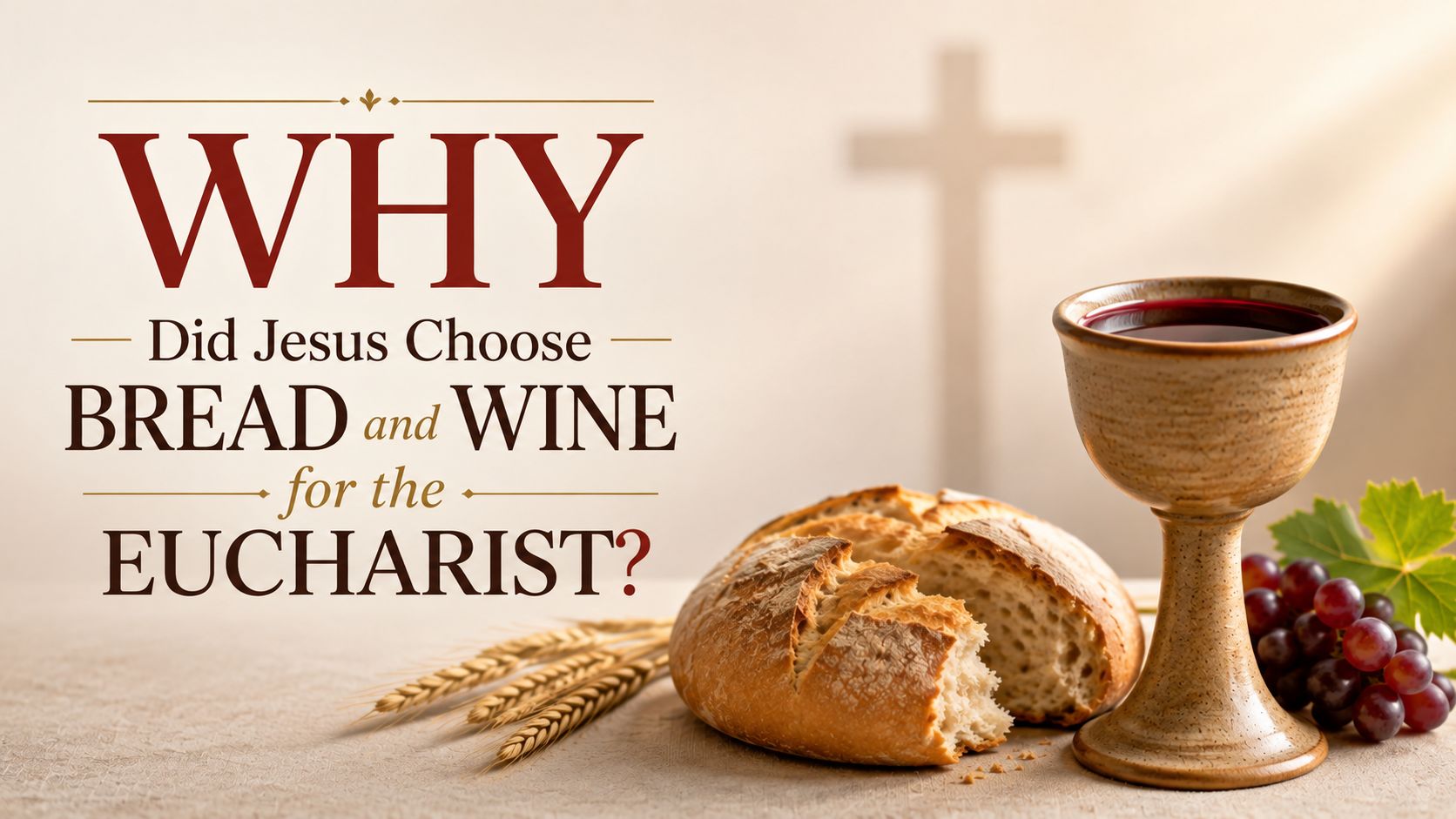
August 22, 2026: You have probably watched the same moment at Mass countless times. The priest takes bread and wine, gives thanks, and consecrates them. You know the words. You know what Catholics believe happens on the altar. But have you ever paused to ask a surprisingly simple question: Why did Jesus choose bread and wine?


We often hear the story of the Last Supper, but the deeper meaning of these two ordinary elements can easily pass us by. Look a little closer, however, and bread and wine reveal something about creation, human work, sacrifice, communion and the very nature of Christ's love.
Broken and Poured Out
Begin with what happens to them. Bread is broken and shared. Wine is poured out.


These actions point towards Christ's complete self-giving. At the Last Supper, Jesus gives his disciples bread as his Body and the cup as his Blood, anticipating the sacrifice he would offer on the Cross.
The Eucharist therefore does not present Christ merely as someone we remember. It sacramentally makes present the one sacrifice in which Christ gives himself for the salvation of the world.
The Eucharist teaches us something about love before we even receive it: love gives itself.
Many Grains, One Bread
There is another beautiful Eucharistic connection hidden in the bread itself.
Bread is made from grain, and the Eucharist becomes a profound sign of unity. St Paul writes: “Because there is one bread, we who are many are one body” (1 Corinthians 10:17).
The Eucharist is therefore not simply an intensely personal moment between an individual and Jesus. When we receive the one Eucharistic Christ, we are also drawn more deeply into communion with his Body, the Church.
The many do not cease to be many, but they are united in the one Christ.
That is why the Eucharist is inseparable from the Church's communion.
Gifts of Creation, Shaped by Human Hands
There is something else we might overlook every time the gifts are brought to the altar.
Bread and wine come from creation, but they also involve human labour.
Wheat is cultivated, harvested and made into bread. Grapes are grown, gathered and made into wine. What begins as God's gift is received, cultivated and offered back through human work.
This gives the offertory a deeper meaning. The Church does not offer God something that humanity created independently of him. Creation itself is God's gift. Yet human beings are called to cooperate with God by cultivating and transforming those gifts.
In the Eucharistic celebration, bread and wine are then transformed into the sacramental presence of Christ.
The Eucharist thus reveals something fundamental about Catholic faith: God's grace works through material creation and human cooperation.
A Meal that Points Beyond Itself
Bread and wine also belong to the language of the table.
A meal is not simply about consuming food. It is about relationship, communion and belonging. To share a meal is, in a very human sense, to share life.
Jesus did not establish the Eucharist as an isolated ritual. He instituted it during the Passover meal, in the context of his relationship with his disciples, and commanded them to continue what he had given them.
At the same time, the Eucharistic meal points beyond an earthly table. Scripture repeatedly uses banquet imagery for the fulfilment of God's Kingdom. The Eucharist gives the Church a foretaste of that promised communion with God.
Bread and Wine Themselves
Only after seeing these wider connections can we appreciate the significance of the elements themselves.
Jesus calls himself “the bread of life” (John 6:35). Bread sustains life, and Christ gives himself as the true food that communicates divine life.
Wine carries the language of celebration, but at the Last Supper Jesus gives the cup a much deeper meaning. He declares: “This cup is the new covenant in my blood” (Luke 22:20). The cup therefore points directly to his sacrificial death and the new covenant established through him.
The choice of bread and wine is also rooted in the biblical story. Bread recalls the manna with which God fed Israel in the wilderness and the unleavened bread of Passover. Wine, together with the cup of blessing, belongs to the Jewish meal tradition within which Jesus instituted the Eucharist.
So Why Bread and Wine?
Perhaps the answer is not found in one single explanation.
Bread and wine allow the Eucharist to gather together creation and human work, nourishment and celebration, sacrifice and communion, Passover and the new covenant, the earthly meal and the heavenly banquet.
And at the centre of all of it is Christ. The Eucharist is not ultimately about bread and wine as objects. It is about Jesus giving himself.
The next time you watch the bread being broken and the chalice being raised, perhaps look beyond what your eyes see. The familiar actions proclaim an extraordinary mystery: the One who gave himself on the Cross continues to give himself sacramentally to his people, drawing them into communion with him and with one another.
God chose the ordinary — bread, wine, human hands and a shared meal — to reveal an extraordinary love: a love that is broken, poured out, shared and given completely.
By Catholic Connect Reporter
Read More :
Why Does the Church Pray for the Whole World at Mass?
Why Do Catholics Say the Creed After the Homily?
Why Can’t We Skip the Homily at Sunday Mass?
Three Little Crosses Before the Gospel — But What Do They Mean?
Why Do Catholics Sit for the Readings but Stand for the Gospel?
Why Is There a Psalm Between the Readings?
Why Are There Usually Three Readings at Sunday Mass?
Why Does the Priest Say “The Lord Be with You” So Often at Mass?
Why Do We Keep Saying “Amen” at Mass? What Are We Really Saying?
The Prayer After “Let Us Pray” Changes at Mass—Do You Know Why?
Why Do Catholics Sing the Gloria—but Not at Every Mass?
Why Do We Confess Our Sins at the Start of Mass? The Deeper Meaning Explained
Why Does the Priest Kiss the Altar at Mass?
Why Does Mass Begin and End with the Sign of the Cross?
What Makes the Catholic Mass Different from Other Christian Worship Services?
If God Made the Seventh Day Holy, Why Do Catholics Worship on Sunday?
Four Parts, One Beautiful Story: Understanding the Flow of the Mass
Why Does the Mass Follow the Same Order Every Time? The Church's Timeless Wisdom
Why Do Catholics Call It the Mass? The Answer Begins with Three Latin Words
How the Mass Developed Over 2,000 Years: A Journey Through History and Worship
If God Made the Seventh Day Holy, Why Do Catholics Worship on Sunday?


© 2026 CATHOLIC CONNECT POWERED BY ATCONLINE LLP