- 15 June, 2026

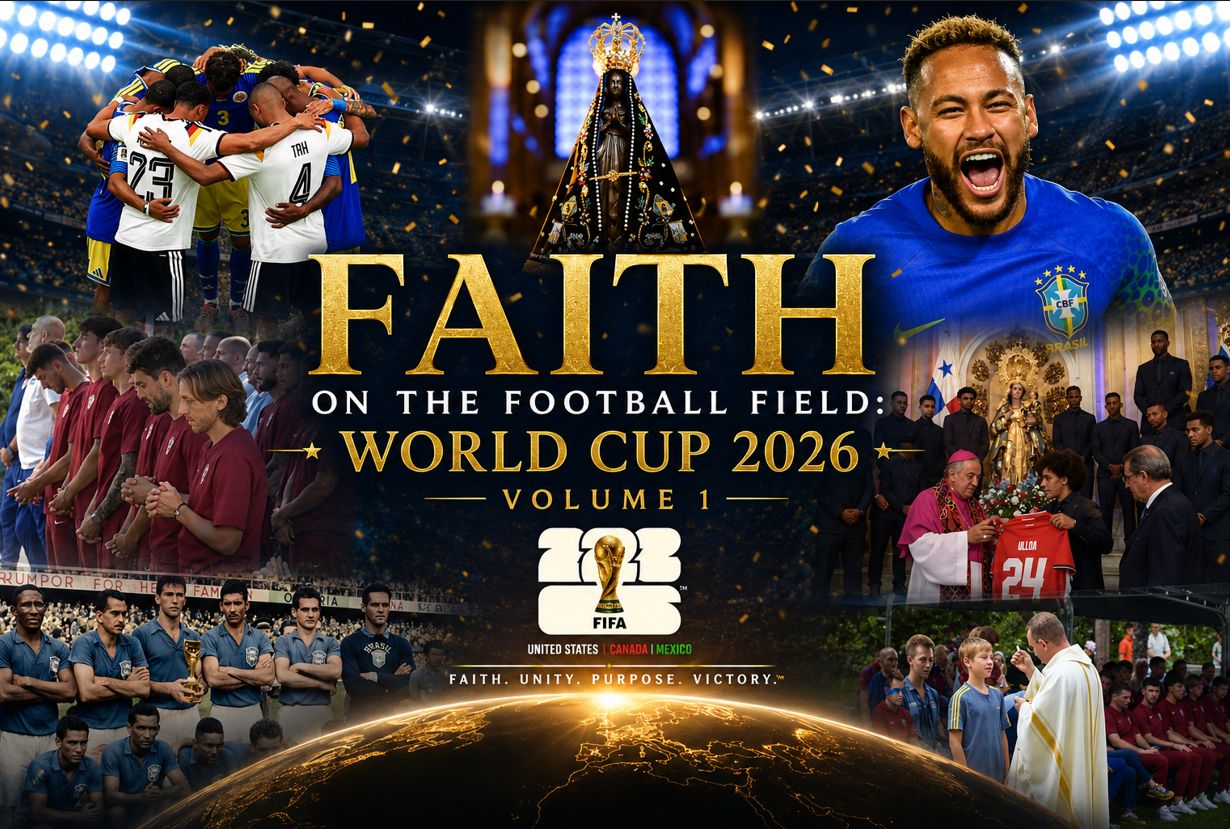
June 15, 2026 : The FIFA World Cup has always been more than a football tournament. Every four years, nations, cultures, languages, and traditions come together through the power of sport. In 2026, as the world prepares for the biggest edition in the history of the competition, football is once again becoming a meeting place for humanity.

The FIFA World Cup 2026 will be hosted by the United States, Canada, and Mexico from June 11 to July 19, 2026. It will be the first World Cup featuring 48 national teams and 104 matches, making it the largest tournament ever organised.
While millions will focus on goals, trophies, and national pride, another story is unfolding alongside the football: the relationship between faith and the beautiful game. Across different nations, Catholic communities, priests, bishops, players, and football associations are preparing spiritually for this global event.


From special blessings for national teams to Masses before departure, from priests competing in the Vatican’s own football tournament to players gathering in prayer after matches, the 2026 World Cup is revealing another dimension of football — one where competition and faith can exist together.
Long before the FIFA World Cup arrives, another unique football tournament has been bringing together the Catholic world: the Clericus Cup.
Founded in 2007 in Rome, the Clericus Cup is an international football competition organised for priests and seminarians studying or serving in Rome. The tournament was created to encourage friendship, community, and healthy competition among members of the Catholic Church from different nations.
The competition is often described as the “World Cup of priests.” Players come from seminaries, religious colleges, and Catholic institutions, representing the many cultures present in the Church.
Teams participating in the Clericus Cup include priests and seminarians from different communities connected to institutions such as the Pontifical colleges and seminaries in Rome. Players represent nations from across Africa, Asia, Europe, and the Americas.
The tournament allows future priests and current clergy members to experience football’s ability to unite people beyond borders. Matches are competitive, but the deeper purpose is fellowship, discipline, teamwork, and fraternity.
The Clericus Cup also reflects the Vatican’s appreciation of sport as a tool for human development. Football teaches values that connect with Christian life: respect, sacrifice, humility, perseverance, and working together.
(CLICK HERE to follow Catholic Connect for regular Catholic News & Content)
Alongside the Clericus Cup, the Vatican has its own unofficial football tradition through the Vatican national football team.
Unlike FIFA member nations, the Vatican City does not compete in World Cup qualification. However, it has organised football activities through teams made up of Vatican employees, clergy members, and residents.
The Vatican team has played friendly matches against other non-FIFA teams and special selections. Its purpose is not international competition but promoting friendship, dialogue, and the values of sport.
The team represents a different approach to football — one where the message is not only about winning but also about building bridges.
One of the powerful faith moments of FIFA World Cup 2026 came from Panama.
On May 27th 2026, members of the Panama national football team visited the Santa María la Antigua Cathedral Basilica in Panama City for a special blessing before travelling to the World Cup.
Those present included the players, manager Thomas Christiansen, president of the Panamanian Football Federation Manuel Arias, and seminarians from the San José Major Seminary.
During the celebration, Archbishop José Domingo Ulloa thanked the players for their dedication, sacrifice, and discipline.
“Today we are here united, praying for our national team and for our country, because when Panama unites around a common dream, it also learns to rediscover itself as a family,” he said.
The moment reflected the important role Christianity plays in Panamanian society. Panama is a predominantly Christian country, and Catholicism remains the largest religious tradition, with around 55% to 60% of the population identifying as Catholic.
For Panama, the 2026 World Cup represents another historic chapter. The nation qualified after a strong CONCACAF campaign and will make its second World Cup appearance after debuting in 2018.
As the team prepares to compete among the world’s best, the blessing at the cathedral reminded players that they carry not only national expectations but also the prayers of their people.
Brazil’s relationship with Catholic faith and football has existed for generations. Ahead of the FIFA World Cup 2026, the Brazilian national team continued a tradition that connects sport with spirituality.
The team’s decision to choose a blue playing kit has been associated with a tribute to the Virgin Mary, the Mother of Jesus. The colour blue carries deep Marian symbolism in Catholic tradition and has often been linked with devotion to Mary.
For many Brazilian Catholics, the gesture reflects the country’s long relationship between faith, culture, and football.
Before major tournaments, Brazilian players have often participated in moments of prayer and reflection. Team members have gathered for religious celebrations, seeking strength, unity, and protection before representing their nation on the world stage.
(CLICK HERE to follow Catholic Connect for regular Catholic News & Content)
Another symbolic moment occurred before Brazil’s departure for the FIFA 2026 World Cup when the team’s aircraft received a special blessing. The baptism of the plane before take-off became a reminder that the journey to football’s biggest tournament was not only physical but also spiritual for many supporters and members of the team.
The Brazilian football tradition has frequently included expressions of Christian faith, with players openly acknowledging their beliefs before and after important matches.
Croatia’s national football team also demonstrated the connection between faith and football preparation.
Led by legendary midfielder Luka Modrić, the Croatian squad gathered for Holy Mass in a chapel in Ičići, Croatia, days before travelling to the United States for the FIFA World Cup 2026.
The celebration reflected the importance of faith in Croatian culture and the team’s desire to begin its World Cup campaign with spiritual preparation.
Croatia has enjoyed remarkable success in recent World Cups, including reaching the final in 2018 and finishing third in 2022. The nation’s football identity has often been connected with determination, unity, and national pride.
The Holy Mass in Ičići showed another side of the team — a group of athletes seeking reflection and gratitude before facing one of sport’s biggest challenges.
As one of the host cities for FIFA World Cup 2026, Dallas is preparing to welcome football fans from around the globe.
The Diocese of Dallas is organising special Masses and Eucharistic adoration events for visitors travelling to Texas during the tournament.
The opening Mass, titled “Welcome the World, Welcome the Stranger,” was celebrated by Bishop Edward Burns on Sunday, June 7, at the National Shrine Cathedral of Our Lady of Guadalupe.
Dallas will host nine World Cup matches, including a semifinal. To support international visitors, the diocese has created resources to help football fans find churches and participate in spiritual activities during their stay.
Special Holy Hours are also planned before major matches, including events ahead of the Netherlands–Japan match on June 13 and the England–Croatia match on June 16.
National teams visiting Dallas will also have opportunities to request private Masses and receive the Sacrament of Confession.
Bishop Burns expressed hope that visitors would experience not only hospitality but also the peace and unity that come from recognising the shared dignity of every person.
The initiative reflects the Church’s tradition of welcoming pilgrims, travellers, and people from different nations.
One of the most inspiring moments connected with the 2026 World Cup came after the match between Germany and Curaçao on June 14.
After competing against each other for 90 minutes, players from both teams came together in prayer.
German goalscorer Felix Nmecha explained that although they were opponents during the match, they shared a deeper connection through their Christian faith.
“During the game we’re opponents, but after the game we’re all Christians and we’re brothers. So we came together and had a little prayer,” he said.
He added that they believed Jesus was glorified through the game and that this was why they gathered together.
The moment captured a powerful message: football can create rivalry, but faith can create unity.
On the world’s biggest sporting stage, players showed that identity is not only found in national colours or competition. It can also be found in shared values of respect, brotherhood, and belief.
The FIFA World Cup 2026 will be remembered for its expanded format, historic number of teams, and unforgettable matches. But beyond the stadiums, another story is being written.
From priests competing in the Clericus Cup to national teams receiving blessings before their journeys, from Masses in Croatia and Panama to welcoming celebrations in Dallas, faith continues to accompany football.
The Catholic Church’s involvement does not change the competitive nature of the World Cup. Instead, it highlights another dimension of the tournament: the ability of football to bring people together.
The ball may decide the winner of each match, but moments of prayer, friendship, and unity remind the world that sport can be a powerful expression of humanity.
As the 2026 FIFA World Cup has begun, millions will watch nations compete. Yet alongside every goal and every victory, there will also be stories of faith — stories that show that football is not only a game played with the feet, but also a journey experienced with the heart.
By Catholic Connect Reporter
© 2026 CATHOLIC CONNECT POWERED BY ATCONLINE LLP