- 30 September, 2026

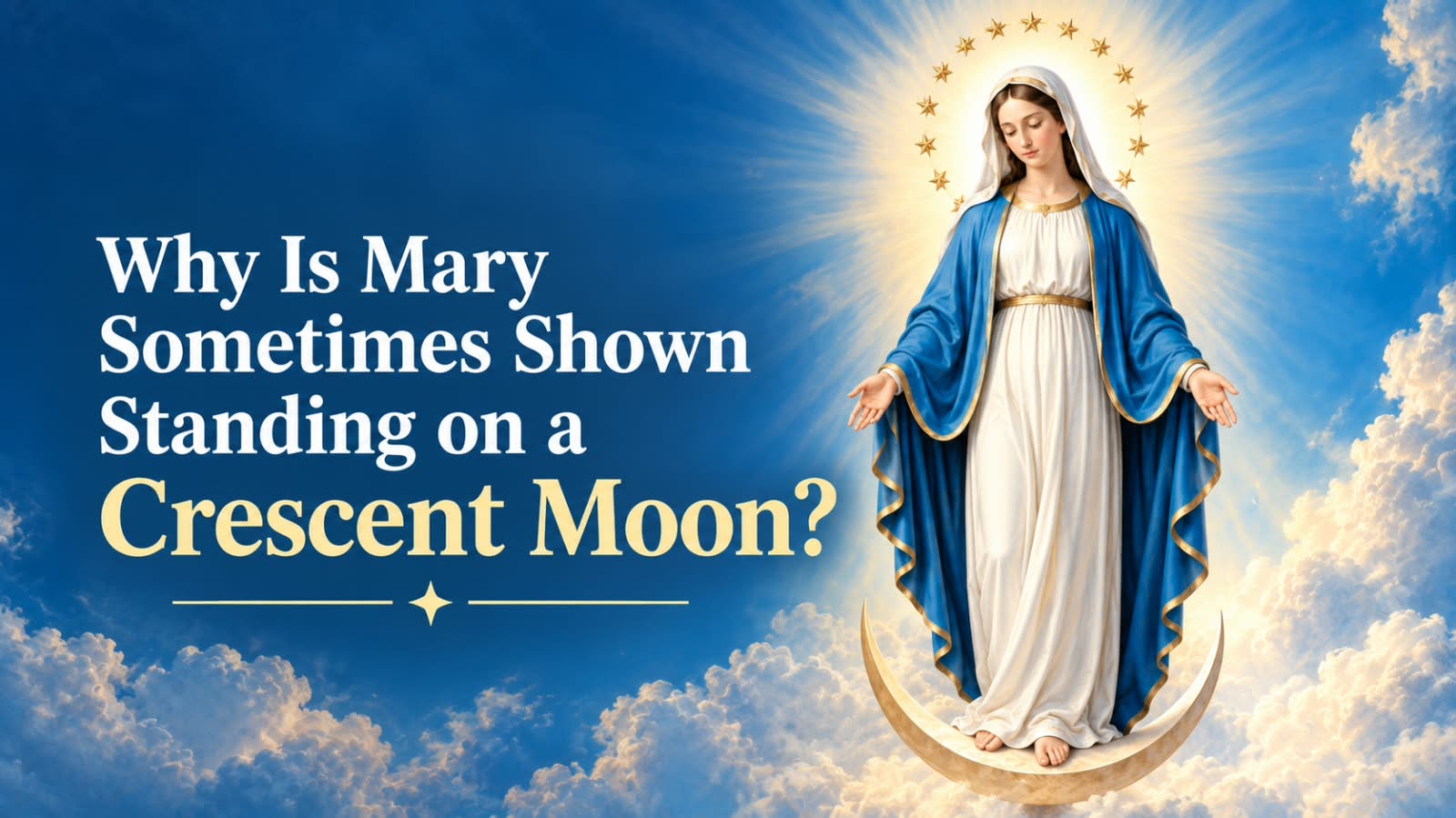
September 30, 2026: Have you ever noticed the Virgin Mary standing on a crescent moon in a painting or statue? The image may seem unusual: why is the moon placed beneath Mary’s feet? The answer comes from the Book of Revelation and the way this biblical vision developed in Christian art, particularly in representations of the Woman of the Apocalypse and the Immaculate Conception.


The Woman of the Apocalypse
In the Book of Revelation, John describes a great sign in heaven: “a woman clothed with the sun, with the moon under her feet, and on her head a crown of twelve stars.” She is pregnant and gives birth to a son who is destined to rule all the nations. The dragon then appears and seeks to destroy her child (Rev 12:1–5).
The passage does not explicitly identify the woman as Mary. In Christian tradition, however, the woman has been understood in relation to the People of God, the Church and Mary. The fact that she gives birth to the Messiah has particularly connected the vision with Mary, the mother of Christ.
(CLICK HERE to follow Catholic Connect and to stay updated with Catholic News & Content)
Why Is the Moon Beneath Mary?
The crescent moon beneath Mary comes from this imagery in Revelation. Christian artists represented the biblical vision by placing the Virgin on a crescent moon, often surrounding her with rays of light and, in some representations, twelve stars.
A specific artistic type of the Virgin standing on a crescent moon developed in Germany and became popular by the middle of the 15th century. Works from this period show the Virgin and Child standing on the moon, reflecting the vision described in Revelation 12:1.
The moon therefore became part of the visual language used to represent Mary as the Woman of the Apocalypse.
From the Apocalypse to the Immaculate Conception
The image later became closely associated with representations of the Immaculate Conception. The crescent moon was incorporated into images of the Immaculate Virgin, alongside other elements drawn from the biblical vision.
The Immaculate Conception refers to Mary being preserved from original sin from the first moment of her conception through the grace of God and in view of the merits of Jesus Christ. The doctrine was solemnly defined by Pope Pius IX in 1854.
By the 17th century, representations of the Immaculate Virgin could show Mary seated or standing on a crescent moon and surrounded by stars. The crescent moon thus became part of the established artistic language used to depict the Immaculate Virgin.
A Biblical Image in Marian Art
The moon in these Marian images points back to the vision in Revelation 12. The biblical woman is shown clothed with the sun, with the moon beneath her feet and a crown of twelve stars.
Through Christian interpretation and artistic development, this imagery became associated with Mary and was later used prominently in representations of the Immaculate Conception.
So, when Mary is shown standing on a crescent moon, the image is rooted in the biblical vision of the Woman of the Apocalypse. Over centuries, artists incorporated this imagery into Marian representations, particularly those depicting Mary as the Immaculate Virgin.
By Catholic Connect Reporter
Read More:
1) Why Is the Pelican a Symbol of Christ? The Christian Meaning Explained
2) Why Are the Four Gospels Represented by a Man, Lion, Ox and Eagle?
3) Why Is the Rooster a Symbol in Christian Art?
4) Why Do Peacocks Appear in Early Christian Tombs?
5) Why Does a Phoenix Appear in Christian Art?
6) Why Does a Pomegranate Appear in Christian Art?
7) A.M., AM or M? What Do These Mysterious Marian Letters Mean?
8) Why Is Mary Sometimes Shown With a Star?
9) What Does an Anchor Have to Do with Christianity?
10) Why Is a Ship One of Christianity’s Oldest Symbols?
11) Why Does the Grapevine Appear in Christian Art? Its Meaning Explained
12) Why Do Palm Branches Appear in Christian Art?
13) Why Do the Letters “IHS” Appear in Catholic Churches?
14) What is the Chi-Rho (ΧΡ)? The Ancient Symbol for Christ Explained
15) When Mary Looked to Heaven: The Curious Meaning Behind the Virgin’s Upward Gaze
16) Why Do Alpha and Omega Appear in Christian Art?
17) What Does the Eye Inside a Triangle Mean in Christian Art?
18) The Strange ‘Weapons’ of Christ: Why the Instruments of His Passion Appear Together
19) Why Does a Unicorn Appear in Medieval Christian Art?
20) The Mystery Behind Mary’s Enclosed Garden
21) Why Does a Scroll Appear in So Many Christian Images?
22) Why Does Jacob’s Ladder Appear in Christian Art? The Heavenly Stairway That Points to Christ
22) Why Does an Olive Branch Appear in Christian Art? The Biblical Symbol of Peace and Hope
23) Why Does Christ Sometimes Appear Inside an Almond-Shaped Frame?
24) Why Did Early Christians Carve Anchors on Their Tombs?
25) Why Does a Hand Appear From the Clouds in Old Christian Art?
26) Six Wings, One Mystery: The Angels Who Stand Before God’s Throne








© 2026 CATHOLIC CONNECT POWERED BY ATCONLINE LLP