- 09 August, 2026
August 9, 2026:


You have probably noticed it countless times.
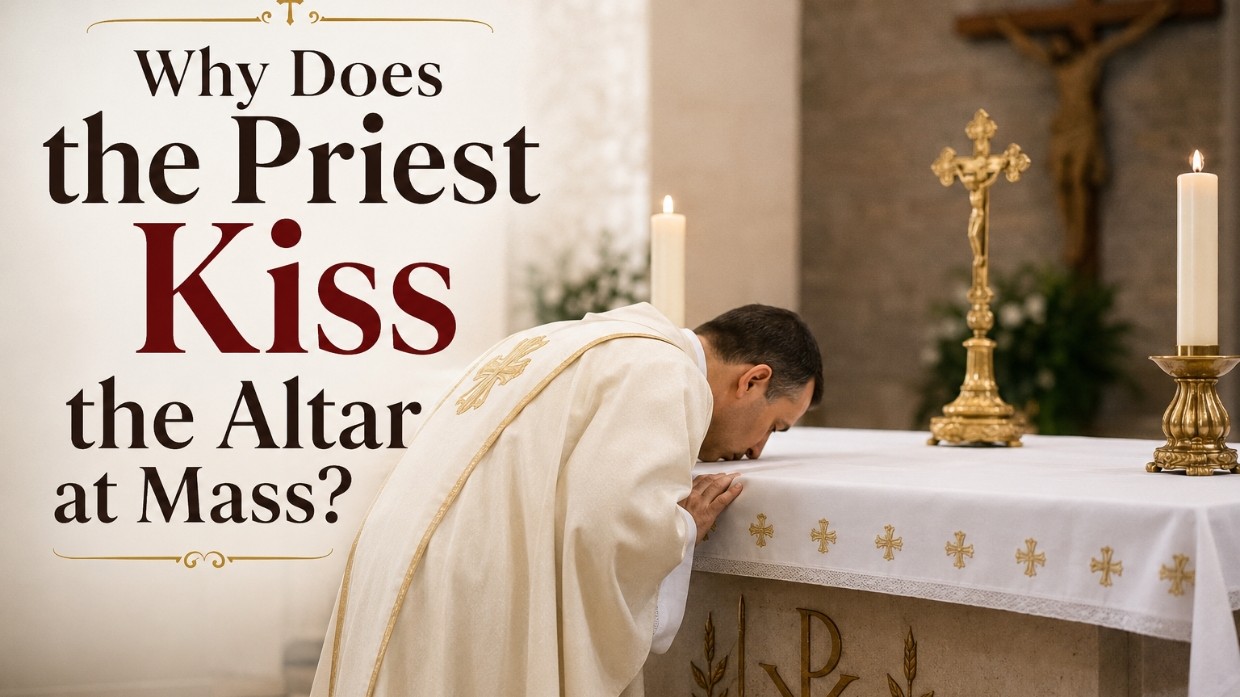
As Mass begins, the priest walks to the altar, bows deeply and then kisses it. Before leaving at the end of the celebration, he kisses the altar once again.
It is a simple gesture that lasts only a moment, yet it carries centuries of Christian tradition and profound spiritual meaning.


So why does the priest kiss the altar?
Why the altar?
The altar is far more than a table used for the Eucharist.
In the Catholic understanding, the altar represents both **the altar of sacrifice** and **the table of the Lord**. It is also a symbol of Christ Himself, present in the midst of the faithful as the Victim offered for our reconciliation and as the Food from heaven given to us.
When the priest approaches the altar, he is therefore approaching the mystery of Christ's saving sacrifice and the sacred table from which Christ gives Himself to His Church.
A gesture of love and reverence
A kiss is one of humanity's oldest signs of honour, affection and respect.
In the liturgy, the priest's kiss is not directed towards an object of stone or wood as though it were divine, but towards the altar because of what it signifies: Christ and His Eucharistic sacrifice.
The General Instruction of the Roman Missal instructs that after reaching the sanctuary, the priest and deacon reverence the altar with a profound bow and then kiss it as an expression of veneration.
This act reminds the faithful that Christ is at the heart of every Mass.
An ancient Christian tradition
The custom of kissing the altar belongs to an ancient Christian tradition. The General Instruction of the Roman Missal describes the altar’s veneration by a kiss as traditional practice.
In the Church’s tradition, altars have also been associated with the relics of saints, especially martyrs who gave their lives for Christ. The placing of relics beneath an altar signifies that the sacrifice of the saints has its origin in Christ’s sacrifice and expresses the communion of the whole Church with Him.
Relics may be placed beneath an altar, but not every altar necessarily contains relics. When relics are present, they are not the altar’s primary meaning: the altar principally represents Christ and serves the Eucharistic sacrifice.
Thus, the altar’s association with the saints can remind the faithful that the holiness and self-sacrifice of the saints flow from Christ’s own sacrifice.
Why at both the beginning and the end?
In the Roman Rite, the priest kisses the altar at the beginning of Mass and again before leaving at the conclusion of the celebration.
At the beginning, the kiss expresses reverence as he prepares to celebrate the sacred mysteries.
At the conclusion, it is another act of veneration for the altar, which represents Christ and has been the place of the Eucharistic celebration. The liturgical meaning of the gesture is principally reverence for the altar, rather than a separate private meaning assigned to each kiss.
A reminder for every Catholic
The priest's kiss of the altar is not simply a ceremonial custom.
It reminds us that the Eucharist is centred on Christ, who offered Himself for the salvation of the world and continues to nourish His Church through the Holy Mass.
The next time you see the priest kiss the altar, remember that it is a quiet yet powerful expression of reverence for Christ, His sacrifice, and the gift of the Eucharist—the source and summit of the Christian life.
By Catholic Connect Reporter
Continue Reading on Catholic Connect App
Get access to exclusive news articles & more.



© 2026 CATHOLIC CONNECT POWERED BY ATCONLINE LLP