- 09 August, 2026

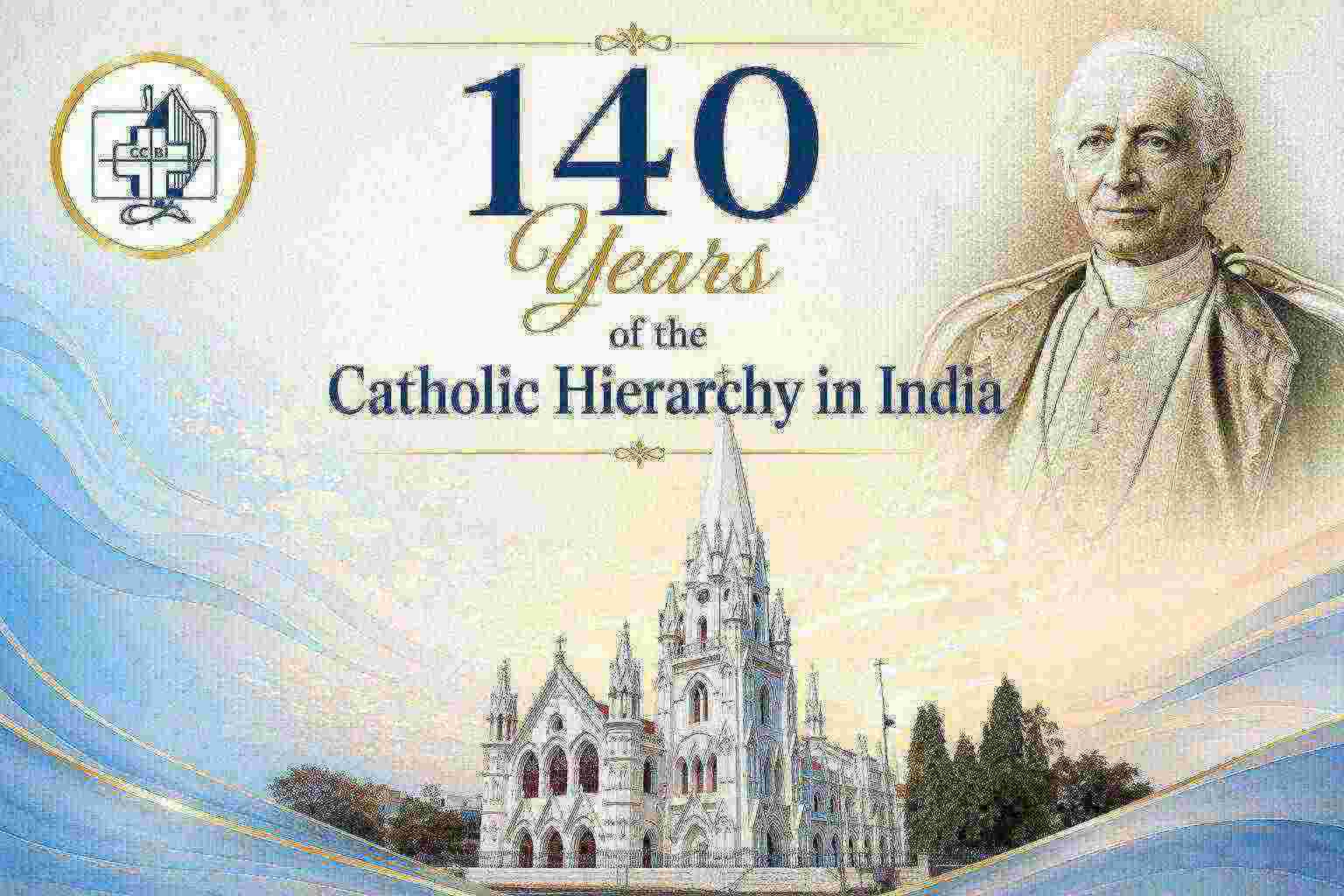
A Journey Written in Faith: On 1 September 2026, as the Church in India commemorates 140 years of the publication of the Apostolic Constitution Humanae salutis, establishing an episcopal hierarchy in the territories of India entrusted to the Congregation for the Propagation of the Faith by Pope Leo XIII on 1 September 1886.


The story of these 140 years is not simply the story of dioceses and bishops. It is a journey from apostolic proclamation to missionary expansion, from missionary territories to dioceses, from foreign missionaries to Indian shepherds, and from a Church receiving missionaries to a Church increasingly sending missionaries to the world.
1886 - The Church in India Takes Hierarchical Form: Pope Leo XIII established a new ecclesial structure in 1886 for the territories entrusted to Propaganda Fide, which had previously been governed by Apostolic Vicars and Prefects.


Six sees were elevated to metropolitan status: (1) Agra, (2) Bombay, (3) Calcutta, (4) Madras, (5) Pondicherry and (6) Verapoly.
Ten dioceses were established or restored as suffragan sees: (1) Allahabad, (2) Coimbatore, (3) Hyderabad, (4) Krishnagar, (5) Mangalore (6) Mysore, (7) Pune, (8) Quilon, (9) Tiruchirappalli and (10) Visakhapatnam. Patna continued as an Apostolic Vicariate.
Thus, in 1886, there were 17 ecclesiastical units under Propaganda Fide, while Goa, Cochin and Mylapore remained under the Padroado.
Mission territories were being transformed into stable ecclesiastical structures, with bishops exercising ordinary jurisdiction. The Church was moving from a primarily missionary framework towards a local hierarchical Church. It was a decisive step towards ecclesial maturity.
Yet 1886 was not the beginning of the Church's story in India. It was a decisive moment within a much longer journey. The hierarchical structure emerged after generations of missionary work and after a long period in which different ecclesial jurisdictions had developed and interacted.
Padroado and Propaganda Fide: Two Visions of Mission: The decline of Portuguese political power created serious difficulties for the missions connected with the Padroado and had a profound effect on Catholic missionary activity. At the same time, the Holy See was developing a new approach to the missions.
The Congregation for the Propagation of the Faith, Propaganda Fide, had been established by Pope Gregory XV on 6 January 1622. Its purpose was to strengthen and coordinate Catholic missionary activity throughout the world.
The Holy See began establishing Apostolic Vicariates independent of Portuguese control. The Vicariate Apostolic of Deccan was erected in 1637, later becoming the Archdiocese of Bombay, followed by the Vicariate Apostolic of Malabar in 1659, which later became Archdiocese of Verapoly.
Leo XIII: The Pope Who Saw India's Future: Pope Leo XIII understood that establishing dioceses was only one part of the Church's future in India. He also recognised that a truly mature Church needed an indigenous clergy. On 24 June 1893, he issued the Encyclical Ad Extremas, specifically addressing seminaries for native clergy.
The document revealed a remarkably farsighted vision. Pope Leo XIII understood that the future of Christianity in India could not depend indefinitely upon foreign missionaries. The Church needed priests formed from among the people themselves. He stressed the importance of properly trained native clergy for the preservation and propagation of Christianity in India. This vision was prophetic. The missionary Church would gradually become an indigenous Church.
From Foreign Missionaries to Indian Shepherds: The history following 1886 is, in many ways, the history of Indianisation. In the early period, many dioceses were led by missionary bishops from Europe. Religious congregations carried an enormous responsibility for evangelisation, education, healthcare and social service. But Indian priests gradually became parish priests, teachers, formators and missionaries. Indian religious congregations grew. Indian bishops increasingly assumed pastoral leadership. Lay leaders became more involved in the life and mission of the Church.
The transformation was profound. The Church that had once depended heavily on missionaries from abroad was becoming a Church capable of providing her own shepherds and missionaries. This was not a rejection of the missionary past. It was its fruit. The missionary planted the seed. The Indian Church nurtured it. And the seed grew into a Church capable of bearing fruit far beyond India's borders.
This movement from dependence to indigenous leadership became one of the defining features of the Church's journey after 1886. The establishment of the hierarchy provided a stable framework, while the formation of Indian clergy and leadership gradually gave the Church a more clearly indigenous face.
The Twentieth Century: Expansion and Maturity: The twentieth century witnessed extraordinary geographical and pastoral expansion. New dioceses were erected. Mission territories became dioceses. Seminaries and religious houses multiplied. Catholic schools, colleges, hospitals, social centres and other institutions spread across the country.
The Church's presence reached northern, central and northeastern India. Missionary activity extended beyond traditional Catholic centres and entered areas where the Church was still young.
The Church's contribution was not limited to sacramental and pastoral ministry. Catholic education became one of the Church's most important contributions to Indian society. Healthcare and social services reached millions, particularly the poor and marginalised. Religious women and men played a major role in education, healthcare, tribal ministry, rural development and care for vulnerable communities.
The hierarchy therefore became not merely an internal ecclesiastical structure. It became the framework through which the Church could serve both her faithful and the wider Indian society.
The growth of the Church was thus visible in many forms. It could be seen in dioceses and parishes, but also in seminaries, schools, hospitals, religious communities and social initiatives. The hierarchical structure provided continuity and organisation, while missionary activity gave it pastoral purpose.
1944: Bishops Begin to Walk Together: Another important milestone came in September 1944 with the establishment of the Catholic Bishops' Conference of India. The CBCI was constituted at the Metropolitans' Conference in Madras to promote common action among the bishops in matters affecting the common interests of the Catholic Church in India.
The establishment of the CBCI reflected an important truth: dioceses are essential, but a mature Church also needs structures of communion, consultation and common mission. The bishops increasingly began to face national questions together. Collaboration became an essential part of the Church's response to the changing circumstances of the country.
The Church was thus growing not only through geographical expansion but also through greater collaboration. The existence of national structures reflected a developing awareness that the bishops could respond more effectively to common concerns when they acted together.
Vatican II: A New Vision of the Church: The Second Vatican Council, held from 1962 to 1965, opened another decisive chapter. The Council's ecclesiology placed communion, participation and mission at the heart of the Church's life. Lumen gentium presented the Church as the People of God and emphasised the collegial responsibility of bishops. Christus Dominus encouraged bishops to work together and recognised the pastoral value of episcopal conferences.
For the Church in India, this opened new possibilities. The Church increasingly understood herself not simply as an institution established in India, but as a Church rooted in the Indian people, culture and society.
The challenge became clear: to be fully Catholic and genuinely Indian; faithful to the apostolic faith and open to India's rich cultural and religious traditions; united with Rome and deeply rooted in the local Church. The Church's identity was therefore understood not merely in terms of institutional presence but also in terms of her relationship with the people among whom she lived and served.
The Emergence of an Indian Episcopate: The growth of indigenous leadership has been one of the most remarkable achievements of these 140 years. The early hierarchy depended heavily on European missionaries. Today, Indian bishops lead dioceses throughout the country. The Church has produced cardinals, archbishops, bishops, theologians, canonists, educators, missionaries and social leaders.
The transformation is striking. In 1886, the hierarchy was largely a missionary structure established for a vast mission territory. In the twenty-first century, the Catholic Church in India possesses an extensive indigenous episcopate, clergy, religious communities and lay leadership.
This is one of the great fruits of the missionary enterprise. The Church that once received missionaries is now called to become a missionary Church herself. The movement from foreign missionaries to Indian shepherds is therefore not simply a change in personnel. It represents deeper ecclesial maturation. The Church has increasingly assumed responsibility for her own life and mission while remaining connected to the universal Church.
The Latin Church and the CCBI: The Latin Church, whose hierarchical foundation we commemorate in 2026, has grown enormously from the structure established in 1886. The Conference of Catholic Bishops of India, established in 1988, serves the Latin Catholic bishops of India. Its statutes received approval from the Holy See in 1994. The CCBI became the canonical national episcopal conference and the CBCI became an assembly.
The CCBI represents another stage in the maturation of the Latin Church in India. It provides a national framework for collaboration, evangelisation and pastoral coordination. The Church today therefore stands firmly on the foundations laid in 1886, but the pastoral reality has changed dramatically.
Currently there 132 dioceses 217 Bishops, 564 religious congregations 18 million Latin Catholic Faithful under the guidance and animation of the CCBI.
From Hierarchy to Mission: The deepest lesson of 140 years is that hierarchy is not an end in itself. A diocese exists for evangelisation. A bishop is ordained for service. A parish exists to form missionary disciples. A Catholic institution exists to serve the human person and bear witness to the Gospel. Structures have meaning only when they serve mission.
Pope Leo XIII's vision in Humanae salutis was missionary. The purpose of the Church's hierarchical development was ultimately the proclamation of the Gospel and the pastoral care of the people.
That missionary purpose remains unchanged. What has changed is the Church's capacity to fulfil it. The 140th anniversary should therefore not become an exercise in nostalgia. India has changed dramatically since 1886. Urbanisation, migration, digital communication, artificial intelligence, religious pluralism, economic inequality, ecological challenges, youth aspirations and changing family structures are creating new pastoral questions.
Maintenance to Mission: The Church must therefore move from maintenance to mission. The future calls for missionary parishes, renewed evangelisation, strong formation of young people, accompaniment of families, deeper involvement of the laity, promotion of vocations, greater participation of women, responsible use of digital media, dialogue with other religions, service to the poor and marginalised, care for creation and protection of human dignity.
Above all, the Church must become a listening and accompanying Church. She must listen before she speaks, accompany herself before she teaches and serve before she asks to be heard.
From Hierarchy to Synodality: The word "hierarchy" recalls the ordered structure of the Church. But the experience of the past 140 years teaches that structure must always be accompanied by communion. The Church of the future cannot be sustained only by administrative structures. Bishops, priests, religious and lay faithful must walk together.
This is especially important in India, a nation of enormous linguistic, cultural, ethnic and social diversity. The Church must hold unity and diversity together, remaining faithful to the universal Church while being deeply rooted in the Indian reality.
The India of 1886 was colonial India. The India of 2026 is a young, diverse, democratic, technologically connected and rapidly changing nation. The Church must therefore ask not only, "Where have we come from?" but also, "What is God asking of us now?"
Synodality offers a path for this future. It calls the Church to communion, participation and mission. It invites the People of God to listen to one another, to discern together and to recognise the movement of the Holy Spirit.
140 Years: A Moment of Gratitude: The anniversary is first of all an occasion for thanksgiving. We give thanks for the apostolic tradition of St Thomas and the ancient Christian communities of India. We remember the tradition associated with St Bartholomew. We remember the medieval missionaries who crossed continents to proclaim Christ. We remember Monte Corvino, Jordan Catalani, Odoric of Pordenone and Giovanni de' Marignolli. We remember St Francis Xavier and the many missionaries who followed him.
We remember the bishops and priests who served vast territories under difficult conditions. We remember religious women and men who built schools, hospitals, seminaries and institutions. We remember catechists and lay leaders who carried the faith into villages and families. We remember the countless unnamed Christians whose fidelity sustained the Church across generations.
For behind every missionary journey, every new diocese, every vocation, every school and every parish lies the mysterious grace of God. The 140th anniversary is therefore a celebration of people, but also a celebration of grace. It recalls the work of generations whose contribution continues to shape the Church today.
From a Grateful Past to a Hopeful Future: The story of Humanae salutis is not finished. The same Spirit who guided the missionaries of the past continues to guide the Church today. The next chapter will be written by bishops, priests, religious and lay faithful walking together in communion, participation and mission.
With gratitude for the past, courage in the present and hope for the future, may the Church in India remain faithful to her apostolic roots, deeply rooted in the Indian reality and ever ready to proclaim Christ with renewed joy.
The 140 years of the Catholic Hierarchy in India are therefore not merely a record of institutional development. They are a testimony to a living faith that has endured, grown and taken deeper root. They are a reminder that the Church's history is never only about structures. It is about people, mission, service, communion and the grace of God working through generations.
The journey continues from 1886 to 2026, 140 years of hierarchy and grace, inspiring the Church in India to embrace her future as a missionary and synodal Church, walking together in faith, hope and mission.
Dr. Stephen Alathara


© 2026 CATHOLIC CONNECT POWERED BY ATCONLINE LLP