- 22 June, 2026

Tiruvallur, June 21, 2026: Tiruvallur district in Tamil Nadu, located close to the expanding industrial belt of Chennai, has long been known for its mix of agriculture, manufacturing units and coastal economic activity. With its proximity to the Bay of Bengal and major transport networks, the region has become an important centre for industries including seafood processing and exports. However, the district was shaken by a tragic industrial accident on Sunday after an ammonia gas leak at a private seafood processing facility near Periyapalayam claimed the lives of seven women workers and left dozens of others hospitalised. The incident has raised serious concerns over workplace safety, emergency preparedness and the protection of migrant labourers employed in hazardous industrial environments.


The seafood industry has provided employment opportunities for thousands of workers, including migrant labourers from states across India. However, the dependence on industrial chemicals such as ammonia in refrigeration systems has also highlighted the importance of strict workplace safety measures.
The tragic incident at the private seafood processing facility has now brought these concerns into sharp focus. An ammonia gas leak at the St. Peter & Paul Seafood Export Company resulted in multiple deaths and left dozens of workers hospitalised, raising questions about industrial safety, migrant worker protection and emergency preparedness.
According to reports,the incident occurred on June 21, where a large number of workers were present inside the factory premises, including around 120 migrant labourers, many of whom were women from Assam, Odisha and Jharkhand.


The workers were reportedly staying in accommodation provided within the factory campus. Although Sunday was their weekly holiday, the ammonia leak spread from the processing unit towards the residential area, exposing workers who were inside their living quarters.
Many workers experienced severe breathing difficulties, nausea and discomfort. Some reportedly suffered bleeding from the nose and mouth after inhaling the toxic gas. The situation quickly became critical as emergency teams rushed to evacuate affected workers.
Initial reports stated that several workers died following exposure, with the death toll later rising to seven women. The victims were mostly migrant workers who had travelled far from their home states in search of employment opportunities.
Following the leak, local authorities immediately launched rescue and medical operations.
Tiruvallur District Collector S. Kavitha stated that 67 workers were taken to hospitals for treatment. Of these, 46 workers were admitted to Vels Hospital, while 21 were treated at Venkateshwara Hospital. Nine critically injured workers were later shifted to the Government Stanley Medical College Hospital in Chennai for specialised care.
Medical teams treated victims suffering from respiratory distress and chemical exposure. Authorities also secured the factory premises and began investigations into how the ammonia escaped from the processing unit.
The incident has created deep concern among workers’ organisations and labour rights groups, particularly because many of the affected employees were migrant workers living inside the industrial compound.
The Tamil Nadu government announced Rs.2 lakh compensation from the Chief Minister’s Public Relief Fund for the families of each worker who died in the Tiruvallur ammonia leak. Chief Minister C. Joseph Vijay expressed grief over the loss of lives and ordered a detailed probe into the incident. A three-member committee comprising officials from the Industrial Safety and Health Department, Tamil Nadu Pollution Control Board and Public Health Department was formed to investigate the cause of the leak. Authorities also registered an FIR, secured the seafood unit owners for questioning, and ordered safety inspections across hazardous industrial facilities. More than 60 injured workers, mostly migrant women, continue to receive medical treatment and support.
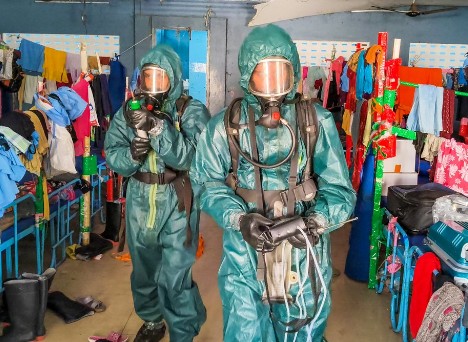
At the national level, the government deployed a specialised Chemical, Biological, Radiological and Nuclear (CBRN) response team from the National Disaster Response Force (NDRF) to assist in containment and safety operations. Prime Minister Narendra Modi expressed deep sorrow over the loss of lives, saying, “Deeply pained to hear about the loss of lives due to a mishap in Tiruvallur district of Tamil Nadu. My condolences to those who have lost their loved ones. Praying for the speedy recovery of the injured.” The incident has also renewed focus on strengthening industrial safety standards for units handling hazardous chemicals.
Ammonia is widely used in refrigeration systems, particularly in food processing industries. While it is an efficient cooling agent, high concentrations can be extremely dangerous, causing serious respiratory injuries and even death.
Industrial experts have repeatedly stressed that factories using hazardous substances must maintain proper ventilation systems, conduct regular inspections and provide workers with safety training and protective equipment.
For migrant workers, these protections become even more important. Many workers leave their home states hoping for financial stability, often accepting difficult jobs far away from their families. Ensuring their safety is not only a legal responsibility but also a moral obligation.
The Tiruvallur tragedy has highlighted the need for stronger monitoring systems so that economic growth does not come at the cost of human lives.
The ammonia leak at the seafood factory near Periyapalayam is not only an industrial accident; it is a painful reminder of the human cost behind everyday economic activity.
Behind every worker affected was a family waiting for their loved one to return home. For the families who lost mothers, daughters and sisters, the days ahead will be filled with grief and uncertainty.
However, the response from medical teams, government officials and communities offers hope that those injured can recover and rebuild their lives.
The tragedy must lead to meaningful change — stronger workplace safety rules, better protection for migrant workers and greater accountability for industries handling hazardous materials.
As investigations continue, the greatest tribute to those who lost their lives will be ensuring that no worker has to sacrifice their safety while earning a living. The future of industrial growth must be built on compassion, responsibility and respect for every worker who contributes to the nation’s progress.
By Catholic Connect Reporter
© 2026 CATHOLIC CONNECT POWERED BY ATCONLINE LLP