- 21 June, 2026

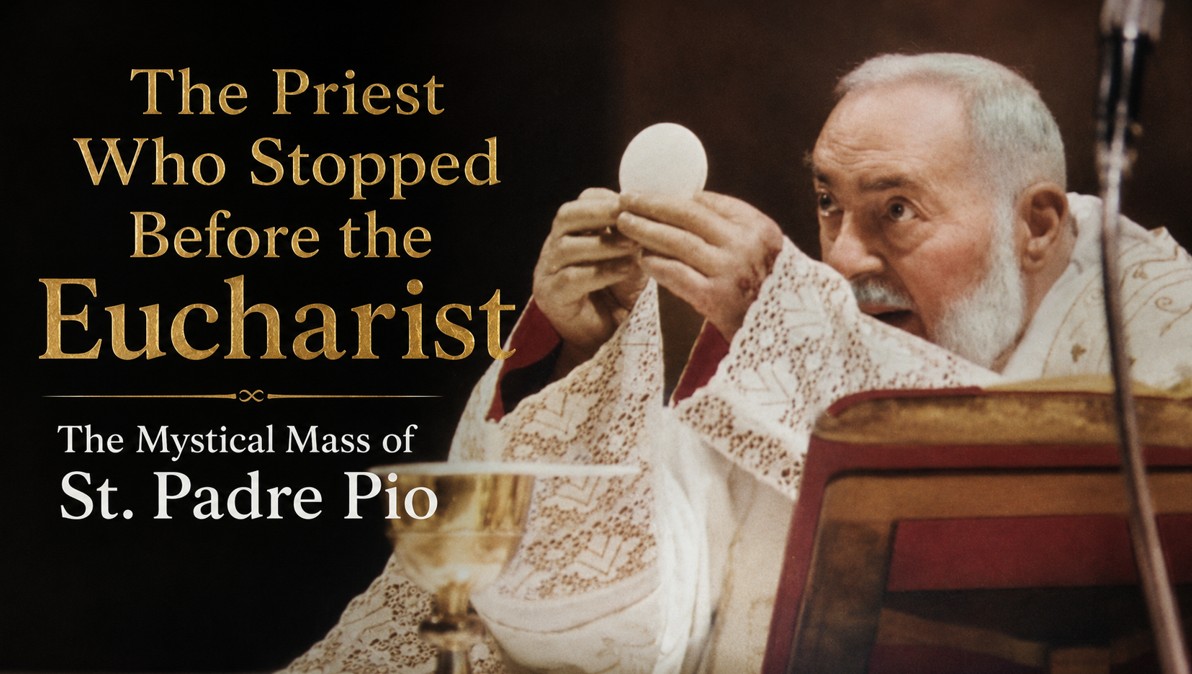
June 21, 2026: For most priests, the Holy Mass is the centre of their ministry. For St. Padre Pio of Pietrelcina, the Mass was a moment when heaven and earth seemed to meet. Witnesses often saw him pause at the altar, overcome with tears and deep prayer, as he entered into a profound union with the suffering of Christ.


During the Consecration, Padre Pio would sometimes become motionless, appearing completely absorbed in the mystery before him. Those present described moments when he seemed to experience Christ’s Passion in a deeply personal way, often weeping as he celebrated the Eucharist.
Having received the stigmata — the wounds of Christ’s crucifixion — Padre Pio’s connection with the suffering of Jesus was unlike anything many had witnessed. His Masses were sometimes extended because of these intense spiritual experiences, reminding people that the Eucharist was not merely a ritual but a living encounter with Christ.
Despite the crowds who gathered to witness his Masses, Padre Pio never wanted attention directed towards himself. When people reacted with excitement, calling his mystical experiences miracles, he would ask them to remain silent and focus only on Jesus present in the Eucharist.


For Padre Pio, the altar was not a place for admiration but a place of surrender.
He once described his moments after Communion as a complete union with Christ, saying that his heart felt as though it “disappeared as if it were a drop in the ocean”.
(CLICK HERE to follow Catholic Connect for regular News and Content)
Padre Pio’s life was marked by extraordinary events, including the stigmata he received in 1918. The Vatican investigated these wounds for years, examining whether they had a natural explanation. The investigations included detailed observations by Church authorities, including Bishop Carlo Raffaello Rossi in 1921.
Despite doubts and restrictions placed upon him, Padre Pio remained obedient and continued his priestly life with humility.
In September 1968, shortly before his death, Padre Pio celebrated his final Mass despite being extremely weak. His body was failing, but his devotion remained unwavering. Like every Mass before it, he offered himself completely to God.
St. Padre Pio died on 23 September 1968, leaving behind millions of people inspired by his faith, compassion and love for the Eucharist.
Today, pilgrims continue to visit San Giovanni Rotondo in Italy, where his legacy remains a powerful reminder of a priest who believed the Mass was not simply something to celebrate — but something to live.
His message remains simple: before the Eucharist, the human heart encounters the very presence of Christ.
By Catholic Connect Reporter
Read More on the Eucharist:
The Bishop Who Refused to Leave Jesus “Abandoned”: St. Manuel González García
The Saint Who Held Up the Eucharist to Stop an Attack: The Story of St. Clare of Assisi
The Boy Who Died Protecting the Eucharist: The Story of St. Tarcisius
The Eucharist: A Symbol or Real Presence? The Biblical and Historical Evidence
The Most Sacred Moment of the Mass—Explained
Eucharistic Miracles That Science Couldn’t Ignore: The Mysteries of Lanciano and Buenos Aires
Eucharistic Miracles That Science Couldn’t Ignore Part 2: The Mysteries of Mexico and Poland
12 Eucharistic Symbols and What They Mean
More Than a Ritual: How the Eucharist Changed the Lives of Saints
© 2026 CATHOLIC CONNECT POWERED BY ATCONLINE LLP