- 16 April, 2026

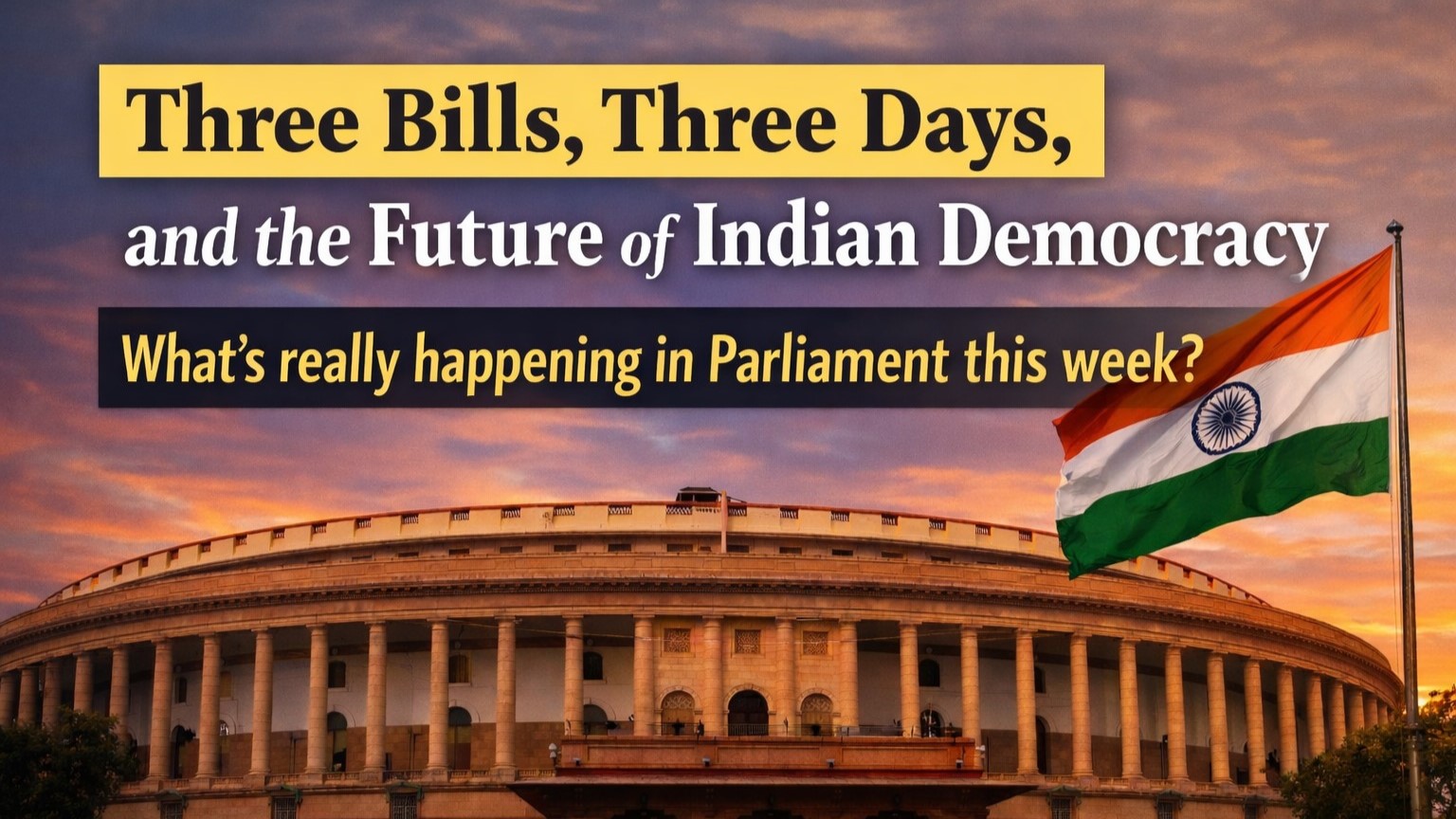
April 16, 2025: Between April 16 and 18, the government is introducing three major bills in a special three-day Parliamentary session — bills that could permanently alter the architecture of Indian democracy.

Why now? What changed?
In the 2024 elections, the BJP lost its outright majority for the first time in ten years. They won 240 seats instead of the 303 they had in 2019. That was a wake-up call.
When the current rules stop working in your favour, you change the rules. That's what this week is about.


The Three Big Moves
1. Delimitation — Redrawing the Map
India's Lok Sabha currently has 543 seats. The government wants to increase it to 850. That sounds like good news — more representation for everyone.
However, let us look closer.
A special commission would be given the power to redraw all constituency boundaries across the country. But this commission would have almost no rules to follow, no formula to ensure fairness, and — crucially — its decisions cannot be challenged in any court.
We already know what happens when similar commissions are given this kind of unchecked power. In Assam and Jammu & Kashmir, maps were redrawn in ways that systematically reduced the political power of minority communities and opposition voters. Muslim-majority areas were split apart or absorbed into surrounding constituencies to weaken their voting influence. In J&K, new seats went to areas that favoured one side, ignoring population realities entirely.
The fear is that the same playbook would be used nationally — particularly in Uttar Pradesh, which could go from 80 seats to 140 or more, with boundaries drawn to lock in advantage for decades.
The bill also quietly removes a constitutional requirement that seat redistribution must be based on census data. Now Parliament can decide by simple majority which census to use. The only complete census available is from 2011, which contains no reliable data on Other Backward Classes — meaning their communities could be structurally sidelined in the new map.
2. Women's Reservation — A Genuine Cause Used as a Trap
Women's reservation in Parliament is a cause that has been fought for across party lines for 30 years. The law already exists — it was passed in 2023.
But the government has tied its implementation to delimitation. The opposition's choice: support the whole package (including the dangerous delimitation bill) or be painted as "anti-women."
Here's a simple test: the reservation could be applied right now, to the existing 543 seats, giving 181 seats to women immediately. The reason this isn't being done? It would require sitting male MPs — including many from the BJP — to give up their seats. Waiting until the house expands to 850 means new seats can be created for women without displacing anyone currently in power.
3. Caste Census — Announced, But Watch What Follows
Prime Minister Modi once called a caste census an "urban Naxal idea." Now his government has agreed to one. The shift happened because the opposition's campaign around reservations and constitutional rights clearly resonated with voters in 2024.
But caution is warranted: watch what happens after the data is collected. Past experience suggests that concessions to one community are often balanced with sweeteners to another, managing political arithmetic rather than delivering genuine justice — all while the real structural game, delimitation, proceeds underneath.
The Assam Warning
This isn't speculation. In Assam, a delimitation commission already did exactly what critics fear at the national level.
Muslim-majority constituencies were broken up and reorganised so that Muslim voters could no longer win seats they had historically held. Some seats that minorities had won for years were reclassified as "reserved" for Scheduled Tribes — not because the tribal population was concentrated there, but because it served a political purpose. The result: Muslim-effective seats dropped from around 35 to about 20 out of 126.
And when courts were approached? The orders had already been gazetted. They became law.
Why This Matters for Everyone
In a healthy democracy, if a government performs badly, voters throw them out. Wave elections — like 1977 after the Emergency, or 2004 — are how democracies self-correct.
Gerrymandering (drawing boundaries to favour one party) breaks that self-correction. Even if public opinion shifts strongly, a rigged map means that shift doesn't translate into changed seats.
Add to that: 850 constituencies means enormous campaign costs. Only the party with the deepest pockets can fund candidates in all of them. The financial advantage compounds the geographical one.
Is There Hope?
Yes — and the situation is not yet lost.
A constitutional amendment requires a two-thirds majority in both houses of Parliament. The BJP does not have that. They are approximately 70 votes short in the Lok Sabha and 15–25 short in the Rajya Sabha.
If the opposition holds together and votes as a bloc, the constitutional amendment can be defeated. The status quo — imperfect as it is — remains. Women's reservation can be demanded immediately, at 543 seats. A fair delimitation process can be designed later, with proper consultation, bipartisan commissions, transparent criteria, and judicial oversight.
The opposition's job this week is simply to hold the line.
A Final Thought
There is a principle worth reflecting on: Study what they do, not what they say.
Promises were made about demonetisation, GST, farm laws, and the CAA. In each case, the stated intent and the actual outcome were very different.
The text of these bills — not the verbal reassurances — is what will govern India's electoral future. And that text, stripped of its technical language, gives one group nearly unlimited power to draw the political map of 140 crore people, with no formula, no judicial check, and no obligation to explain its decisions.
Courtesy: Based on a post by Varun Santhosh on X
© 2026 CATHOLIC CONNECT POWERED BY ATCONLINE LLP