- 18 September, 2026

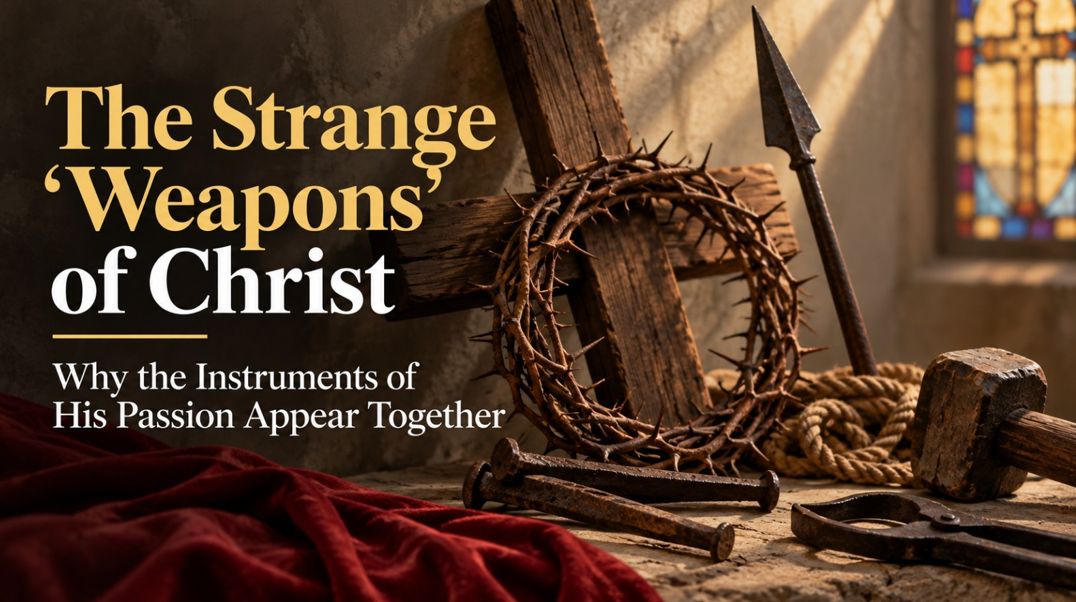
September 18, 2026: A crown of thorns, nails, a spear, scourge, hammer and cross may seem like an unlikely collection of objects. Yet in Catholic art, these instruments are often deliberately gathered together around Christ. Known as the Arma Christi, or the “Weapons of Christ”, they form one of the most distinctive visual languages of Christian devotion.

But why call instruments of suffering “weapons”? The answer reveals how Catholic theology understands the mystery of Christ's Passion.
The Arma Christi are the objects associated with Christ's Passion — His arrest, trial, scourging, Crucifixion and death. Alongside the cross, crown of thorns, nails, spear and scourge, artists might include the pillar of the scourging, hammer, pincers, sponge on a reed, ladder, dice, rooster and other objects mentioned in the Passion narratives or associated with later Christian tradition.
From the later Middle Ages, artists increasingly presented these objects together rather than only within individual scenes from the Gospel story.

The collection became a kind of visual shorthand for the entire Passion.
(CLICK HERE to follow Catholic Connect and to stay updated with Catholic News & Content)
The Latin word arma normally means weapons or arms. Its use here carries an important theological idea: Christ's apparent defeat on Calvary is understood by Christianity as His victory over sin and death.
The instruments used against Him therefore become paradoxical trophies of His triumph.
The crown of thorns, originally intended as mockery, points towards Christ's true kingship. The nails recall the Crucifixion through which Christians believe salvation was accomplished. The cross, an instrument of Roman execution, becomes the supreme Christian sign of redemption.
Thus, the Arma Christi turn symbols of humiliation into signs of victory.
The instruments also helped medieval Christians meditate upon the different stages of Christ's suffering.
The scourge recalled His flagellation. The crown of thorns evoked His mockery as “King of the Jews”. The nails recalled His fastening to the cross, while the spear referred to the piercing of His side. The sponge on a reed recalled the drink offered to Christ during His Crucifixion.
Placed together, these objects allowed a viewer to recall the Passion almost at a glance.
This was especially valuable in an age when devotional images were an important means of teaching and prayer.
The popularity of the Arma Christi was closely connected with medieval devotion to Christ's humanity and suffering. Particularly from the later Middle Ages, Christians were encouraged to contemplate the Passion not merely as a historical event but as the supreme expression of Christ's love and self-offering.
The instruments could therefore become prompts for prayer. Looking upon the crown, nails or spear invited the believer to remember what Christ endured and to meditate upon the meaning of His sacrifice.
They frequently appeared in manuscripts, wall paintings, sculpture, devotional prints and images of the Man of Sorrows.
The deepest meaning of the Arma Christi lies in this paradox: the instruments of Christ's apparent defeat become symbols of His victory.
Catholic theology does not regard the Passion as meaningless suffering. Christ freely offers Himself for the salvation of humanity, and His death leads to the Resurrection.
That is why the Arma Christi are shown together. They are not simply a collection of gruesome reminders of an execution. They form a visual proclamation of the Paschal mystery: through the Cross comes redemption, through suffering comes victory, and through death comes life.
By Catholic Connect Reporter
Read More:
1) Why Is the Pelican a Symbol of Christ? The Christian Meaning Explained
2) Why Are the Four Gospels Represented by a Man, Lion, Ox and Eagle?
3) Why Is the Rooster a Symbol in Christian Art?
4) Why Do Peacocks Appear in Early Christian Tombs?
5) Why Does a Phoenix Appear in Christian Art?
6) Why Does a Pomegranate Appear in Christian Art?
7) A.M., AM or M? What Do These Mysterious Marian Letters Mean?
8) Why Is Mary Sometimes Shown With a Star?
9) What Does an Anchor Have to Do with Christianity?
10) Why Is a Ship One of Christianity’s Oldest Symbols?
11) Why Does the Grapevine Appear in Christian Art? Its Meaning Explained
12) Why Do Palm Branches Appear in Christian Art?
13) Why Do the Letters “IHS” Appear in Catholic Churches?
14) What is the Chi-Rho (ΧΡ)? The Ancient Symbol for Christ Explained
15) When Mary Looked to Heaven: The Curious Meaning Behind the Virgin’s Upward Gaze
16) Why Do Alpha and Omega Appear in Christian Art?
17) What Does the Eye Inside a Triangle Mean in Christian Art?




© 2026 CATHOLIC CONNECT POWERED BY ATCONLINE LLP