- 07 September, 2026

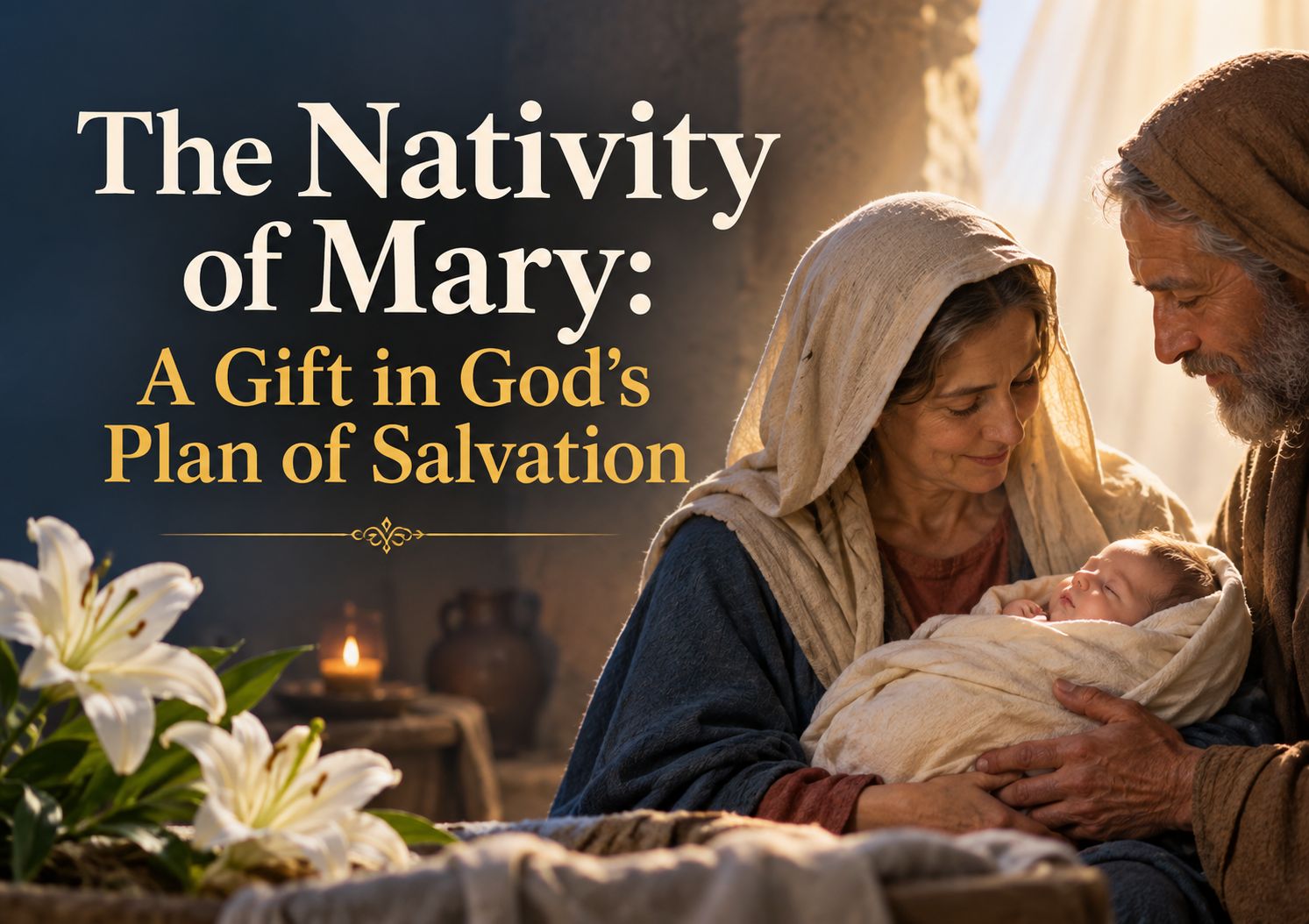
Sep 7, 2026: On September 8, the Church celebrates the Feast of the Nativity of the Blessed Virgin Mary. The Church’s celebration of Mary’s Nativity is more than a remembrance of her earthly birth; it invites us to contemplate the place God gave her in the history of salvation. Her birth is significant because she is the woman chosen by God to become the Mother of His Son. Her Nativity, therefore, is inseparably connected with Christ and the unfolding of God’s saving plan.


Mary’s birth may beautifully be described as the dawn preceding the rising of the Sun of Justice, Christ. With her coming into the world, the woman prepared by God for the Incarnation enters human history. St Paul writes: “When the fullness of time had come, God sent his Son, born of a woman” (Gal 4:4). Mary belongs to this “fullness of time”; her life stands at the threshold between the promise and its fulfilment in Jesus Christ. St John Paul II himself described Mary, on her Nativity, as “the purest dawn of the Redemption.”
The Second Vatican Council places Mary within the long history of God’s preparation for Christ. Lumen Gentium teaches that she is “already prophetically foreshadowed in that promise” given to our first parents after the fall, and that with her, “the times are fulfilled” as the Son of God takes human nature from her. (LG 55). Her Nativity, therefore, belongs to the history of God’s faithfulness. Salvation unfolds through persons and events that may initially appear ordinary and hidden. Mary’s birth took place without worldly attention, yet God was preparing through her the coming of the Saviour.

Mary’s greatness, however, lies not merely in being chosen but in her response to God’s grace. At the Annunciation, she freely gave her obedient “yes”: “Let it be with me according to your word” (Lk 1:38). Vatican II teaches that Mary, by her consent to the divine Word, “became the mother of Jesus, the one and only Mediator” (LG 56). Her consent did not originate salvation or replace Christ’s saving work. Rather, she freely cooperated with God’s grace and accepted the vocation entrusted to her.
In this obedience, the Church sees Mary as the New Eve. The Fathers of the Church reflected on the contrast between Eve and Mary: Eve’s disobedience became associated with humanity’s fall, while Mary’s obedience became part of God’s plan for the coming of the Redeemer. Yet this comparison must always remain Christ-centred. Christ is the New Adam and the sole Redeemer. Mary’s greatness consists in her unique cooperation with His saving mission. Vatican II therefore speaks of her as “freely cooperating in the work of human salvation through faith and obedience” (LG 56).
The feast is also closely related to the Immaculate Conception. These are distinct mysteries. The Immaculate Conception celebrates the grace by which Mary, from the first moment of her conception, was preserved from original sin in view of the merits of Jesus Christ (CCC 490–491). Her Nativity celebrates her birth into the world. Both reveal God’s gracious initiative and His preparation of Mary for her vocation as the Mother of the Redeemer.
Mary’s holiness is therefore never independent of Christ. What the Church believes about Mary is inseparable from what it believes about Christ. Her entire existence points beyond herself to her Son. She is not another redeemer alongside Christ, but the humble handmaid who received His grace and cooperated with His saving mission.
From a liturgical perspective, this is essential. The Church does not celebrate Mary in isolation from Christ. Her Nativity ultimately directs our gaze towards Jesus, the Saviour and fulfilment of God’s promises. Mary is not the end of the celebration; Christ is its centre and fulfilment.
The feast also speaks to every Christian. Mary reminds us that God can bring forth His greatest purposes from small and hidden beginnings. Mary’s Nativity is therefore a celebration of hope. Her birth reminds us that God remains faithful to His promises and continues to work patiently within human history. The dawn may appear small, but it announces the coming of light.
As we celebrate the Nativity of the Blessed Virgin Mary, we are invited not merely to admire her, but to imitate her faith, humility and obedience. Her Nativity is thus the celebration of the dawn of salvation, of a woman prepared by grace, and of God’s faithfulness—a faithfulness that reaches its fullness in Jesus Christ.
By Br. Malvino Alfonso OCD



© 2026 CATHOLIC CONNECT POWERED BY ATCONLINE LLP