- 07 September, 2026

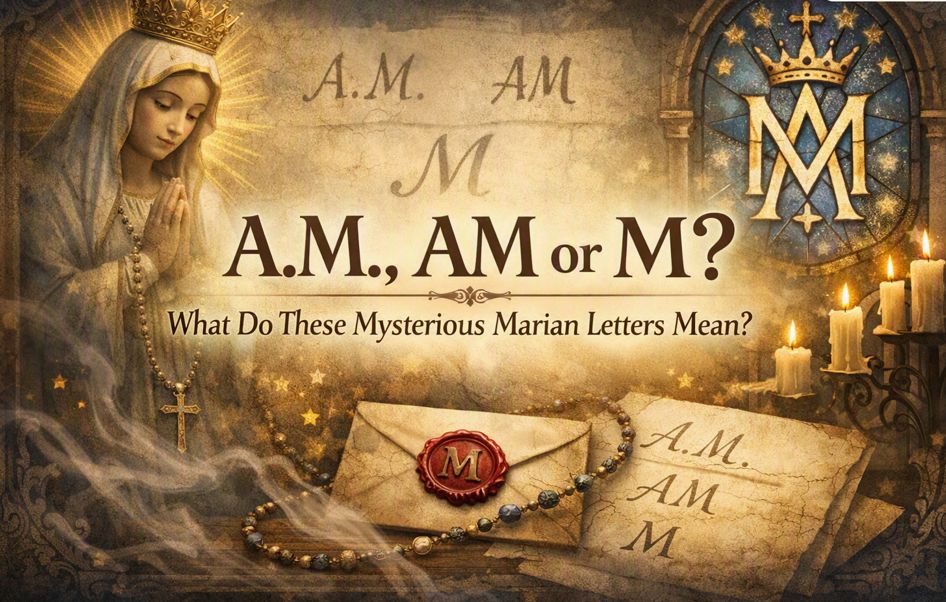
September 7, 2026: If you have ever noticed an A and M intertwined on a church window, altar, medal, vestment, rosary or old religious object, you have probably encountered a Marian monogram. These mysterious-looking letters are more than decoration: they are compact devotional symbols associated with the Blessed Virgin Mary and centuries of Catholic prayer and tradition.


But what exactly does A.M., AM or M mean?
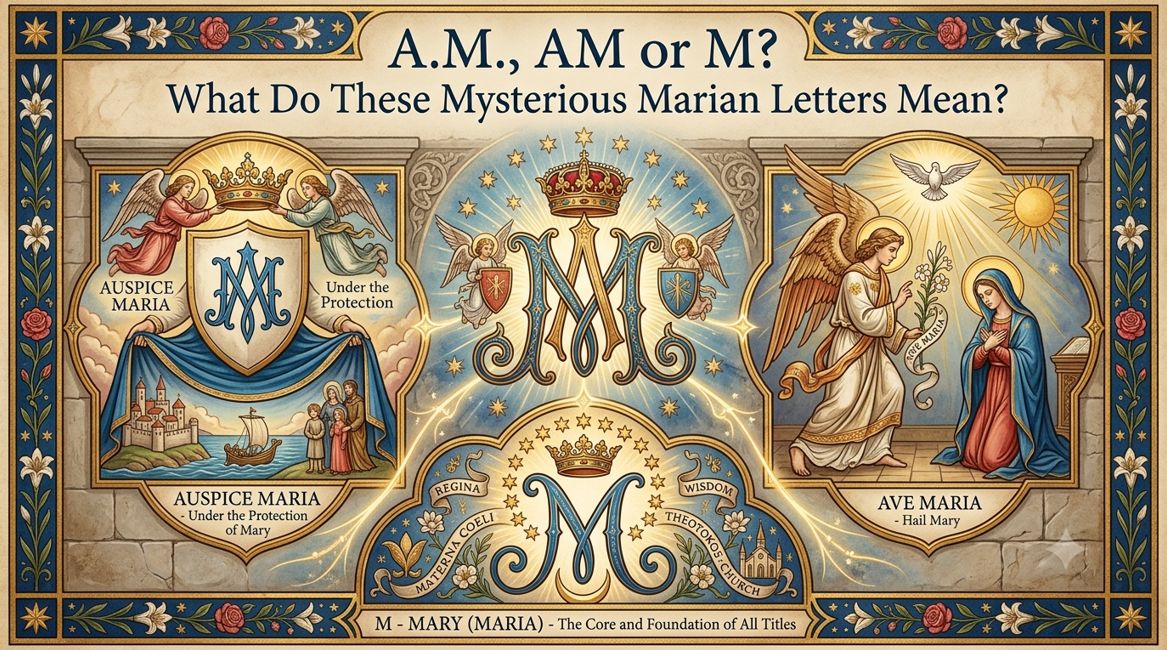
The most common devotional interpretation of AM is Ave Maria, Latin for “Hail Mary.” The words recall the Angel Gabriel’s greeting to Mary at the Annunciation: “Hail, full of grace” (Luke 1:28). The intertwined letters can therefore serve as a visual reminder of the Hail Mary and Mary's role in the mystery of the Incarnation.
Another traditional interpretation is Auspice Maria, generally understood devotionally as “under the protection of Mary” or “under Mary's guidance.” This should not, however, be presented as a universally established expansion of AM. It is better understood as a traditional interpretation found in certain devotional contexts.

The intended meaning cannot always be determined from the letters alone. The period, artistic tradition, purpose of the object and accompanying symbols may provide important clues.
Marian monograms were designed as artistic symbols rather than ordinary typography. The A and M may be intertwined so closely that the A becomes almost hidden within the M.
A monogram may therefore appear as AM, MA or simply M. These forms do not necessarily have one fixed meaning in every historical setting. MA may be associated with Maria, but it may also simply be an artistic arrangement of Marian initials.
Another variation is AMR, which can be interpreted as Ave Maria Regina, “Hail Mary, Queen.” This is a specialized possible interpretation, not a meaning that should automatically be assumed whenever AMR appears.
A crown can signify Mary's queenship, recalling titles such as Regina Caeli, “Queen of Heaven.”
Twelve stars evoke the woman crowned with twelve stars in Revelation 12:1.
Catholic tradition has associated this imagery with Mary as well as the Church, so the symbol should not be understood as referring exclusively to Mary.
Lilies and roses may express Mary's purity, virginity and love, while a cross emphasizes that Marian devotion is always centred upon Christ. Mary points beyond herself to her Son.
Marian monograms have developed through centuries of Latin prayer, Catholic devotion, artistic traditions and local customs. Ave Maria is the most familiar interpretation of AM, while Auspice Maria, Maria and Ave Maria Regina may occur as traditional or contextual readings.
Ultimately, the monogram points to Mary, her fiat at the Annunciation, her place in salvation history and her maternal intercession in the life of the Church — the woman who said yes to God, in whose womb the Word became flesh by the power of the Holy Spirit.
These seemingly mysterious letters are therefore more than decorative marks. They are small visual prayers, directing the heart toward Mary and, ultimately, toward Christ.
Read More:
1) Why Is the Pelican a Symbol of Christ? The Christian Meaning Explained
2) Why Are the Four Gospels Represented by a Man, Lion, Ox and Eagle?
3) Why Is the Rooster a Symbol in Christian Art?
4) Why Do Peacocks Appear in Early Christian Tombs?






© 2026 CATHOLIC CONNECT POWERED BY ATCONLINE LLP