- 22 July, 2026

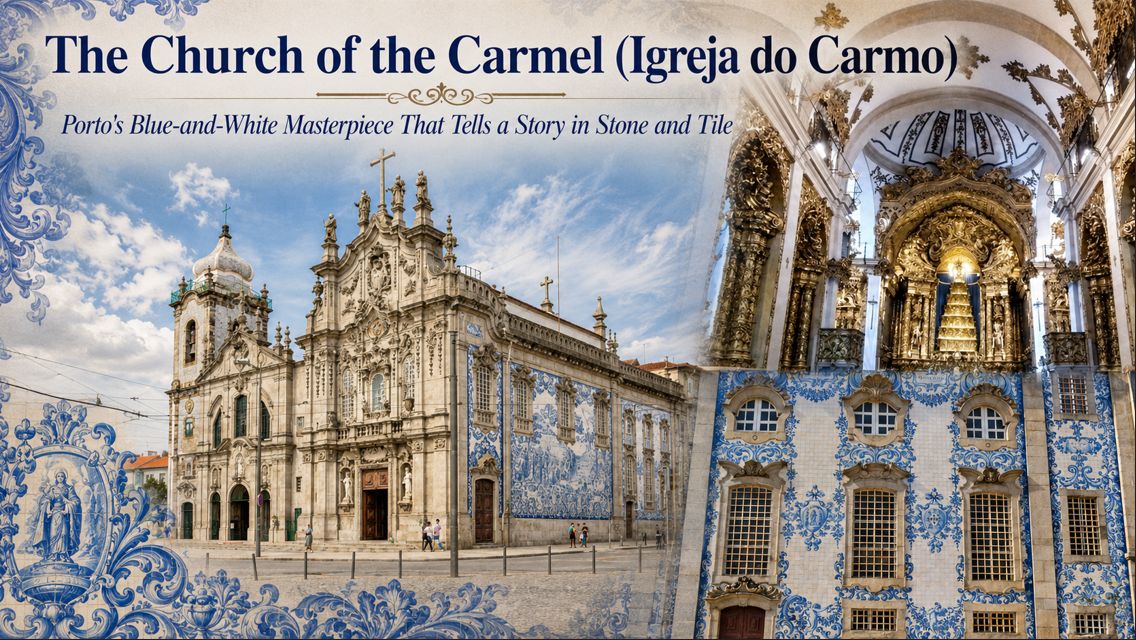
July 22, 2026:Some churches captivate with soaring towers, others with dazzling stained glass or majestic domes. In the heart of Porto, Portugal, one church tells its story through thousands of hand-painted ceramic tiles. The Church of the Carmel, known locally as Igreja do Carmo, is one of the world's most beautiful examples of how architecture and art can work together to proclaim faith. Its breathtaking blue-and-white façade has become one of Portugal's most recognizable landmarks, transforming an ordinary church wall into a magnificent canvas of devotion.


Standing proudly along Rua do Carmo, just a short walk from Porto's famous Livraria Lello, this eighteenth-century Baroque and Rococo church immediately captures the imagination. Sunlight dances across its gleaming azulejo tiles, while elegant stone carvings frame the building with timeless grace. It is a place where every surface tells a story, inviting visitors not merely to admire its beauty but to reflect on the rich spiritual heritage of the Carmelite Order.
As you approach the Church of the Carmel, your eyes are naturally drawn to its extraordinary northern wall. Covering almost the entire side of the building is one of the largest and most celebrated azulejo murals in Portugal.


Composed of nearly 1,700 blue-and-white ceramic tiles, this spectacular work of art was created in 1912 by the artist Silvestro Silvestri. Rather than serving as simple decoration, the mural unfolds like the pages of an illustrated manuscript, depicting scenes from the founding of the Carmelite Order on Mount Carmel in the Holy Land.
(CLICK HERE to follow Catholic Connect for regular News and Content)
From a distance, the countless individual tiles merge into a breathtaking panorama. Up close, however, every figure, flowing robe, cloud, and architectural detail reveals the extraordinary craftsmanship of the artisans who patiently painted each tile by hand.
The rich cobalt blue, set against brilliant white, creates a striking harmony that has become a defining feature of Portuguese architecture. Throughout the day, the changing sunlight gives the mural new depth and character, making it seem almost alive as shadows drift gently across its surface.
While the magnificent tile mural often steals the spotlight, the church itself is an architectural treasure worthy of equal admiration.
Completed during the eighteenth century, the Church of the Carmel beautifully combines the grandeur of the Baroque with the delicate refinement of the Rococo style. Its richly carved granite façade is alive with movement. Graceful columns, ornamental scrolls, statues of saints, and finely sculpted windows rise toward the heavens, drawing the eye upward in a celebration of divine glory.
Stepping through the entrance, visitors are greeted by an interior that feels warm, radiant, and inviting. The ornate gilded altars shimmer beneath soft light, their intricate carvings covered in delicate gold leaf that reflects centuries of Portuguese craftsmanship. Elegant woodwork, sacred paintings, and beautifully carved chapels surround the nave, creating an atmosphere where beauty naturally leads to prayer.
Every decorative detail serves a purpose. Rather than overwhelming the worshipper, the rich ornamentation reminds us that offering our finest artistic talents to God has long been an expression of Christian devotion.
Perhaps the church's most surprising feature is one that many visitors overlook at first glance.
Tucked tightly between the Church of the Carmel and the neighboring Church of the Carmelites stands one of the narrowest houses in Europe. Barely one meter wide, this tiny building appears almost impossible to inhabit.
Its existence, however, reflects an important chapter in the Church's history.
The neighboring churches belonged to two different religious communities—the Carmelite monks and the Carmelite nuns. Church law required strict separation between the two communities, and so this remarkably narrow residence was constructed to ensure that the churches remained physically independent buildings.
Today, visitors can explore this fascinating hidden house, whose narrow staircases and compact rooms offer a remarkable glimpse into daily life in centuries past. It is a charming reminder that even the smallest architectural details often carry profound historical significance.
One of the greatest joys of visiting the Church of the Carmel is observing how its different artistic elements complement one another.
Outside, brilliant blue-and-white tiles tell stories of faith beneath the open sky. Inside, warm golden altars glow beneath gentle light filtering through the church's windows. The cool elegance of ceramic art gives way to the richness of carved wood and gilded ornamentation, creating a beautiful dialogue between simplicity and splendor.
The church demonstrates that architecture is never merely about constructing walls and roofs. It is about creating spaces that inspire reflection and lift the human spirit toward God. Every curve, every sculpture, every painted tile becomes part of a larger story of faith expressed through beauty.
For more than two centuries, the Church of the Carmel has stood as both a place of worship and a symbol of Porto's artistic heritage. Locals continue to gather here for Mass, while visitors from around the world pause to admire one of Portugal's most iconic churches.
Its location in the heart of Porto makes it easy to include in any journey through the city, yet many travelers leave feeling they have discovered something far more valuable than a tourist attraction. They have encountered a sanctuary where history, craftsmanship, and spirituality exist in perfect harmony.
Standing before the magnificent azulejo mural as sunlight illuminates thousands of shimmering ceramic tiles, it becomes clear why this church remains one of Portugal's greatest architectural treasures. Here, ordinary clay has been transformed into sacred art, stone has become a proclamation of faith, and architecture itself tells the enduring story of a community devoted to God.
The Church of the Carmel reminds us that beauty has many languages. In Porto, it speaks through cobalt blue and brilliant white, through carved granite and golden altars, inviting every visitor to pause, to admire, and to discover how faith can be expressed one carefully crafted tile at a time.
By Catholic Connect Reporter
Read more on Must-Visit Catholic Architectural and Historical Wonders:
Ōura Church, Nagasaki: The Church Where Japan's Hidden Christians Emerged
How a Tiny Statue Inspired Brazil's National Shrine Basilica of Our Lady Aparecida
Basilica of Our Lady of Guadalupe: The Shrine That Draws 20 Million Pilgrims Each Year
Notre-Dame du Haut: The Chapel That Redefined Sacred Architecture
How Did the Holy Family's House End Up in Italy?
Sumela Monastery: Where Faith Finds a Home on the Cliffs
Sanctuary of Monte Sant'Angelo: Descending into the Cave Where Heaven Touched Earth
The Church Where Heaven Touched Earth: Mount Tabor's Basilica of the Transfiguration
Meteora: The Monasteries That Seem to Hang Between Heaven and Earth
Monastery of Alcobaça: Portugal's Treasure of Love and Legacy
Las Lajas Sanctuary: Colombia's Breathtaking Church Between Cliffs and Sky
Church of Saint George, Lalibela: The Astonishing Church Carved from a Single Rock
Archbasilica of St John Lateran: Inside the Highest-Ranking Church in the Catholic Church
Saint Catherine's Monastery: The World's Oldest Living Christian Monastery
The Church of the Holy Sepulchre: Walking Through the Sacred Heart of Christianity
Inside St. Mark's Basilica: The Church That Glows Like Heaven
Notre-Dame Cathedral: The Gothic Masterpiece That Rose from the Ashes to Inspire the World
Milan Cathedral: Italy's Crown of Marble Reaching Towards Heaven
Chartres Cathedral: Where Stone, Light, and Heaven Meet
Montserrat Monastery: A 1,000-Year-Old Architectural Marvel in the Mountains
Inside the Sagrada Família: The Incredible Story of Gaudí's Greatest Masterpiece



© 2026 CATHOLIC CONNECT POWERED BY ATCONLINE LLP