- 22 July, 2026

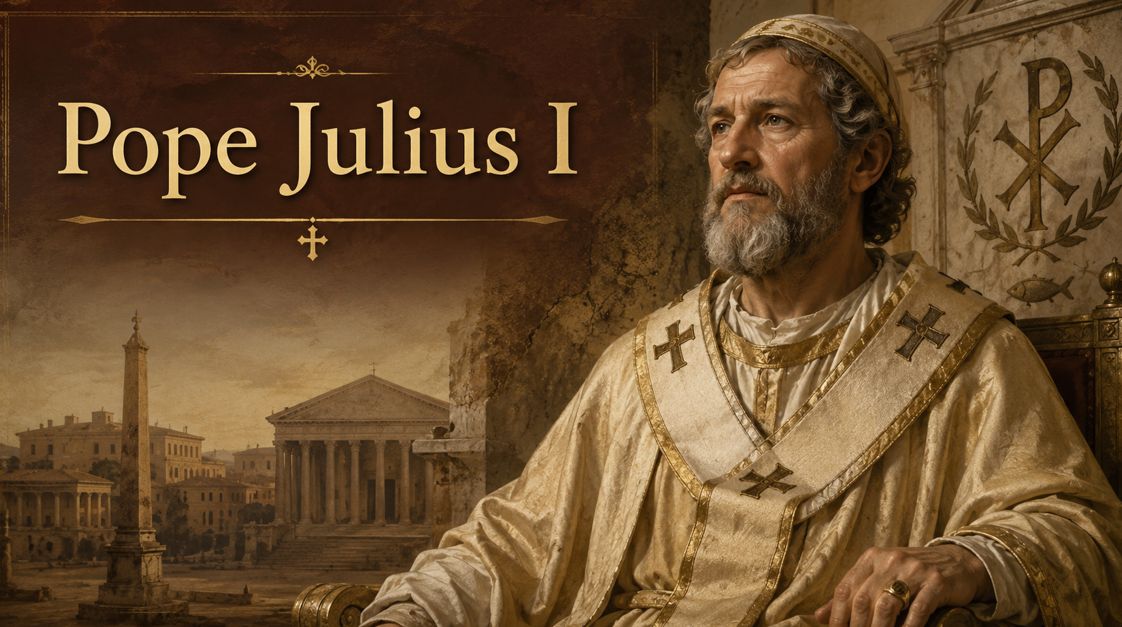
July 22, 2026: St. Julius I, the thirty-fifth successor of Saint Peter, led the Catholic Church during one of its most turbulent theological periods. Serving as Pope from 337 to 352 AD, he became a courageous defender of orthodox Christian teaching at a time when the Arian controversy threatened to divide the Church. Through his unwavering support for the Nicene faith and his defence of the authority of the Bishop of Rome, Julius helped preserve the Church's unity during a period of intense political and religious conflict.


Although he did not enjoy the peace experienced by some of his predecessors, his steadfast leadership ensured that the teachings of the First Council of Nicaea continued to guide the Church.
What happens when the greatest threat to the Church comes not from persecution, but from division within?


This was the challenge Pope Julius I faced throughout his fifteen-year pontificate. While Christianity had gained legal recognition under Emperor Constantine, disagreements over the nature of Christ created deep divisions among bishops and emperors alike.
Julius emerged as one of the strongest defenders of the Nicene faith, affirming that Jesus Christ is fully divine, equal to the Father, as proclaimed by the Council of Nicaea.
His leadership demonstrated that preserving the truth of the Gospel sometimes requires courage in the face of powerful opposition.
(CLICK HERE to follow Catholic Connect for regular News and Content)
Little is known about Julius' early life. Tradition holds that he was born into a Christian family in Rome during the final years of the Roman persecutions.
Growing up as Christianity moved from oppression to acceptance, Julius witnessed the Church's rapid expansion and the emergence of new theological debates. His knowledge of Scripture and Church tradition prepared him to guide the faithful during one of Christianity's defining doctrinal struggles.
Following the death of Pope Mark, Julius was elected Bishop of Rome in February 337 AD.
His election coincided with the death of Emperor Constantine the Great, whose empire was divided among his sons. Political instability, combined with the growing influence of Arian bishops, meant that Julius inherited a Church facing significant internal conflict.
From the beginning of his pontificate, he sought to defend both Church unity and apostolic teaching.
The Church during Julius' papacy was no longer persecuted by the Roman Empire, but it was deeply divided over doctrine.
These disputes affected not only bishops but also ordinary Christians across the empire.
Pope Julius I made several lasting contributions to the life of the Church.
His leadership helped ensure that the Nicene doctrine remained at the heart of Catholic belief despite sustained opposition.
St. Julius I is remembered for:
His spirituality reflected a shepherd committed to protecting both truth and unity.
The greatest challenge of Julius' pontificate was the Arian controversy.
Powerful bishops and influential political leaders supported Arian theology, placing immense pressure on those who defended the Nicene Creed. Julius' support for St. Athanasius brought him into conflict with several Eastern bishops, who questioned Rome's involvement in their affairs.
His insistence that important ecclesiastical disputes should involve the See of Rome also became an important milestone in the development of papal authority.
Despite these tensions, Julius consistently sought reconciliation without compromising the Church's teaching.
Although no major theological works by Julius survive, his actions express an enduring principle: The unity of the Church must always be rooted in the truth of Christ.
The Catholic Church venerates Julius I as a saint.
He is remembered as one of the great defenders of orthodoxy whose courage preserved the faith during one of Christianity's most challenging doctrinal crises.
Why does St. Julius I matter today?
His legacy continues through the life of the Church today, carried forward by his successors, reminding Christians that truth and charity must always go hand in hand.
To know more about the previous Popes, click here
By Catholic Connect Reporter
St. Julius I, Pope Julius I biography, Pope Julius I history, Pope Julius I and Arianism, St. Athanasius and Pope Julius I, thirty-fifth pope of the Catholic Church, Nicene Creed, early Catholic popes, Catholic Church history, apostolic succession, Pope Julius I facts
© 2026 CATHOLIC CONNECT POWERED BY ATCONLINE LLP