- 31 July, 2026
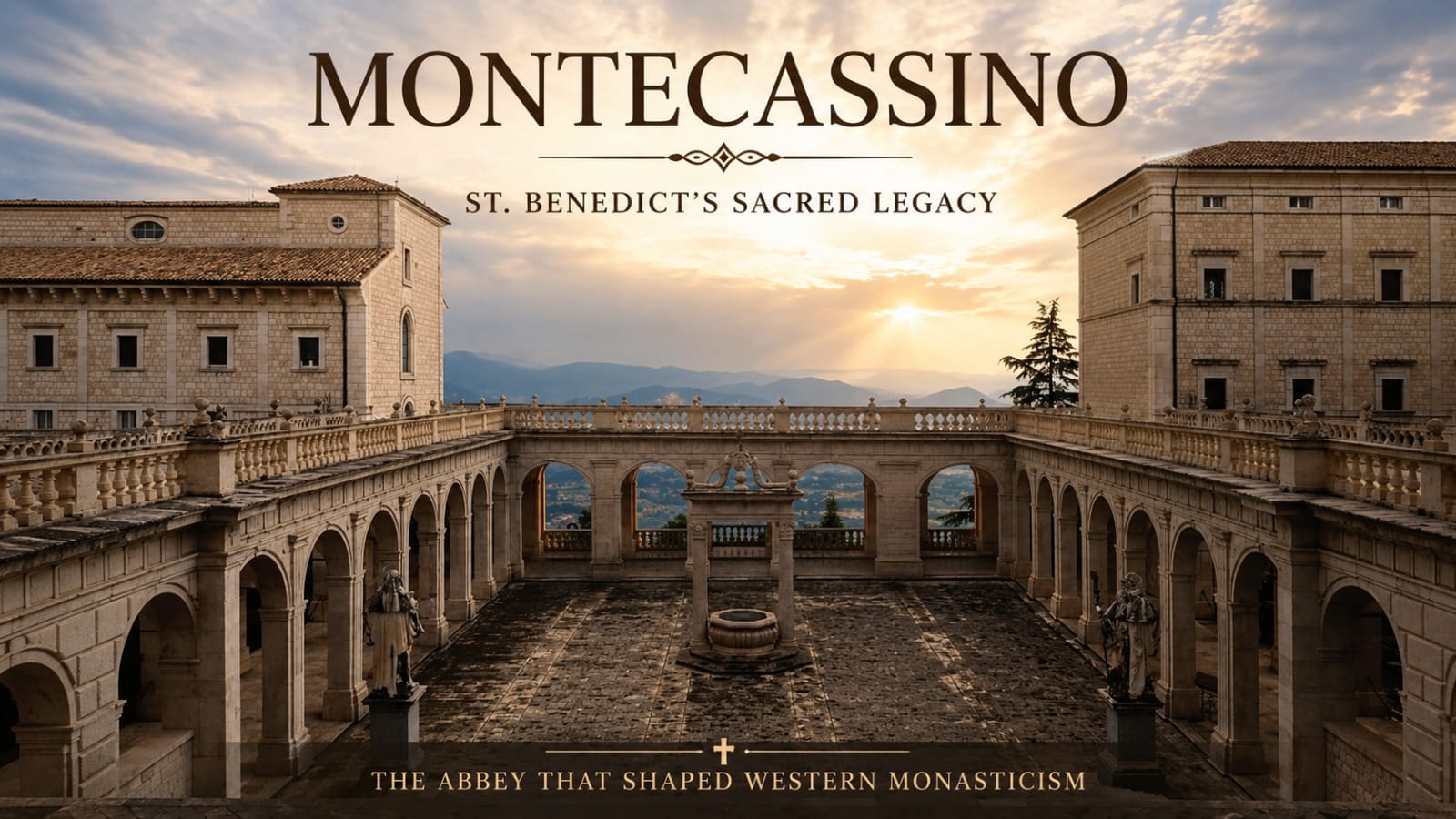
July 31, 2026: The climb to Montecassino is as memorable as the destination itself. A winding road leads steadily up the mountainside, leaving behind the bustle of the town of Cassino. As the abbey slowly comes into view, its grand stone walls rise against the sky, standing with quiet dignity above the valley below. Step through its gates and the world seems to slow down. Sunlight pours into peaceful courtyards, centuries-old cloisters echo with silence, and the gentle rhythm of monastic prayer reminds every visitor that this is far more than a historic monument.


Perched atop a hill in central Italy, the Abbey of Montecassino is where St Benedict of Nursia founded the first Benedictine monastery around AD 529. Here, he wrote the Rule of St Benedict, a guide to monastic life centred on prayer, work and community that would shape Christian monasticism across the Western world for centuries.
Where a New Chapter of Christian History Began
When St Benedict arrived at Montecassino, the hill still bore traces of an ancient Roman settlement and a temple dedicated to Apollo. According to tradition, he transformed the site into a place dedicated entirely to God, replacing pagan worship with a life rooted in faith and prayer. It was here that he established a monastic community whose influence would extend far beyond the walls of the abbey.


The Rule he composed at Montecassino became the foundation of Benedictine life, encouraging monks to seek God through a balanced life of prayer, manual labour and study. Over the centuries, Benedictine monasteries carried this vision throughout Europe, preserving sacred texts, promoting education and serving as centres of learning, hospitality and culture. Montecassino thus came to be recognised as the cradle of Western monasticism.
Walking Through Centuries of Faith
A visit to Montecassino is like walking through layers of Christian history. The abbey's magnificent basilica, elegant cloisters and richly decorated chapels reflect centuries of artistic devotion. Its museum, archives and renowned library preserve precious manuscripts, illuminated texts and sacred works of art that testify to the abbey's enduring role in safeguarding Europe's spiritual and cultural heritage.
Yet the true beauty of Montecassino lies not only in its architecture but in its atmosphere. The silence of its corridors, the sound of prayer rising from the monastery and the sweeping views across the surrounding countryside invite visitors to pause, reflect and encounter God in stillness.
A Story of Destruction and Resurrection
Few sacred places have endured as many trials as Montecassino. Throughout its nearly 1,500-year history, the abbey has been destroyed and rebuilt several times following invasions, earthquakes and conflict. Its greatest tragedy came during the Second World War when it was almost completely destroyed during the Battle of Monte Cassino in 1944.
After the war, the abbey was painstakingly reconstructed using the principle of rebuilding it "where it was, as it was." Today, visitors walking through its restored halls witness not only remarkable craftsmanship but also a powerful symbol of hope. Rising once again from the ruins, Montecassino stands as a testament to the resilience of faith and the enduring spirit of the Church.
A Living Legacy
Although Montecassino is not a UNESCO World Heritage Site, it forms part of Italy's UNESCO Tentative List within the proposed "Cultural Landscape of the Benedictine Settlements in Medieval Italy." Its historical and spiritual significance continues to attract pilgrims, historians and travellers from around the world.
For many, Montecassino is more than a destination. It is a place where the legacy of St Benedict comes alive through prayer, hospitality and quiet contemplation. Standing on the hill where Western monasticism took root, visitors are reminded that even after centuries of destruction, faith has the power to rebuild, renew and inspire. Long after the journey down the mountain begins, the peace of Montecassino lingers in the heart—a timeless invitation to seek God in prayer, work and hope.
By Catholic Connect Reporter
Read more on Must-Visit Catholic Architectural and Historical Wonders:
Florence Cathedral: The 600-Year-Old Engineering Marvel That Still Amazes the World
The Church of Our Lady of the Rosary: Where Portugal's Renaissance Spirit First Took Root in India
Mont-Saint-Michel Abbey: France's Timeless Wonder Between Heaven and the Sea
Where an Apostle Rests: Step Inside Santhome Basilica, Chennai's Timeless Shrine of St. Thomas
The Story Behind the White Basilica That Watches Over Paris
Church of Válega, Portugal: The Colourful Church Wrapped in Thousands of Hand-Painted Tiles
The Blue Church of Bratislava: The Inspiring Story Behind Slovakia's Iconic Landmark
The Church of the Carmel: Porto's Blue-and-White Masterpiece That Tells a Story in Stone and Tile
Ōura Church, Nagasaki: The Church Where Japan's Hidden Christians Emerged
How a Tiny Statue Inspired Brazil's National Shrine Basilica of Our Lady Aparecida
Basilica of Our Lady of Guadalupe: The Shrine That Draws 20 Million Pilgrims Each Year
Notre-Dame du Haut: The Chapel That Redefined Sacred Architecture
How Did the Holy Family's House End Up in Italy?
Sumela Monastery: Where Faith Finds a Home on the Cliffs
Sanctuary of Monte Sant'Angelo: Descending into the Cave Where Heaven Touched Earth
The Church Where Heaven Touched Earth: Mount Tabor's Basilica of the Transfiguration
Meteora: The Monasteries That Seem to Hang Between Heaven and Earth
Monastery of Alcobaça: Portugal's Treasure of Love and Legacy
Las Lajas Sanctuary: Colombia's Breathtaking Church Between Cliffs and Sky
Church of Saint George, Lalibela: The Astonishing Church Carved from a Single Rock
Archbasilica of St John Lateran: Inside the Highest-Ranking Church in the Catholic Church
Saint Catherine's Monastery: The World's Oldest Living Christian Monastery
The Church of the Holy Sepulchre: Walking Through the Sacred Heart of Christianity
Inside St. Mark's Basilica: The Church That Glows Like Heaven
Notre-Dame Cathedral: The Gothic Masterpiece That Rose from the Ashes to Inspire the World
Milan Cathedral: Italy's Crown of Marble Reaching Towards Heaven
Chartres Cathedral: Where Stone, Light, and Heaven Meet
Montserrat Monastery: A 1,000-Year-Old Architectural Marvel in the Mountains
Inside the Sagrada Família: The Incredible Story of Gaudí's Greatest Masterpiece

© 2026 CATHOLIC CONNECT POWERED BY ATCONLINE LLP