- 11 August, 2026

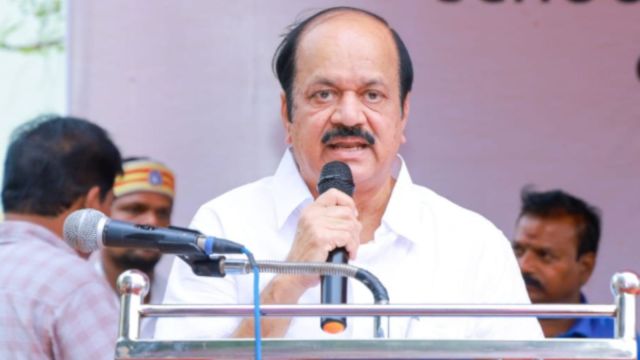
CHENNAI, August 11, 2026: Tamil Nadu Legislative Assembly Speaker JCD Prabhakar joined thousands of Catholics at the fifth National March for Life in Chennai and affirmed the Catholic pro-life movement’s conviction that human life begins at conception.


Prabhakar, 73, a legislator of the ruling Tamilaga Vettri Kazhagam (TVK) representing Thousand Lights, addressed the gathering organised at Stella Maris College by CHARIS India under the aegis of the Catholic Bishops’ Conference of India. Organisers said more than 5,000 people took part in the August 9 event.
The gathering was held around August 10, the date on which India’s Medical Termination of Pregnancy Act was enacted in 1971. The law established a legal framework for abortion and was amended in 2021 to broaden access to termination of pregnancy in specified circumstances.


“Life begins at conception,” Prabhakar told the gathering. “The deep belief of this movement is that the value of a child’s life should not be counted only from the day it is born, but that it should be valued as a life beginning in the womb itself.”
His remarks echoed the Catholic Church’s longstanding teaching that every human life possesses inherent dignity and must be protected from conception. Catholic teaching considers direct abortion morally unacceptable and calls Christians to defend human life at every stage.
‘Every human life is a gift from God’
Prabhakar described human life as a sacred gift and urged Catholics and others to recognise the dignity of unborn children.
“Life is a sacred gift given by God. Every human life is a sacred gift from God,” he said. “The value of a child does not diminish merely because it has not yet been born.”
Reflecting on changes in family life and economic pressures, he recalled the transition from larger families to the family-planning slogans “We two, ours two” and later “We two, ours one”. He argued that changing social attitudes towards family and children had contributed to the circumstances in which abortion became more common.
Prabhakar also shared a personal experience from his own marriage. He said his wife, whom he described as a devout Catholic, became pregnant after the birth of their two sons.
Recalling his initial reaction, he said he had suggested that terminating the pregnancy might make it easier for the family to manage. His wife, he said, rejected the suggestion, telling him that she would accept what God had given her.
Prabhakar said he subsequently consulted a doctor about terminating the pregnancy when it was around three months old. According to his account, his wife opposed the decision and, despite receiving an injection, continued with the pregnancy.
He said the experience had reinforced his conviction that children should be received as gifts rather than viewed only through the lens of economic or social difficulty.
“Children are a gift of grace given by God,” he said.
Call for compassion, not condemnation
While firmly defending unborn life, Prabhakar also stressed that women facing crisis pregnancies should not be subjected to shame or condemnation.
“We should neither shame nor blame a woman for a decision she takes in an extremely difficult situation,” he said. “What she needs is not judgment, she needs support. What she needs is not condemnation, she needs compassion. What she needs is not isolation, she needs a community.”
He called for greater economic security, access to healthcare and protection of women’s education, saying that governments, religious institutions and voluntary organisations have a responsibility to create conditions in which women do not feel compelled to terminate pregnancies because of poverty, lack of support or other social pressures.
The emphasis on accompanying women and families is consistent with the Catholic Church’s wider pro-life approach, which seeks not only to defend unborn children but also to support mothers, families and vulnerable people.
Church position and India’s legal framework
The Catholic Church teaches that human life has inviolable dignity from conception and rejects direct abortion as contrary to the dignity of the human person. At the same time, India’s legal framework permits abortion under specified conditions.
The Medical Termination of Pregnancy Act provides for termination in circumstances including risks to a woman’s physical or mental health, pregnancies resulting from rape and certain cases involving contraceptive failure. For adult women, the law places consent with the pregnant woman.
The Supreme Court of India has also recognised reproductive choice as part of a woman’s bodily autonomy. Its 2022 abortion judgment emphasised that decisions concerning whether to continue or terminate a pregnancy are closely connected to bodily and decisional autonomy.
The Catholic pro-life movement, however, begins from a different moral premise: that the unborn child is already a human life whose dignity does not depend on birth, development, independence or social circumstances.
A politically significant presence
Prabhakar’s participation was noteworthy because he attended the event not simply as a private Catholic or supporter but as Speaker of the Tamil Nadu Legislative Assembly and a legislator of the ruling party.
His remarks, however, did not announce any proposed change to Tamil Nadu’s abortion policy or any move to amend the MTP Act. They were presented as an appeal for respect for human life and greater support for mothers and families rather than as an official government policy statement.
The event brought together bishops, priests, Catholic organisations, students and pro-life advocates to promote what organisers described as a culture that respects and protects human life.
The National March for Life has emerged as a significant Catholic platform for raising awareness about the dignity of unborn children and encouraging Catholics to accompany women and families facing difficult pregnancies.
Concluding his address, Prabhakar called on participants to make protection of life a shared social responsibility.
“Let us respect life,” he said. “Let us protect life. Let us stand by the mother. Let us protect the child’s future. Let us nurture humanity.”
Courtesy: The Indian Express
© 2026 CATHOLIC CONNECT POWERED BY ATCONLINE LLP