
- 10 July, 2026

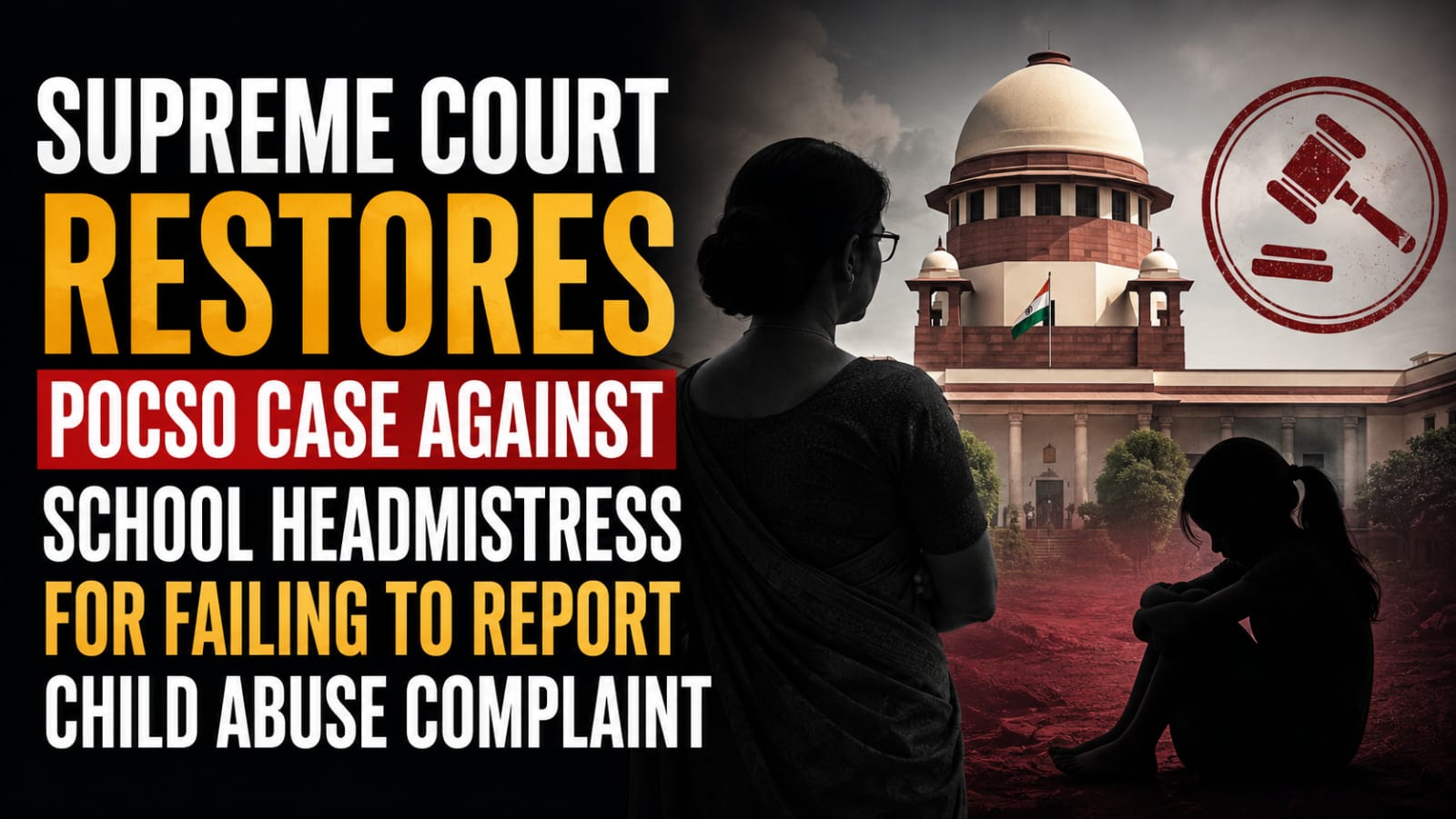
NEW DELHI, July 10, 2026: The Supreme Court has ruled that school authorities cannot avoid criminal liability under the Protection of Children from Sexual Offences (POCSO) Act by conducting their own inquiry into allegations of child sexual abuse instead of reporting them to the police.


In a judgment delivered on July 9, a Bench of Justices Manoj Misra and K.V. Viswanathan restored criminal proceedings against a school headmistress accused of failing to report an eight-year-old student's allegation of rape by a senior student. The Court held that the mandatory reporting requirement under Section 19 of the POCSO Act is triggered when a responsible person receives credible information directly from a child victim.
Setting aside the discharge orders passed by the trial court and upheld by the Gauhati High Court, the Bench observed that a school official cannot escape prosecution by privately "verifying" the allegation and concluding that no offence had occurred.


"When a child victim directly reports sexual abuse, the recipient is deemed to have knowledge of the offence for the purpose of Section 19 of the POCSO Act," the Court held, adding that the law does not permit private investigations before informing the authorities.
The case arose from an appeal filed by the mother of an eight-year-old girl who alleged that her daughter had been sexually assaulted by a Class VIII student. According to the prosecution, the child first informed her elder sister, a friend, the school's Head Girl and later the headmistress.
Instead of reporting the allegation to the police as required under the POCSO Act, the headmistress allegedly questioned the accused student, examined the child herself, monitored the students for several days and concluded that "nothing had happened." She was also accused of instructing the children not to disclose the incident.
Both the trial court and the Gauhati High Court discharged the school authorities, holding that they lacked sufficient "knowledge" of the alleged offence because their internal inquiry and a subsequent medical examination did not conclusively establish sexual assault.
Reversing those findings, the Supreme Court held that the lower courts had incorrectly assessed the defence evidence at the discharge stage, effectively conducting a "mini-trial" instead of determining whether the prosecution had established a prima facie case.
The Bench emphasised that the phrase "has knowledge that such an offence has been committed" under Section 19(1) of the POCSO Act must be interpreted broadly to fulfil the law's objective of protecting children.
The Court observed that requiring independent verification before reporting allegations would undermine the statutory scheme, delay investigations, risk the loss of crucial evidence and defeat the purpose of mandatory reporting. It stressed that any investigation into the truthfulness of an allegation must be carried out by law enforcement authorities after the matter has been reported, not by school officials.
The judgment also clarified that information received directly from a child capable of communicating the allegation should ordinarily be treated as credible for the purpose of triggering the reporting obligation under the Act.
However, the Supreme Court restored proceedings only against the headmistress, holding that she alone had received the complaint directly from the child. It upheld the discharge of the principal, teachers and hostel warden, finding that they had no direct knowledge of the alleged incident and therefore could not be held liable under the mandatory reporting provisions.
The Court also noted that although the victim had initially disclosed the incident to her elder sister, a friend and the school's Head Girl, all three were minors at the time. Under Section 21(3) of the POCSO Act, children are exempt from prosecution for failing to report offences under the Act.
The ruling reinforces the mandatory reporting obligations imposed by the POCSO Act and underscores that institutions entrusted with the care of children must promptly inform law enforcement authorities whenever credible allegations of sexual abuse are brought to their notice.
Courtesy: Live Law.in

© 2026 CATHOLIC CONNECT POWERED BY ATCONLINE LLP