- 03 July, 2026
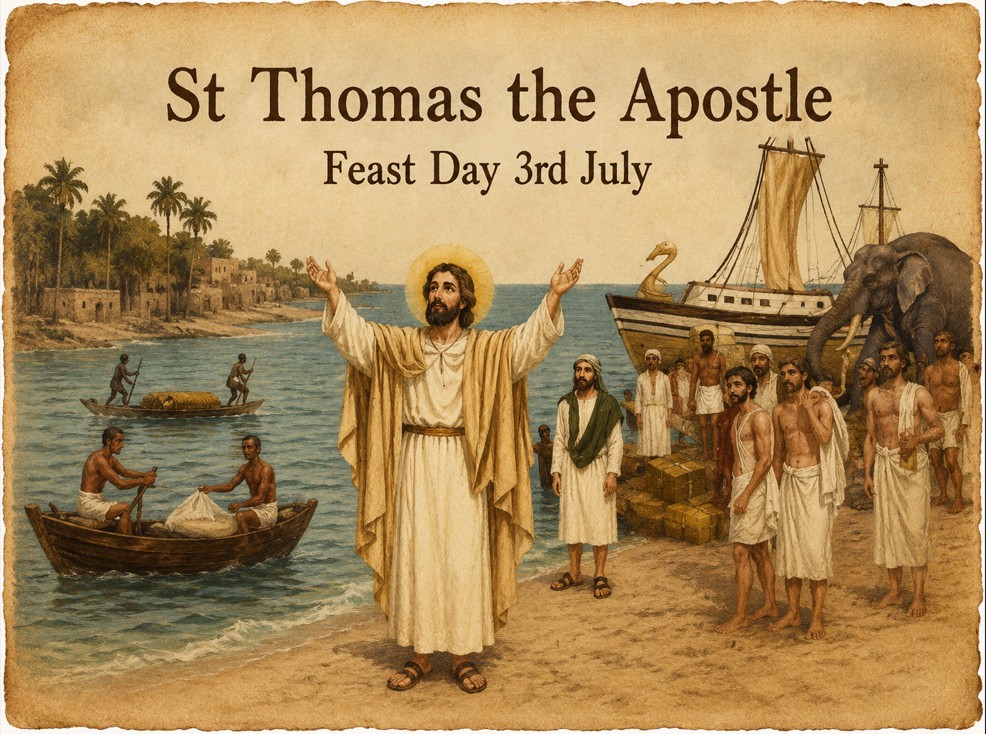
Mylapore, July 3, 2026 : When we think of St. Thomas, many remember him as the apostle who doubted the Resurrection of Jesus. Yet, his story is one of remarkable transformation. The disciple who once sought proof of Christ's victory over death became the fearless missionary who carried the Gospel farther east than any of the other apostles. According to ancient Christian tradition, St. Thomas brought Christianity to India, making the country one of the earliest lands outside the Roman Empire to receive the message of Christ.


His life reminds us that sincere questions can lead to unwavering faith and that God can use even our weaknesses to accomplish extraordinary things.
St. Thomas, also known as Didymus ("the Twin"), was one of Jesus' twelve apostles. Throughout the Gospel of John, he is portrayed as a man of honesty and courage. When Jesus decided to return to Judea despite the danger, Thomas boldly declared, "Let us also go, that we may die with Him" (John 11:16).
At the Last Supper, Thomas asked Jesus how the disciples could know the way to where He was going. This prompted Jesus' timeless response: "I am the way, and the truth, and the life." (John 14:6)


After Christ's Resurrection, Thomas was absent when Jesus first appeared to the apostles. Unable to believe their testimony, he declared that he would believe only after seeing and touching the wounds of the risen Lord. Eight days later, Jesus appeared again and lovingly invited Thomas to touch His hands and side.
Overwhelmed by the encounter, Thomas made one of the greatest professions of faith in Scripture: "My Lord and my God!" (John 20:28)
From that moment onward, the apostle once remembered for his doubt became a fearless witness to the Resurrection.
(CLICK HERE to follow Catholic Connect for regular News and Content)
Ancient Christian tradition holds that St. Thomas arrived on the Malabar Coast of present-day Kerala around A.D. 52. Travelling as a missionary, he preached the Gospel, baptized new believers, and established Christian communities that continue to flourish nearly two thousand years later.
He is traditionally credited with founding several of the earliest churches in Kerala, giving rise to the ancient community known as the St. Thomas Christians or Nasranis. Their rich Christian heritage stands as a testimony to the apostle's missionary work and remains one of the oldest continuous Christian traditions in the world.
St. Thomas' mission demonstrates that Christianity reached India centuries before the arrival of European missionaries. For millions of Indian Christians, he is not only one of the Twelve Apostles but also the Apostle of India, whose preaching laid the foundations of the Church in the country.
Jesus commissioned His apostles to preach the Gospel and heal in His name, and early Christian tradition remembers St. Thomas as a faithful instrument of that mission. Although the New Testament does not record specific miracles performed by him, ancient Christian writings—particularly the Acts of Thomas—describe him healing the sick, casting out demons, restoring people through prayer, and leading many to faith through signs and wonders during his missionary journeys.
These accounts are not part of Sacred Scripture and are not regarded by the Catholic Church as historical records. Nevertheless, they reflect the deep conviction of the early Christian community that God worked powerfully through the apostle's ministry.
Over the centuries, countless pilgrims have journeyed to St. Thomas' tomb in Mylapore, Chennai, seeking his intercession. Many devotees have shared testimonies of answered prayers, physical healing, spiritual renewal, and strength during times of suffering. While the Church has not officially recognized a specific miracle attributed to his intercession, his witness continues to inspire hope and faith among Christians around the world.
After years of preaching across southern India, tradition says that St. Thomas travelled to Mylapore, near present-day Chennai, where he continued proclaiming Christ despite growing opposition.
Around A.D. 72, he was martyred after being pierced with a spear while praying on a hill, now known as St. Thomas Mount. His tomb in Mylapore remains one of India's most revered Christian pilgrimage sites, drawing thousands of pilgrims each year who come to honour the apostle who first proclaimed the Gospel on Indian soil.
The legacy of St. Thomas is woven deeply into the history of Christianity in India. Nearly two thousand years after his arrival, the faith he preached continues to thrive through vibrant Christian communities that trace their origins to his mission.
His life also offers a timeless lesson. Thomas teaches us that faith is not the absence of questions but the willingness to encounter Christ with an open heart. The disciple who once struggled to believe became the apostle who travelled thousands of kilometres to proclaim the Gospel and ultimately gave his life for the Lord he joyfully confessed as "My Lord and my God."
The Church celebrates the Feast of St. Thomas the Apostle on 3 July, honouring the apostle whose missionary zeal brought the Gospel to India and whose courageous witness continues to inspire Christians throughout the world.
As we celebrate his feast, may St. Thomas intercede for us, helping us to grow in faith, courage, and trust in Christ. May his example inspire us to proclaim the Gospel with conviction and to echo his profound confession each day: "My Lord and my God!"
By Catholic Connect Reporter
To know about more saints please visit the spiritual section.
By Catholic Connect Reporter
__________________________
Relevant Keywords
St. Thomas the Apostle, Saint Thomas feast day, St. Thomas India, Apostle of India, St. Thomas Christians, St. Thomas martyrdom, Doubting Thomas, St. Thomas miracles, St. Thomas Mount Chennai, St. Thomas Tomb Mylapore, Christianity in India, July 3 feast day, Saint Thomas biography, St. Thomas Kerala, Gospel in India
© 2026 CATHOLIC CONNECT POWERED BY ATCONLINE LLP