- 12 July, 2026

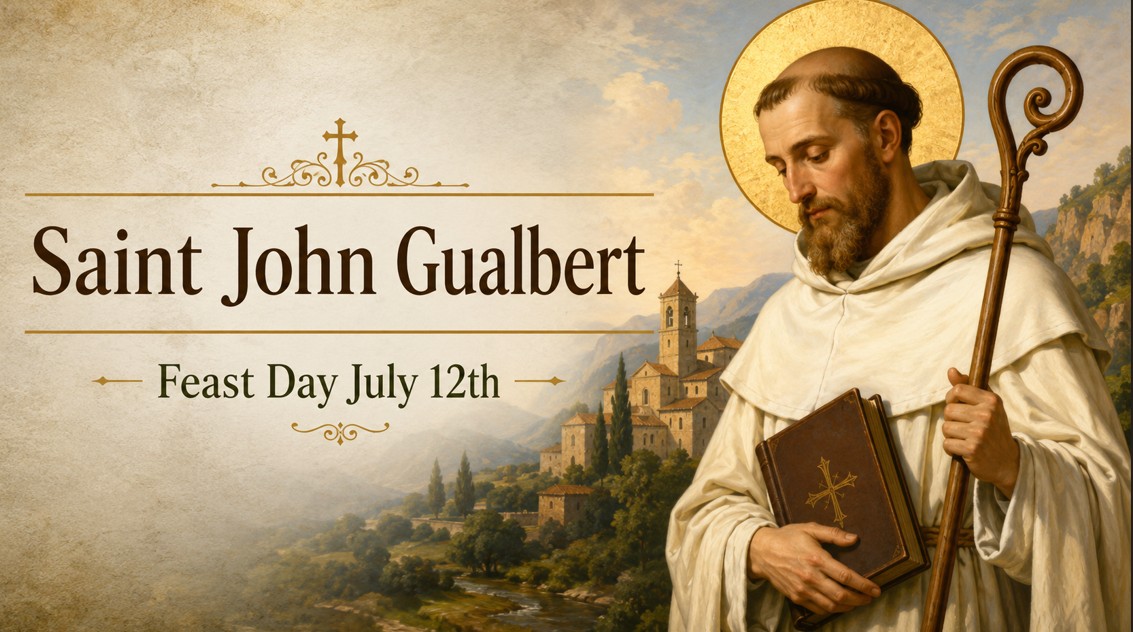
Italy, July 12, 2026: Why is Saint John Gualbert remembered as one of the Church's greatest examples of forgiveness and reform? Discover the extraordinary story of the young Florentine nobleman who spared his brother's killer after seeing him beg for mercy, abandoned a life of revenge to become a monk, and founded a religious order dedicated to prayer, holiness, and the renewal of the Church.


Feast Day: 12 July
Born: c. 985, Florence, Italy
Died: 12 July 1073, Passignano Abbey, Tuscany, Italy
Canonized: 1193 by Pope Celestine III


Patron of: Forest workers, foresters, park rangers, and the Italian Forestry Corps
Known For: His heroic act of forgiveness, founding the Vallombrosan Order, promoting Church reform, and defending integrity within the clergy
Title: Abbot and Founder
Few saints illustrate the transforming power of forgiveness as vividly as Saint John Gualbert.
Born into a wealthy and influential Florentine family, John was raised in a culture where family honor often demanded revenge for wrongdoing.
When his only brother was murdered, John set out to avenge the crime. Yet one encounter on a narrow road changed not only his own life but also the history of the Church.
Instead of taking a life, he chose mercy.
That moment of forgiveness became the beginning of a remarkable journey toward holiness, leading him to found a monastic community that renewed Christian life throughout medieval Italy.
(CLICK HERE to follow Catholic Connect for regular News and Content)
John Gualbert was born around the year 985 into an aristocratic family in Florence.
As a young nobleman, he received training in military skills and leadership, preparing for a life of influence and responsibility.
Like many young men of his social class, he valued courage, loyalty, and family honor.
Everything changed, however, when tragedy struck his family.
The murder of his beloved brother filled John with grief and an overwhelming desire for revenge.
According to tradition, on Good Friday, John unexpectedly came face to face with the man who had killed his brother.
The narrow road left no room for escape.
Seeing John armed and prepared for vengeance, the murderer fell to his knees and stretched out his arms in the form of a cross, pleading for mercy in the name of Jesus Christ.
Moved by the memory of Christ's forgiveness on the Cross, John laid down his sword and forgave him.
This extraordinary act of mercy marked the turning point of his life.
After sparing his brother's killer, John entered a nearby church to pray before a crucifix.
According to long-standing tradition, as he knelt in prayer, the figure of Christ on the crucifix bowed its head toward him in approval of his forgiveness.
The miracle deeply confirmed John's decision to follow Christ completely.
Leaving behind wealth, ambition, and worldly honors, he entered the Benedictine monastery of San Miniato near Florence.
The miraculous crucifix remains one of the best-known traditions associated with Saint John Gualbert.
Although John embraced monastic life wholeheartedly, he became concerned about corruption and abuses that had entered parts of the Church.
Rather than remaining silent, he encouraged monks and clergy to return to lives of holiness, humility, and faithful observance of their religious vows.
His commitment to reform was always rooted in prayer and fidelity to the Gospel rather than personal ambition.
Seeking a stricter form of Benedictine life, John established a new monastic community in the forest valley of Vallombrosa in Tuscany.
The community later became known as the Vallombrosan Order.
The monks devoted themselves to:
Their example inspired many monasteries throughout Italy to embrace renewed spiritual discipline.
Saint John Gualbert lived during a time when simony—the buying and selling of Church offices—was a serious problem.
He firmly opposed such abuses, insisting that Church leadership must be guided by holiness rather than wealth or political influence.
His courage earned both admiration and opposition, yet he remained steadfast in defending the integrity of the Church.
His efforts contributed to the broader movement of ecclesiastical reform during the eleventh century.
Despite his growing reputation, John remained deeply humble.
He cared for his monks as a loving spiritual father, encouraging patience, charity, and obedience.
He believed that genuine reform always begins with personal conversion rather than criticism of others.
Under his leadership, Vallombrosa became a center of prayer and spiritual renewal.
Many sought his advice because of his wisdom, compassion, and holiness.
After decades of faithful service, Saint John Gualbert died peacefully on 12 July 1073 at Passignano Abbey.
His reputation for holiness spread rapidly throughout Italy.
Only 120 years later, Pope Celestine III canonized him in 1193, recognizing his heroic virtues and lasting contribution to the renewal of the Church.
His relics continue to be venerated by the faithful.
Because the Vallombrosan monasteries were established in wooded mountain regions and cared responsibly for forests, Saint John Gualbert later became the patron saint of foresters, forest workers, park rangers, and environmental stewards.
His legacy reminds Christians that caring for creation is also an expression of gratitude to the Creator.
The life of Saint John Gualbert teaches enduring lessons:
His witness reminds believers that one act of forgiveness can transform an entire life.
More than nine centuries after his death, Saint John Gualbert remains one of the Church's greatest examples of mercy and renewal.
He was a nobleman who became a monk, a man seeking revenge who discovered forgiveness, and a reformer who changed the Church through humility rather than power.
From the streets of medieval Florence to the peaceful forests of Vallombrosa, his life proclaims a timeless truth:
The greatest victory is not defeating an enemy, but allowing Christ's mercy to conquer our own hearts.
To know about more saints please visit the spiritual section.
By Catholic Connect Reporter
Saint John Gualbert, Saint John Gualbert feast day, Vallombrosan Order, Saint John Gualbert biography, Catholic saints of Italy, Benedictine reform, Christian forgiveness, medieval saints, monastic founders, Catholic Church reform, foresters patron saint, July saints, Florence saints, Vallombrosa Abbey, Saint John Gualbert miracles

© 2026 CATHOLIC CONNECT POWERED BY ATCONLINE LLP