- 12 October, 2026
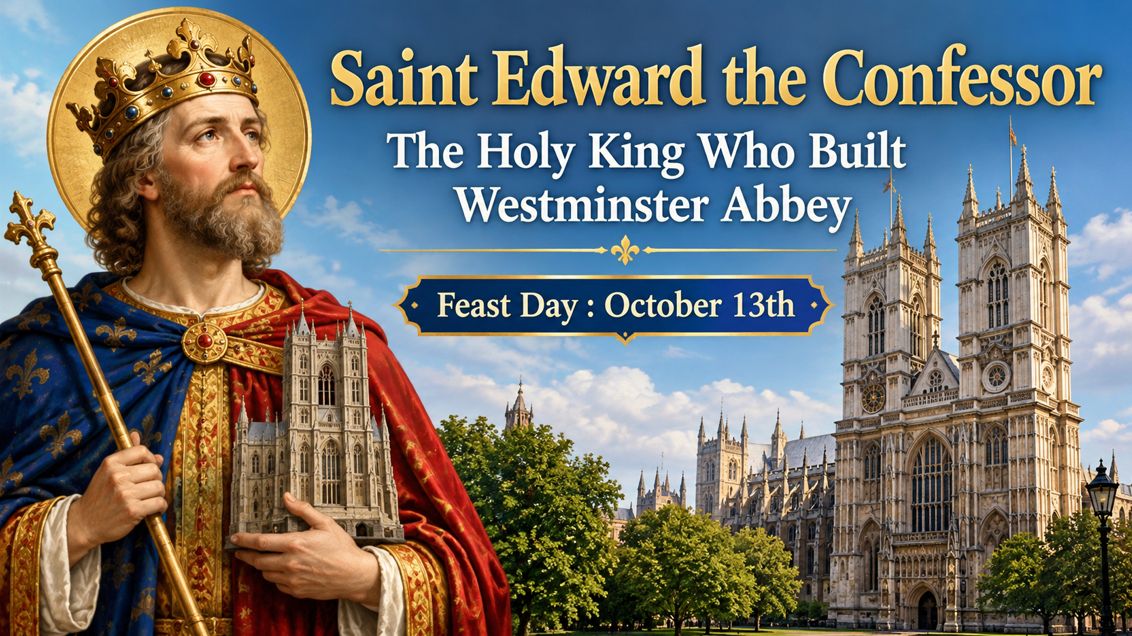
London, 13 October 2026: Can a king be remembered not only for his crown but also for his faith, humility and devotion to God? Saint Edward the Confessor, one of England’s most revered medieval monarchs, is remembered for his personal piety, concern for his people and the founding of the church that became Westminster Abbey. His life offers a powerful example of how leadership can be guided by faith and a desire to serve others.


Feast Day: 13 October
Born: Around 1002–1005, Islip, Oxfordshire, England
Died: 5 January 1066, Westminster, England
Known For: King of England, Christian devotion and the rebuilding of Westminster Abbey
Canonised By: Pope Alexander III in 1161
Patronage: Traditionally regarded as a patron of kings and difficult marriages.
Saint Edward was the son of King Æthelred II of England and Emma of Normandy. During his childhood, Danish invasions forced him into exile in Normandy, where he spent many years away from his homeland. These experiences shaped his life before he eventually returned to England.
(Click Here to follow Catholic Connect for regular News & Content)
In 1042, Edward became king. He was crowned at Winchester in 1043 and ruled England until his death in 1066. Although he inherited a kingdom marked by political tensions, he became known for his religious devotion and personal kindness.
Edward’s Christian faith played a central role in his life. He valued prayer, supported religious communities and sought to govern with a sense of responsibility towards his people.
In 1045, he married Edith, the daughter of the powerful Earl Godwin of Wessex. Their marriage produced no children, and historical accounts portray Edith as an educated and devout woman who supported religious life and learning.
Edward’s reputation for holiness grew during his lifetime. The title “Confessor” distinguishes him from saints who died as martyrs; it honours his faith and religious devotion.
One of Saint Edward’s most enduring achievements was his rebuilding and enlargement of the Benedictine monastery at Westminster. According to tradition, he had promised to make a pilgrimage to Rome but was unable to leave England without neglecting his royal responsibilities. The Pope allowed him to fulfil his vow by establishing or restoring a monastery dedicated to Saint Peter.
Edward’s new church was consecrated on 28 December 1065, shortly before his death. This early Norman church became the foundation of the Westminster Abbey known today, making Edward’s legacy inseparable from one of Britain’s most important religious and historic sites.
Saint Edward died on 5 January 1066 and was buried in the church he had built. His reputation for holiness continued to grow, and Pope Alexander III canonised him in 1161.
On 13 October 1163, his remains were transferred to a shrine at Westminster Abbey. This event established the date that became his principal feast day. His shrine remains an important place of pilgrimage and prayer.
Saint Edward’s life encourages Catholics to place faith at the heart of their responsibilities. His example reminds leaders to practise humility, support the Church and consider the needs of others. He also shows that holiness can be pursued while carrying the demanding duties of public life.
In a world where power is often measured by wealth and influence, Saint Edward offers a different example of leadership. His devotion to God and his lasting contribution to Westminster Abbey continue to inspire Christians to live with integrity, generosity and faith.
Saint Edward the Confessor, pray for us!
To know about more saints and Catholic feast days, please visit the spiritual section.
By Catholic Connect Reporter
Saint Edward the Confessor, Saint Edward feast day, Catholic saints of October, King Edward of England, Westminster Abbey, English saints, Christian kings, medieval Catholic history, faith and leadership, Saint Edward the Confessor biography


© 2026 CATHOLIC CONNECT POWERED BY ATCONLINE LLP