- 08 May, 2026

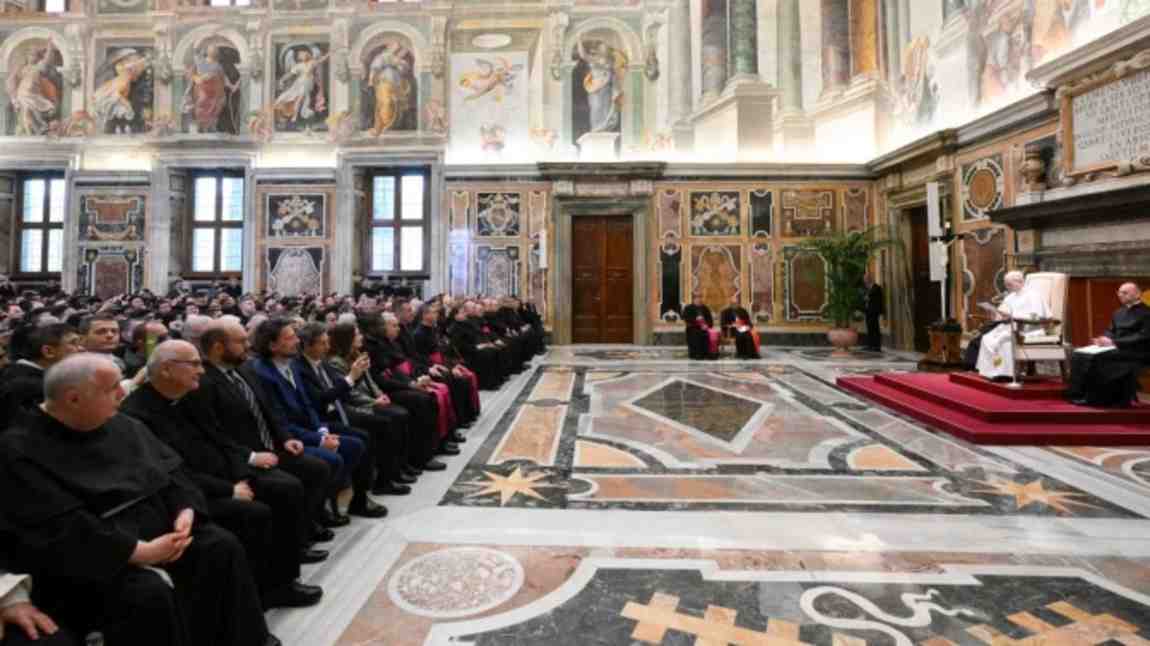
Vatican City, March 16, 2026: “Do those Christians who bear grave responsibility in armed conflicts have the humility and courage to make a serious examination of conscience and to go to confession?” the pontiff asked.


Pope Leo XIV met with priests taking part in the annual course dedicated to the formation of confessors organized by the Apostolic Penitentiary on March 13, 2026, at the Vatican.
On Friday, March 13, Pope Leo XIV made a direct appeal to Christians who hold responsibility in armed conflicts, encouraging them to undertake a serious examination of conscience.


“Do those Christians who bear grave responsibility in armed conflicts have the humility and courage to make a serious examination of conscience and to go to confession?” the pontiff asked while addressing priests involved in the ministry of confession.
The Holy Father’s remarks came in an international climate marked by heightened tensions related to the conflict between the United States and Israel with Iran.
The meeting took place at the Vatican during an audience with priests participating in the annual training course for confessors organized by the Apostolic Penitentiary. Every year, these courses bring together priests from different parts of the world to deepen their understanding of the pastoral practice of the sacrament of penance.
In his address, the pope highlighted the importance of the sacrament of reconciliation, explaining that it serves the mission of restoring a person’s “inner unity.”
That reconciliation produces, he added, “the inner unity of the individual and unity with the Church,” and for this reason “it also promotes peace and unity within the human family.”
During his remarks, Leo XIV noted that the ministry of confession requires closeness, attentive listening, and the ability to spiritually accompany the faithful — particularly in a context shaped by tensions and conflicts.
In a world that, as he described, is experiencing a period of “fragmentation,” the pope stressed that reconciliation helps restore a person’s inner unity, a search that is especially noticeable among young people. He noted that disappointments caused by “unbridled consumerism” or by “a freedom detached from the truth” can become “opportunities for evangelization.”
He also explained that reconciliation with God has an ecclesial dimension. “In the celebration of the sacrament of confession, whilst penitents are reconciled with God and with the Church, the Church herself is edified and enriched by the renewed holiness of her repentant and forgiven children,” he remarked.
Many Christians don’t make use of the sacrament of reconciliation
Leo XIV expressed concern that many baptized individuals do not frequently approach the sacrament of reconciliation, warning that the Church’s “infinite treasure of mercy” risks remaining unused.
During the meeting with priests and candidates for the priesthood attending the annual course for confessors organized by the Apostolic Penitentiary at the Vatican, the pontiff emphasised that although the sacrament can be received repeatedly, this does not necessarily translate into regular practice among the faithful.
“It is as though the infinite treasure of the Church’s mercy remained “unused,” he said, attributing this to widespread distraction among Christians.
According to him, it is common for many faithful to “remain in a state of sin for a long time rather than approaching the confessional with simplicity of faith and heart to receive the gift of the risen Lord.”
The pope also recalled that confession has a long-standing normative tradition in the Church. He referred to the Fourth Lateran Council, which established in 1215 the obligation to go to confession at least once a year. This requirement is also affirmed in the Catechism of the Catholic Church after the Second Vatican Council: “After having attained the age of discretion, each of the faithful is bound by an obligation faithfully to confess serious sins at least once a year” (Code of Canon Law, 989).
During the address, Leo XIV also recalled a teaching of Augustine of Hippo: “He who confesses his sins, and accuses them, does now work with God. God accuses your sins: and if you also accuse, you are united to God.”
The sacrament of reconciliation: ‘A workshop of unity’
Expanding on this idea, the pontiff said the sacrament of reconciliation can be understood as a genuine “workshop of unity.”
“It restores unity with God through the forgiveness of sins and the infusion of sanctifying grace,” he affirmed.
The Holy Father also explained how sin functions, noting that it “does not break unity, understood as the creature’s ontological dependence on the Creator.”
He added that even a sinner remains completely dependent on God the Creator, and recognizing this dependence can open the path toward conversion.
Sin: Turning one’s back on God
Pope Leo explained that sin breaks “spiritual unity with God,” describing it as “turning one’s back” on Him.
He noted that this possibility exists because of the freedom given by God to human beings. Denying that sin breaks unity with God, he said, fails to acknowledge human dignity, since people remain free and responsible for their actions.
Addressing the young priests and candidates for the priesthood present at the gathering, Leo XIV emphasised the importance of the ministry of confession. “Always be keenly aware of the most exalted task that Christ himself, through the Church, entrusts to you: to restore people’s unity with God through the celebration of the sacrament of reconciliation.”
The pope also pointed out that many priests have reached holiness through this ministry, citing examples such as John Mary Vianney, Leopold Mandić, Pio of Pietrelcina, and Michał Sopoćko.
Finally, Leo XIV said that reconciliation is also a path toward peace. “Only a reconciled person is capable of living in an unarmed and disarming way! Those who lay down the weapons of pride and allow themselves to be continually renewed by God’s forgiveness become agents of reconciliation in everyday life. In him or her are fulfilled the words attributed to Francis of Assisi: ‘Lord, make me an instrument of your peace.’”
Before concluding, the pope encouraged the priests to regularly approach the sacrament themselves: “Never neglect to approach the sacrament of reconciliation yourselves, with faithful constancy, so that you may always be the first to benefit from divine mercy.”
Courtesy: EWTN News

© 2026 CATHOLIC CONNECT POWERED BY ATCONLINE LLP