- 05 November, 2026
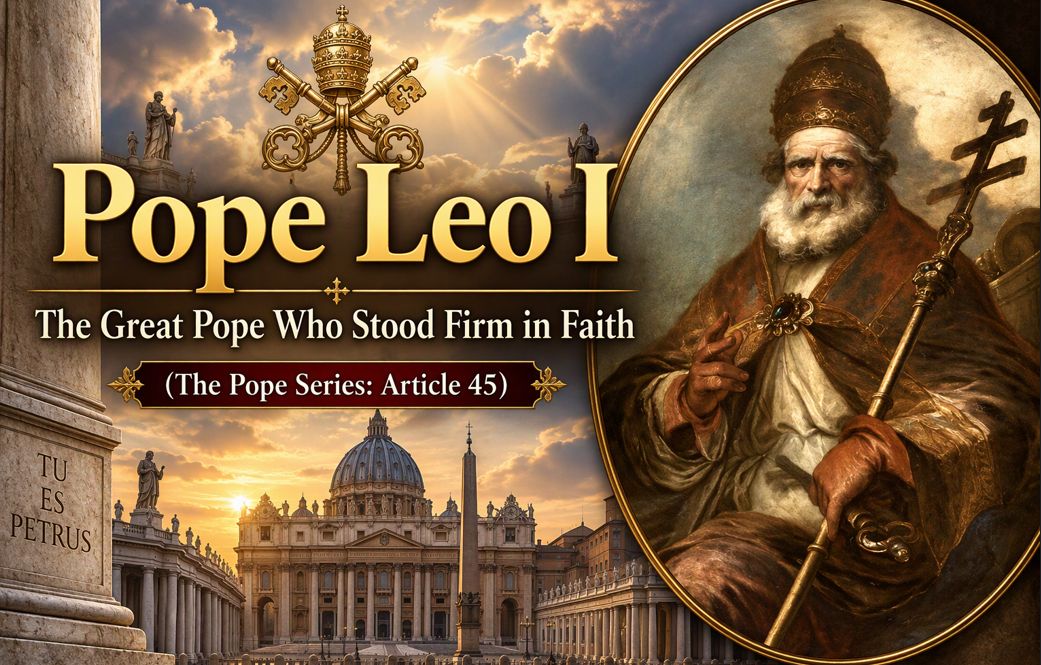
November 5, 2026: Pope Leo I, remembered throughout history as Leo the Great, guided the Catholic Church through one of the most difficult periods of the fifth century. As the Western Roman Empire weakened and theological divisions threatened Christian unity, he became a strong voice for the faith. From defending the true nature of Christ to negotiating with Attila the Hun, Leo demonstrated courage, wisdom and spiritual leadership. He is the forty-fifth successor of St. Peter, led the Catholic Church
Little is known about Leo’s early childhood. He served as a deacon in the Roman Church and became respected for his intelligence, administrative ability and understanding of Christian teaching. Before becoming pope, he was already involved in important Church matters and diplomatic missions.
In 440, while Leo was away in Gaul on a mission to settle a political dispute, Pope Sixtus III died. Leo was chosen as his successor and returned to Rome, where he was consecrated on 29 September 440.
Leo became the 45th pope at a time when the Church needed firm leadership. He believed that the Bishop of Rome had a special responsibility to protect Christian teaching and preserve unity among the churches. His leadership helped strengthen the position of the papacy during a period of uncertainty.
The Western Roman Empire was approaching its final collapse, facing political instability, economic difficulties and invasions. At the same time, disagreements about the nature of Jesus Christ continued to divide Christian communities in the East.
Leo had to address both the spiritual needs of the Church and the dangers threatening Rome and its people.
One of Leo’s greatest contributions was his famous Tome of Leo, a letter written in 449 to Flavian, the Patriarch of Constantinople. It explained that Jesus Christ is one person with two complete natures: fully divine and fully human.
At the Council of Chalcedon in 451, this teaching was received as an authoritative expression of Christian faith. The bishops famously acclaimed, “Peter has spoken through Leo!” His work became a major foundation for Catholic teaching about Christ.
In 452, Attila the Hun invaded northern Italy and threatened Rome. Leo travelled with a delegation to meet him near Mantua. Through negotiation, he helped persuade Attila to withdraw from Italy.
Three years later, when the Vandals under Genseric entered Rome in 455, Leo again negotiated. Although he could not prevent the city from being plundered, he helped secure an agreement against widespread killing and the burning of the city.
Leo promoted charity, supported the poor and strengthened the authority of the Roman See. His sermons and letters addressed Christian life, prayer, responsibility and the importance of remaining faithful to Christ.
Leo faced serious disagreements with Church leaders in the East, particularly over theological disputes and the authority of different patriarchal centres. He also rejected the decisions of the Second Council of Ephesus in 449, which had failed to uphold the Christological teaching he defended.
His firm position strengthened the Roman Church's influence but also contributed to continuing tensions between Rome and Constantinople.
Leo was known for his courage, discipline, intelligence and strong sense of responsibility. His surviving sermons reveal a pastor deeply concerned with the spiritual growth of ordinary Christians. He encouraged humility, generosity, prayer and practical care for those in need.
One of Leo’s best-known spiritual teachings expresses the dignity of Christian life: “Christian, remember your dignity.”
He encouraged believers to live according to the grace they had received through Christ.
In 1754, Pope Benedict XIV declared Leo a Doctor of the Church in recognition of his important theological contribution.
Pope Leo the Great left an extraordinary legacy through his writings, leadership and defence of Christian doctrine. His teaching at the Council of Chalcedon remains central to the Church’s understanding of Jesus Christ. He is also remembered as one of the first popes to receive the lasting title “the Great”.
His legacy continues through the structured life of the Church today, carried forward by his successors.
Leo I reminds Catholics that leadership requires courage, wisdom and faithfulness, especially during uncertain times. His example shows that defending the truth and seeking peace are not opposing responsibilities. His life continues to inspire the Church to remain united in Christ while serving people with compassion.
To know more about the previous Popes, click here
By Catholic Connect Reporter
Pope Leo I, Pope Leo the Great biography, Pope Leo I 440–461, Saint Leo the Great, 45th Pope, Pope Leo I and Attila the Hun, Pope Leo I Tome, Council of Chalcedon 451, Pope Leo I Doctor of the Church, early Catholic popes, Catholic Church history, history of the papacy, Saint Leo feast day
© 2026 CATHOLIC CONNECT POWERED BY ATCONLINE LLP