- 24 August, 2026

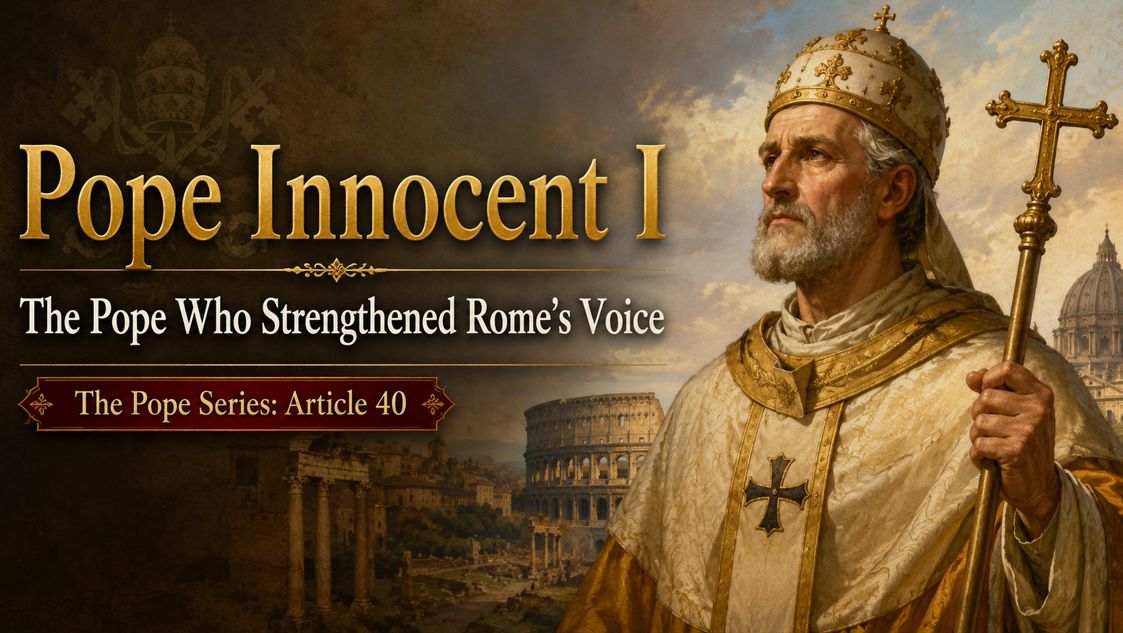
August 24, 2026:Pope Innocent I, the fortieth successor of St Peter, led the Catholic Church from 401 to 417 AD during one of the most turbulent periods of the late Roman Empire. His more than fifteen-year pontificate was marked by theological controversies, questions of Church authority and the dramatic sack of Rome by the Visigoths in 410 AD.


Innocent I is especially remembered for strengthening the role of the Bishop of Rome in defending Church unity and Catholic teaching. Through correspondence with bishops in Gaul, Spain, Africa and other regions, he increasingly presented Rome as an important point of reference in serious ecclesiastical disputes and appeals.
His pontificate unfolded as the Western Roman Empire faced growing political and military instability.


Little is known about Innocent's childhood or education. Ancient tradition associates him with Albano, near Rome, and identifies his father as Innocentius. These details are not certain, but they indicate his connection with the Roman Church.
Before becoming pope, Innocent was already an experienced member of the Roman clergy.
(CLICK HERE to follow Catholic Connect and to stay updated with Catholic News & Content)
Innocent strongly emphasized the Roman See's role in serious ecclesiastical disputes and appeals. His letters demonstrate Rome's growing involvement in questions of doctrine, discipline and Church unity.
Innocent supported the African bishops, including St. Augustine of Hippo, in their opposition to Pelagianism. The controversy concerned original sin, human freedom and the necessity of divine grace.
In 416 AD, African synods appealed to Innocent, who supported their condemnation of teachings he considered contrary to Catholic doctrine. The controversy continued after his death, but his response strengthened Rome's role in defending orthodox teaching.
Innocent also became involved in disputes concerning St. John Chrysostom and other ecclesiastical controversies. His correspondence reflects his concern for communion among Christian communities.
One of the greatest challenges of Innocent's pontificate came in 410 AD when Alaric and the Visigoths sacked Rome.
Innocent was away from the city at the imperial court in Ravenna, where efforts were made to negotiate with Alaric. These efforts were unsuccessful. The fall of Rome demonstrated how deeply the political world around the Church had changed.
Although little is known about Innocent's private spirituality, his surviving correspondence reflects concern for:
The unity of the Church must be protected through fidelity to apostolic teaching.
This is a thematic summary of Innocent's surviving correspondence, not a direct quotation from him.
Pope Innocent I remains significant because he led the Church during a period of enormous uncertainty. His example highlights the importance of unity, responsible authority and fidelity to Christian teaching.
He helped strengthen the voice of Rome while responding to theological disputes and political crisis. His legacy continued through the development of the papacy and the Church leadership of his successors.
Pope Innocent I died in Rome on 12 March 417 AD and is honoured as a saint in the Catholic Church.
To know more about the previous Popes, click here
By Catholic Connect Reporter
Pope Innocent I, Pope Innocent I biography, Saint Innocent I, Pope Innocent I history, Pope Innocent I and St Augustine, Pope Innocent I and Pelagianism, sack of Rome 410, 40th Pope, early Catholic popes, Catholic Church history




© 2026 CATHOLIC CONNECT POWERED BY ATCONLINE LLP