- 12 June, 2026

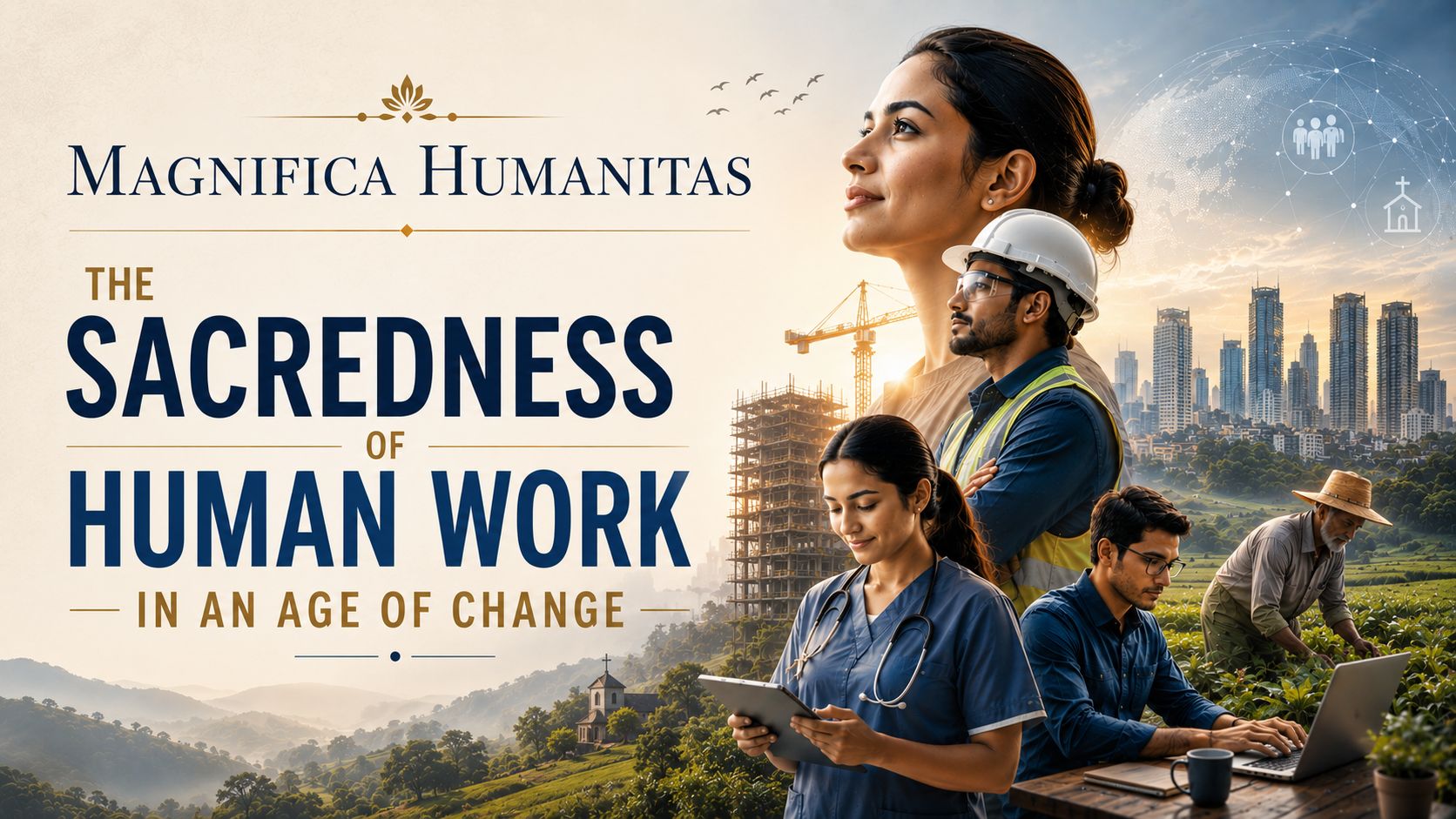
June 12, 2026: Every morning, long before many of us awaken to a new day, millions of people have already begun their work. A migrant labourer boards a crowded bus to a construction site. A nurse completes a sleepless night shift. A farmer studies the sky with hope. A domestic worker quietly enters another home after caring for her own family. A software engineer logs in to a world where the boundaries between work and rest are increasingly blurred.


Different occupations, different circumstances, different dreams and yet all share a sacred vocation. Human work, in all its forms, is far more than a means of livelihood; it is a participation in God's continuing work of creation.
It is against this backdrop that Pope Leo XIV's encyclical Magnifica Humanitas arrives as a timely invitation to rediscover the grandeur of the human person in an age shaped by Artificial Intelligence and rapid technological transformation. Like Rerum Novarum responded to the upheavals of the Industrial Revolution, this new social encyclical speaks to the anxieties and hopes of our own time. It reminds us that progress finds its true meaning only when it serves the human person and safeguards the dignity bestowed by the Creator.


In my ministry among migrants and workers across the country, I have often realized that work is not merely about earning wages. It is about identity, dignity and belonging. A person deprived of meaningful work loses more than income; he or she risks losing hope.
The Hidden Stones
An old story tells of a traveller who admired the grandeur of a magnificent cathedral. He praised its towers and stained-glass windows. An elderly mason who had spent his life working on its foundation quietly said, "People marvel at what rises above the ground, but few remember the stones buried beneath. Yet without those unseen stones, the cathedral would not stand."
Modern society often resembles that cathedral. We celebrate economic growth, digital revolutions and technological achievements, but rarely pause to acknowledge the countless workers whose sacrifices sustain them. Migrant labourers, farmers, domestic workers, sanitation workers, drivers, delivery personnel, nurses and teachers form the hidden foundation upon which society rests.
The Covid-19 pandemic exposed this reality with painful clarity. The sight of migrant workers walking hundreds of kilometres to return home revealed not only their vulnerability but also their indispensable contribution. Those who are often forgotten proved to be the very people holding society together.
More Than Numbers
One of the profound insights of Magnifica Humanitas is that human beings must never be reduced to instruments of production. In an increasingly automated world, there is a danger of measuring persons by efficiency, ratings and productivity alone.
Machines may process information with astonishing speed, but they cannot replace compassion, creativity, conscience and love. These remain uniquely human gifts.
Jesus Himself spent most of His earthly life as a carpenter. The Son of God sanctified ordinary labour. In the workshop of Nazareth, work became an expression of love and service. Every honest occupation, therefore, possesses a sacred character.
The Book of Ecclesiastes reminds us: "It is God's gift that all should eat and drink and take pleasure in all their toil" (Eccl 3:13). Work is not merely a burden to be endured; it is also a gift through which human beings contribute to society and experience the joy of serving others.
Weaving a Common Fabric
A beautiful piece of cloth is made from thousands of threads interwoven together. No single thread can claim importance over another. If one strand is weakened, the fabric itself suffers. Human society is much like that fabric.
The scientist and the street sweeper, the entrepreneur and the fisherman, the doctor and the domestic worker, the engineer and the artisan all contribute to the common good. Their tasks differ, but their dignity remains equal.
Yet many workers continue to live with uncertainty. Informal employment, exploitation, unsafe working conditions and lack of social security continue to affect millions. Women frequently carry a double burden of professional and domestic responsibilities. Young people worry about an uncertain future. Migrants often struggle not only for employment but also for acceptance and recognition.
Our challenge is not merely to create wealth, but to ensure that no one is excluded from sharing in its blessings.
Builders of Jerusalem
Pope Leo XIV presents two contrasting images: Babel and Jerusalem. Babel represents ambition without fraternity; Jerusalem symbolizes communion and a shared destiny.
Every society must choose what it seeks to build.
Whenever labour serves only profit and power, we continue to erect new towers of Babel. But whenever work becomes an expression of solidarity and service, we participate in building Jerusalem the city where humanity discovers its true vocation.
I often think of Nehemiah rebuilding the walls of Jerusalem. Different families worked on different sections, each contributing according to their abilities. No one built the whole wall alone, yet together they restored a broken city.
Perhaps that image speaks powerfully to our own times. The world itself is a great construction site, and every worker is a builder. Farmers nourish life, teachers shape minds, healthcare workers preserve hope, migrants sustain economies, and countless others contribute quietly to the common good.
Towards an Economy with a Human Face
Artificial Intelligence and automation are transforming the world of work. The Church does not fear innovation. But Magnifica Humanitas reminds us that technology must remain a servant, never a master. Progress should liberate people from drudgery, not deprive them of dignity.
Perhaps the most important question before humanity is not whether machines will become more intelligent, but whether we ourselves will remain wise enough to protect the sacredness of human work.
St. Paul offers a beautiful spirituality of labour when he writes: "Whatever your task, put yourselves into it, as done for the Lord and not for your masters" (Col 3:23). Whether one is a farmer in the field, a migrant on a construction site, a teacher in a classroom, or a nurse at a hospital bedside, every honest task acquires a sacred dimension when performed in the spirit of service and love.
In an age fascinated by algorithms and automation, Magnifica Humanitas calls us to recover a simple yet profound truth: work is sacred because the worker is sacred. The future of humanity will not be determined solely by the intelligence of machines, but by our ability to uphold the dignity of every person whose hands continue to build our common home.
Those hands sometimes roughened by toil, frequently unnoticed, but always precious continue to hold our communities together. And in those hands, we may still glimpse the touch of the Creator, who invites humanity to continue His work of love in history.
By Fr. Jaison Vadassery
Executive Secretary, CCBI Commission for Migrants
© 2026 CATHOLIC CONNECT POWERED BY ATCONLINE LLP