- 12 June, 2026

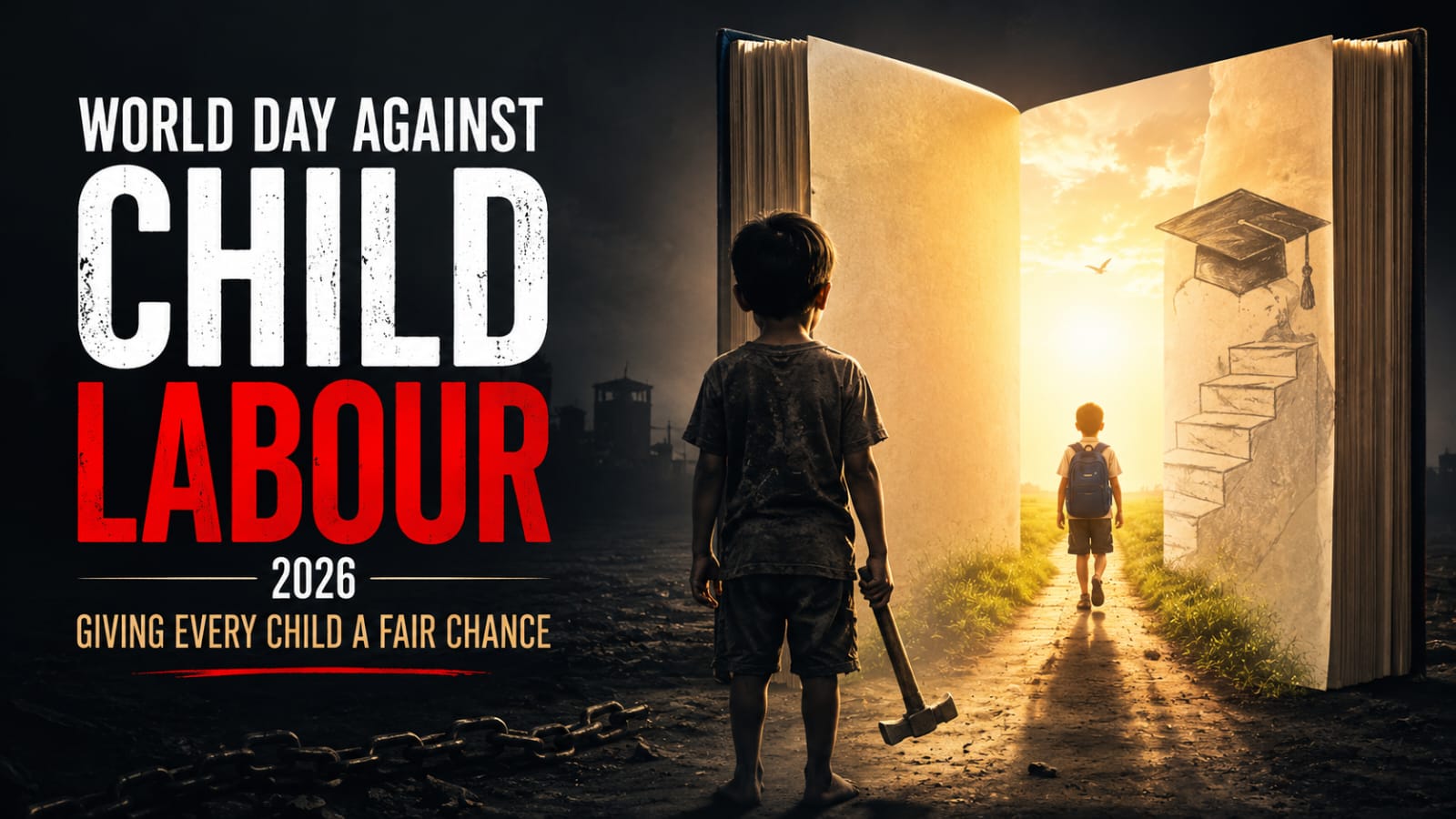
June 12, 2026: Every year on June 12, the world observes the World Day Against Child Labour, a reminder that millions of children continue to spend their childhoods working instead of learning, playing and growing in safe environments. The 2026 observance comes at a crucial moment, as governments, international organisations, businesses and communities reassess their strategies to eliminate child labour and protect children's rights.


This year's global slogan, "Red card to child labour: Fair play for children, decent work for adults," highlights a simple but powerful message: children belong in schools and safe environments, while adults deserve dignified and fairly paid employment.
A Missed Target, A Renewed Commitment
The 2026 campaign follows the Sixth Global Conference on the Elimination of Child Labour, held in Marrakech, Morocco. The conference resulted in the adoption of the Marrakech Global Framework for Action, a renewed roadmap aimed at eliminating child labour by 2030.


The framework arrives after the international community missed Sustainable Development Goal Target 8.7, which sought to end child labour by 2025. The new roadmap reflects a recognition that stronger and more coordinated efforts are needed to address a challenge that continues to affect millions of children worldwide.
The Numbers Behind the Crisis
According to the latest joint estimates from the International Labour Organization (ILO) and UNICEF, 138 million children remain trapped in child labour across the world.
Among them, nearly 54 million children are engaged in hazardous work that directly threatens their health, safety and overall well-being. These are children working in conditions that can expose them to physical injury, long-term health problems and dangerous environments.
The burden is not evenly distributed. Sub-Saharan Africa remains the region most affected by child labour, accounting for nearly two-thirds of all cases, or approximately 87 million children.
At the same time, there are signs of progress. Asia and the Pacific have recorded significant improvements, reducing child labour prevalence from 6 per cent to 3 per cent, demonstrating that targeted interventions can produce meaningful results.
India's Continuing Challenge
India has made significant progress in reducing child labour over the past two decades, yet the challenge remains substantial. According to the 2011 Census, India had 10.1 million working children aged 5–14 years, representing 3.9 per cent of the country's total child population. The number declined by 2.6 million between 2001 and 2011, indicating steady progress in curbing child labour.
However, concerns remain over children who continue to work in both rural and urban areas, often at the cost of their education and well-being. Poverty, inequality, limited educational opportunities and social vulnerabilities continue to contribute to child labour. The close link between education and child labour is also evident, with millions of children remaining outside the formal education system.
(CLICK HERE to follow Catholic Connect for regular Catholic News & Content)
Where Child Labour Happens
Child labour is often associated with factories and industrial workplaces. However, global data shows that 61 per cent of all child labour cases occur in agriculture, making it the largest sector. The services sector accounts for 27 per cent, including domestic work and market vending, while industry accounts for 13 per cent, including manufacturing and mining.
Understanding the Root Causes
The ILO emphasises that child labour is often a symptom of wider systemic challenges. A lack of decent work for adults, weak social protection systems and barriers to quality education continue to push children into the workforce. Families facing economic hardship are often forced to rely on children's labour for survival, while limited access to affordable and quality education increases the risk of children dropping out of school.
From Prohibition to Prevention
The Marrakech Global Framework for Action calls for a shift from simply prohibiting child labour to preventing it. Key priorities include strengthening child protection systems, increasing business and supply-chain accountability, and using location-based risk mapping to direct assistance to vulnerable communities.
As the world marks World Day Against Child Labour 2026, the message is clear: ending child labour requires more than laws. It demands decent work for adults, stronger social protections and accessible education. For India and the rest of the world, only then can every child be given a fair chance at a safe and fulfilling childhood.
By Catholic Connect Reporter




© 2026 CATHOLIC CONNECT POWERED BY ATCONLINE LLP