- 14 October, 2026

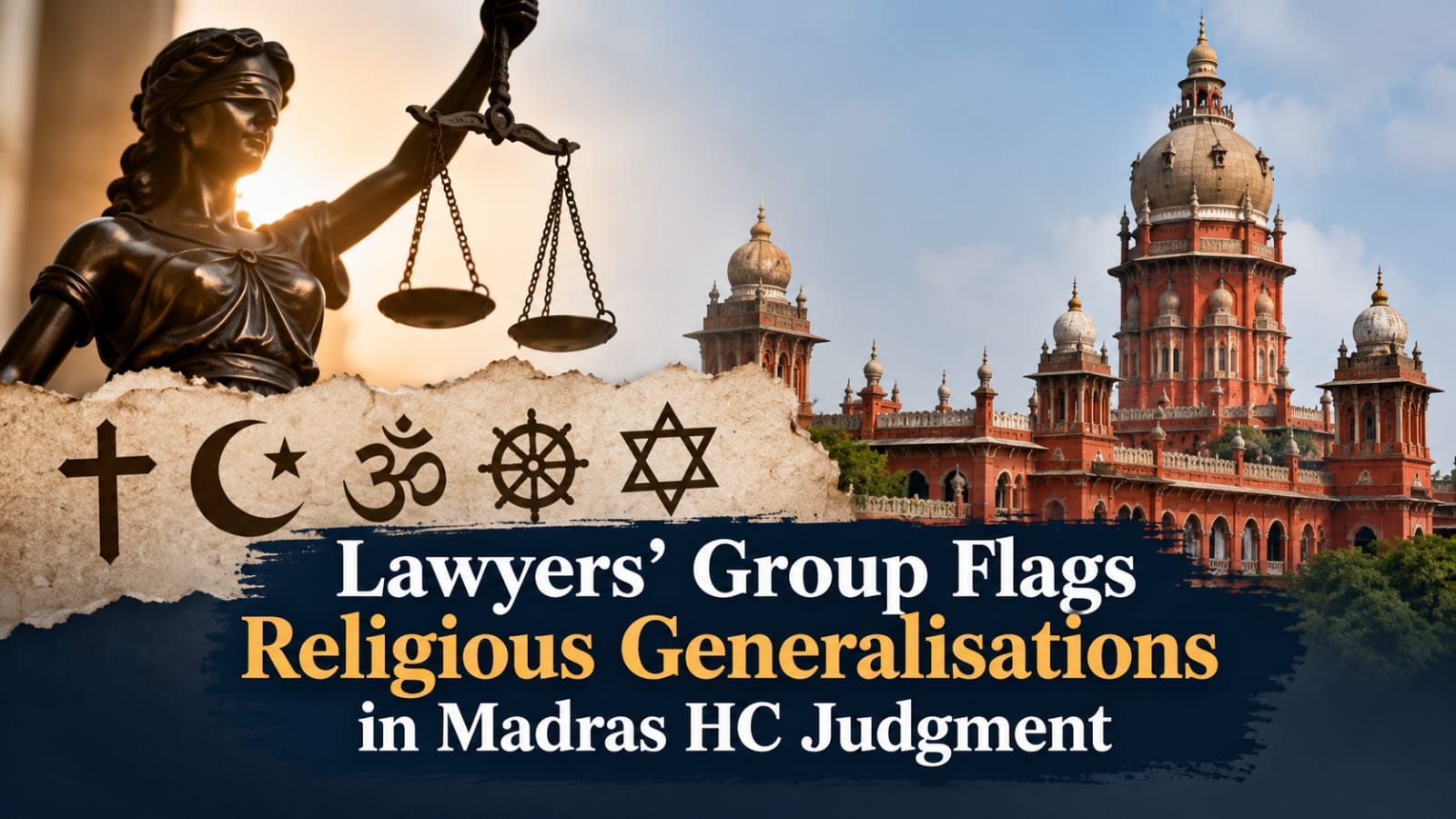
CHENNAI, October 14, 2026: Lawyers Fraternity-TN has questioned religious generalisations in a recent Madras High Court judgment, urging the Chief Justice to examine their relevance to the case and their implications for constitutional secularism, religious neutrality and judicial restraint.



A representation submitted by the group’s convener, A. Santhanam, concerns the October 6 judgment in Kanzeon Public Charitable Trust v. Union of India, delivered by Justices G.R. Swaminathan and M.D. Sumathi at the court’s Madurai Bench. A copy was also sent to the Chief Justice of India.
The representation takes issue with observations concerning Christianity, Abrahamic religions, religious conversion, the origins of Zen philosophy and Jewish communities. It argues that these broader characterisations were unnecessary to determine whether the Trust had correctly disclosed its religious character in its application for registration under the Foreign Contribution (Regulation) Act (FCRA).
Santhanam clarified that the representation was not intended to question the court’s authority, seek an administrative review of the judgment or attribute personal bias to the judges. He said it was submitted in the interest of constitutional values, religious freedom and the rule of law.
Questions over remarks on Christianity
The representation specifically questions paragraph 6 of the judgment, which describes Christianity as a messianic religion whose mission is to bring everyone within the fold of Jesus Christ. It also refers to the judgment’s characterisation of Hinduism as inclusive and Abrahamic religions as inherently exclusive, alongside the proverb, “a leopard will not change its spots”.
It further takes issue with the judgment’s observation that devout Jews, Christians and Muslims believe their faith represents the one true and complete revelation because their respective holy books say so.
According to Santhanam, these statements amount to broad theological generalisations rather than findings required to resolve the statutory dispute. The representation questions the relevance of the Trust founder’s religious identity and general comments about followers of particular faiths to determining the organisation’s eligibility for FCRA registration.
It also argues that expressions such as “nagging doubt” and the proverb about a leopard’s spots could convey a negative impression of Christians and followers of other religions.
Citing the Supreme Court’s ruling in S.R. Bommai v. Union of India (1994), the representation stresses that constitutional secularism requires the State to maintain religious neutrality and treat all faiths equally. It recalls the court’s formulation that the State is “neither pro particular religion nor anti particular religion”.
Conversion and religious identity
The representation also challenges the necessity of the judgment’s observation in paragraph 10: “We specifically highlight the issue of conversion because radical Christian Institutions are notorious for indulging in such activities. We hasten to clarify that we do not accuse the appellant of having any such agenda.”
Santhanam questions the relevance of the generalisation, particularly because the judgment explicitly states that the Trust is not accused of pursuing such an agenda.
The representation distinguishes between the right to change one’s religion, the propagation of religious beliefs and unlawful conversion, arguing that these are separate issues requiring different legal assessments. It maintains that findings concerning unlawful conversion should ordinarily rest on evidence of specific conduct rather than broad assumptions about religious concepts or institutions.
The judgment also refers to Section 12(4)(a)(ii) of the FCRA and states that the provision applies to all religious organisations, citing a fundamentalist Hindu organisation engaged in “Ghar Wapsi” as an example.
Objection to reference to Zen’s origins
Santhanam has also questioned the relevance of the judgment’s observation that “Zen philosophy is of Chinese origin” in considering the Trust’s claim to FCRA registration.
The representation argues that the historical or geographical origin of a religious or philosophical tradition does not, by itself, establish whether an organisation meets the statutory requirements governing foreign contributions. It raises concerns that a broad interpretation of the observation could disadvantage Indian organisations that teach, practise or preserve traditions originating outside the country.
While acknowledging the State’s authority to regulate foreign contributions in the interests of national integrity and security, the representation cautions against treating the foreign origins of religious or philosophical ideas as grounds for suspicion.
It also raises the question of whether such an approach would be consistent with Article 14 of the Constitution, which guarantees equality before the law.
Questions over remarks on Jewish communities
The representation further questions a passage in paragraph 9 concerning Jewish communities and their influence in countries where they settled.
The judgment states: “Let us take the example of Jews. The Jews were driven out of their homeland. They settled all over the world. They acted as effective pressure groups in each country where they were. The Bharatiya diaspora can play a similar role.”
Santhanam argues that the observation has no apparent connection with the dispute over the Trust’s FCRA application, which concerned the classification of the organisation and the accuracy of its disclosures.
The representation also cautions that broad statements about religious and ethnic communities can acquire significance beyond the immediate case and may subsequently be cited as judicially expressed propositions. It urges particular care when making such generalisations in judicial reasoning.
Calls for judicial restraint
To support his concerns, Santhanam cites the Supreme Court’s ruling in State of U.P. v. Surendra Kumar Solanki (2007), which emphasised that unnecessary observations should not be made while deciding a case. The representation notes that the Supreme Court had directed the deletion of general and sweeping observations that were not required for adjudication.
It also draws attention to the judgment’s statement that “It is not within our province to engage in such debates. They have to be waged elsewhere”, arguing that the subsequent theological discussion appears difficult to reconcile with this principle of restraint.
The representation questions the use of the expression “unfettered discretion” in paragraph 12, where the judgment states that “considerable leeway and unfettered discretion should be given to the authority in the matter of granting or refusing registration under Sections 11 and 12 of the FCRA, 2010.”
Santhanam submits that statutory discretion, however broad, remains subject to the governing law, relevant considerations, constitutional guarantees, reasoned decision-making and judicial review.
Seeks institutional consideration
The representation acknowledges that the judgment’s central legal reasoning concerned the Trust’s disclosure of its religious character and the court’s finding that Zen Buddhism falls within the broader Buddhist religious tradition.
Santhanam argues that the statutory issue could have been decided without wider observations about Christianity, Judaism, Islam and Hinduism or the founder’s personal religious identity.
He has requested that the concerns be placed on record and considered within the appropriate constitutional and institutional framework. The representation also urges consideration of institutional guidance, including a possible circular, to ensure that observations about religious, ethnic and philosophical communities are confined, as far as possible, to matters necessary for adjudication and supported by the evidence and legal framework of each case.
Santhanam clarified that questions concerning the correctness of the judgment and any expunging or modification of its observations should be pursued through the appropriate judicial forums and remedies available under law. He reiterated that the representation was not a personal allegation against the judges.
The representation concludes that judicial independence and dignity are indispensable to the constitutional order, while public confidence in the judiciary is strengthened when decisions involving religion and minority rights remain anchored in statutory provisions, evidence and constitutional principles.
By Catholic Connect Reporter

© 2026 CATHOLIC CONNECT POWERED BY ATCONLINE LLP