- 14 October, 2026

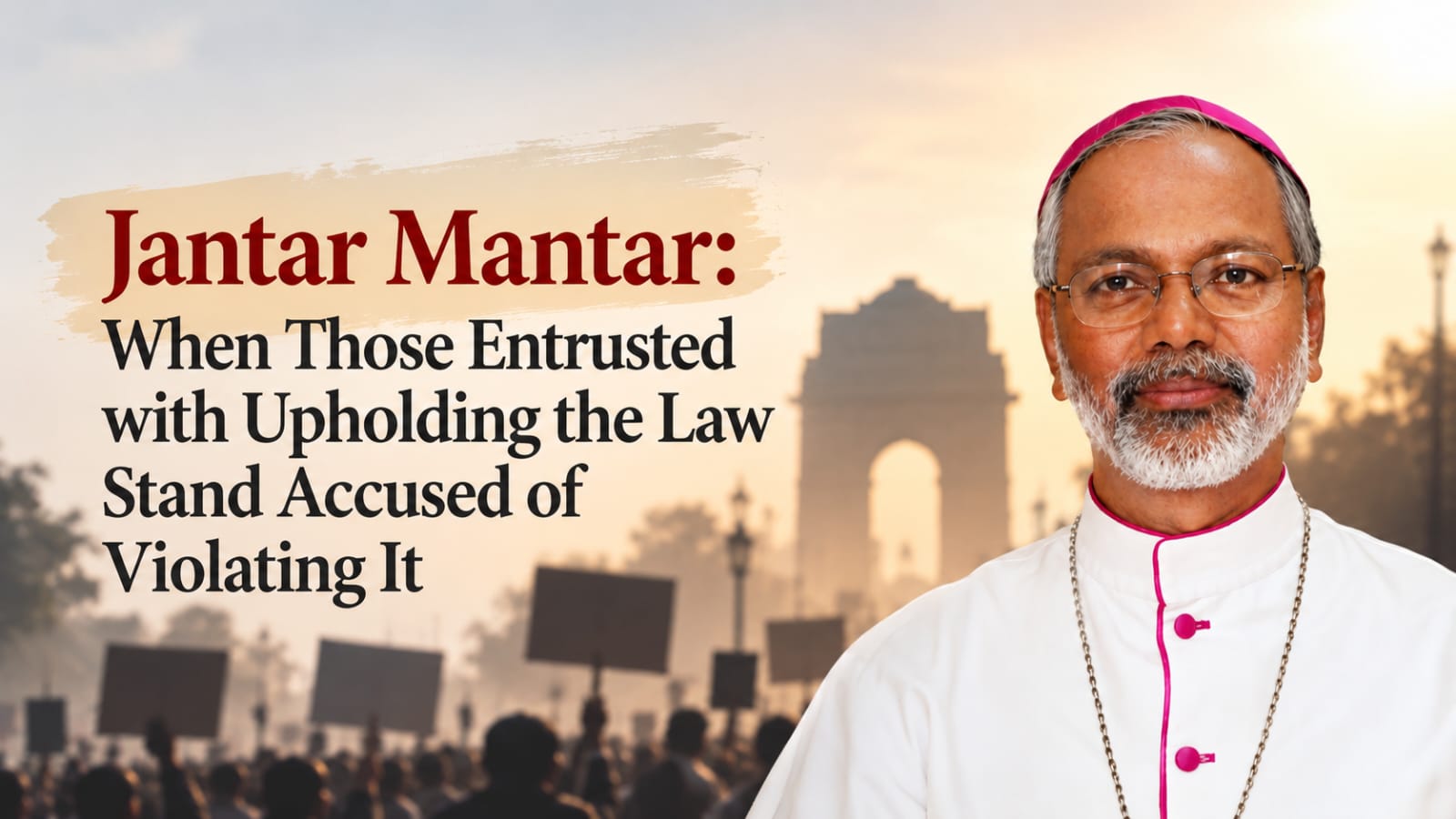
14 October 2026: In the midst of what is unfolding in our country, should the Church remain a silent spectator and speak only about spiritual matters? As I wrestled with this question, I asked myself: What would Jesus do in such a situation? I was reminded of how Jesus stood up for the vulnerable and challenged injustice, particularly when it affected women and children. I was also reminded of God’s words to the prophet Jeremiah (1:17): “But you, gird up your loins; arise, and say to them everything that I command you. Do not be dismayed by them, lest I dismay you before them.” It was then that I decided to speak up once again.



The events surrounding the protests at Jantar Mantar from 10 October 2026 to the present raise disturbing questions about democracy, police accountability, women’s safety and the independence of constitutional institutions in India. What should have been an occasion for citizens to exercise their democratic right to protest has instead become a matter of grave concern, with serious allegations being raised about the conduct of the authorities and those allegedly acting in concert with them.
The central question is stark: What happens to democracy when those entrusted with enforcing the law are themselves accused of violating it? Reports of a crackdown on protesters, including mass detentions and restrictions on movement, have intensified concerns about the government’s response to dissent. The scale of the force deployed appeared less like routine crowd control and more like a full-scale military operation to defend India’s borders against an invading army. Was this overwhelming show of force intended to protect citizens or to crush them into submission? If the allegations are substantiated, these events would represent a deeply troubling reversal of the police’s fundamental duty to uphold the law.
For many observers, one of the most disturbing aspects of the events was the alleged conduct of the police. There were accusations that officers without clearly visible identification badges acted against protesters, raising serious questions about accountability and the ability to identify individual personnel responsible for misconduct.
Even more troubling are allegations that individuals described as goons, apparently without uniforms or official identification, operated alongside the police. If private individuals were permitted to intimidate, assault or molest protesters in the presence of law-enforcement personnel, who authorised their actions, and who will hold them accountable?
The most disturbing allegations concern the treatment of women. Videos circulating on social media have reportedly shown women being beaten and molested, while police personnel allegedly failed to intervene decisively. Some accounts suggest that, when officers did intervene, they appeared to escort the alleged perpetrators away gently rather than restrain them firmly. If these accounts are substantiated, such conduct would constitute a shocking betrayal of the police’s duty to protect citizens.
The reported absence of visible identification badges on some officers, coupled with the presence of unidentified men in civilian clothes, raises another troubling question: Was accountability being compromised, and will the authorities take concrete steps to establish the identities of those involved?
Serious questions also arise about the possible coordination or complicity of various actors, including sections of the television media, political leaders of the BJP — particularly the Prime Minister and the Home Minister — men in civilian clothes, the police and the Election Commission. These are grave concerns that demand evidence-based investigation rather than assumptions. Allegedly misleading television coverage, where it occurs, can distort public perception, discredit legitimate protests and provide political cover for the excessive use of force.
The perception that institutions established to serve the people are instead serving the interests of the ruling party is deeply damaging to democracy. Constitutional institutions must be, and must be seen to be, independent of partisan political interests. The Election Commission must demonstrate its independence through impartial action, transparency and accountability, not merely through assurances. The government, too, must address legitimate questions openly rather than allowing dissent to be portrayed as disloyalty.
Allegations that the police acted contrary to Supreme Court directions warrant urgent judicial scrutiny. If credible evidence indicates that court orders or fundamental rights were violated, the Supreme Court should consider whether to take suo motu cognisance or adopt other appropriate measures to ensure accountability.
Failure to address credible allegations of serious violations risks eroding public confidence in the judiciary. The Court has a vital constitutional responsibility to safeguard fundamental rights and ensure that the law applies equally to everyone, regardless of who holds political power. No public authority should be beyond judicial scrutiny.
The comparison made on social media with the Emergency imposed by Indira Gandhi in 1975 is difficult to avoid. That period witnessed the curtailment of civil liberties, censorship and the imprisonment of political opponents. The Emergency was formally declared, making the extraordinary concentration and exercise of state power explicit.
The present situation, as critics perceive it, raises a different but equally disturbing concern: the possibility of democratic freedoms being eroded without a formal suspension of the constitutional order. Democratic institutions remain in place, elections continue and constitutional freedoms are formally recognised, even as allegations of intimidation, excessive force and the suppression of dissent persist.
The danger is that practices incompatible with a healthy democracy may gradually become normalised, while those responsible evade accountability. This is not to suggest that the Emergency of 1975 was less oppressive or that the two situations are identical. Rather, the concern is that the gradual erosion of democratic safeguards can be harder to recognise and resist than overt authoritarianism.
A democracy does not remain healthy merely because elections are held and constitutional institutions continue to exist. It also depends on the effective protection of civil liberties, the independence of public institutions, a free media and the ability of citizens to question, without fear, those who govern them.
The events at Jantar Mantar demand an independent and impartial investigation, accountability for every offence established by the evidence, protection for victims and transparency from the police, the government and the Election Commission. Political affiliation must neither shield the guilty nor condemn the innocent.
The police must protect citizens, not intimidate them. The media must inform, not mislead. Constitutional institutions must defend the Constitution, not accommodate those in power.
India’s armed forces stand guard at the nation’s borders to defend it against external threats. Yet the scale of the force reportedly deployed against fellow citizens at Jantar Mantar appeared as though the protesters were an invading enemy — an army to be subdued rather than citizens whose rights deserved protection. If this characterisation reflects the reality of what occurred, it represents a tragic inversion of the state’s duty: instead of protecting its people, the machinery of the state appears to have been turned against them.
India’s borders deserve protection, but so do its citizens, its women, its democratic freedoms and its constitutional institutions. National security and the protection of civil liberties are not competing responsibilities; both are essential duties of a democratic state.
A government entrusted with the machinery of the state has a fundamental obligation to protect the people, including those who criticise it, oppose it or peacefully protest against it. When citizens fear the very authorities charged with safeguarding their rights, the government must confront that failure with honesty and accountability.
Ultimately, the question is not whether the state has the power to suppress a protest. It is whether that power is being exercised lawfully, proportionately and in the service of the people.
Is the government protecting the nation, or is the machinery of the state being used to protect the political interests of those in power? That is the question the events at Jantar Mantar demand that every democratic institution confront.
By Bishop Savio Fernandes
Auxiliary Bishop, Archdiocese of Bombay


© 2026 CATHOLIC CONNECT POWERED BY ATCONLINE LLP