- 18 March, 2026
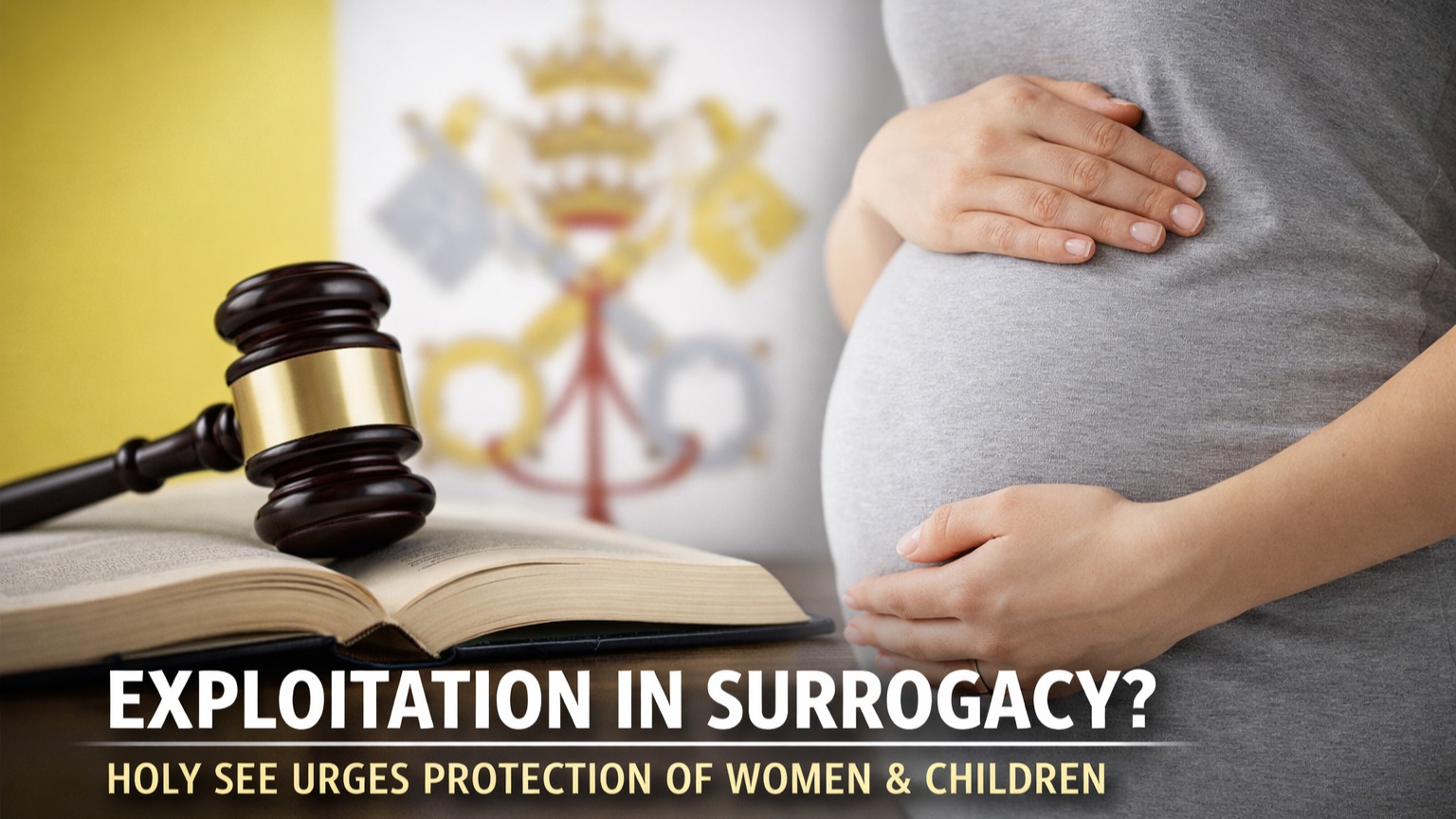
Vatican, Mar 18, 2026: The Permanent Mission of the Holy See to the United Nations has highlighted the risks of exploitation in surrogacy, describing it as a field where “technology and practice have run laps around the law and ethics,” while calling for stronger efforts to address related violence and uphold the dignity of women and children. The statement was issued during a side event at the 70th Commission on the Status of Women on “Protecting Women and Children: Combating Violence and Exploitation in Surrogacy.”

A debate at the Commission on the Status of Women
The statement begins by acknowledging the partners involved in the initiative — the Governments of Italy, Türkiye, and Paraguay — and highlights the issue as “urgent,” noting that “the technology and practice have run laps around the law and ethics.”
While recognising that some consider surrogacy “a compassionate solution for those wishing to be parents,” the statement stresses the importance of evaluating the broader context to determine whether it aligns with “respect for the dignity and rights of women and children.”



Economic pressures and risk of exploitation
The statement points to economic factors as a significant concern. It notes that many women who choose to become surrogates do so primarily due to financial necessity. It further observes that instances of affluent individuals commissioning surrogates are common, whereas wealthy women rarely act as surrogates themselves.
It adds that the demand for children through surrogacy already surpasses availability, and suggests that improved access to social protection, education, and economic opportunities could reduce exploitation, potentially leading many women to decline such arrangements.
The statement raises the question of whether the surrogacy industry would continue to exist if poverty were eliminated.
It also highlights that in regions where commercial surrogacy is allowed, prospective surrogates may be drawn into unhealthy competition for commissioning parents. Even in places where commercial surrogacy is banned, payments may be concealed under the guise of expense reimbursements or “gifts.”
Additionally, it notes that some women may be influenced or compelled by family members to enter such agreements, and those in financially vulnerable situations often lack access to independent legal or medical counsel.
(Also Read: Pope Leo XIV: Protecting minors is essential for life of the Church)
The rights of children
The statement references specific instances where more than a dozen infants were found being cared for by nannies in rented accommodations while commissioning parents continued to engage additional surrogates.
It further warns that treating children as commodities can intersect with discriminatory attitudes, particularly in cases involving prenatal diagnoses of disabilities. In such situations, children may be regarded as defective or problematic rather than welcomed.
According to the statement, this perspective conflicts with the principles of a just society where children are allowed to grow and thrive. It emphasises that children have inherent rights and interests that must be upheld, including “a moral right to be created in an act of love.”
Referring to the Convention on the Rights of the Child, described as “the most widely ratified human rights instrument,” the statement reiterates that children have “a right to know and be cared for by their parents.”
It adds that the inability to fulfil this right in certain cases should not be used to justify practices that intentionally undermine it.
The position of the Holy See
While acknowledging the genuine and understandable desire of individuals to have children, the statement argues that such concerns cannot be adequately addressed through regulation alone.
In this regard, it welcomes the decision of the Hague Conference on Private International Law to pause further work on a convention addressing legal parentage in surrogacy cases.
The statement concludes by recalling a recent remark by Pope Leo XIV, who stated that “by transforming gestation into a negotiable service, [surrogacy] violates the dignity both of the child, who is reduced to a ‘product,’ and of the mother, exploiting her body and the generative process, and distorting the original relational calling of the family.”
It also cites Pope Francis, who said that “a child is always a gift and never the basis of a commercial contract.”
In conclusion, the Permanent Mission expresses hope that discussions within the Commission will lead to further action “toward ending this practice in all its forms and at all levels,” aiming to protect women and children “from exploitation and violence.”
(Also Read: Pope Leo To Receive Liberty Medal For Promoting Religious Liberty)
Courtesy: Vatican News
© 2026 CATHOLIC CONNECT POWERED BY ATCONLINE LLP