- 21 April, 2026

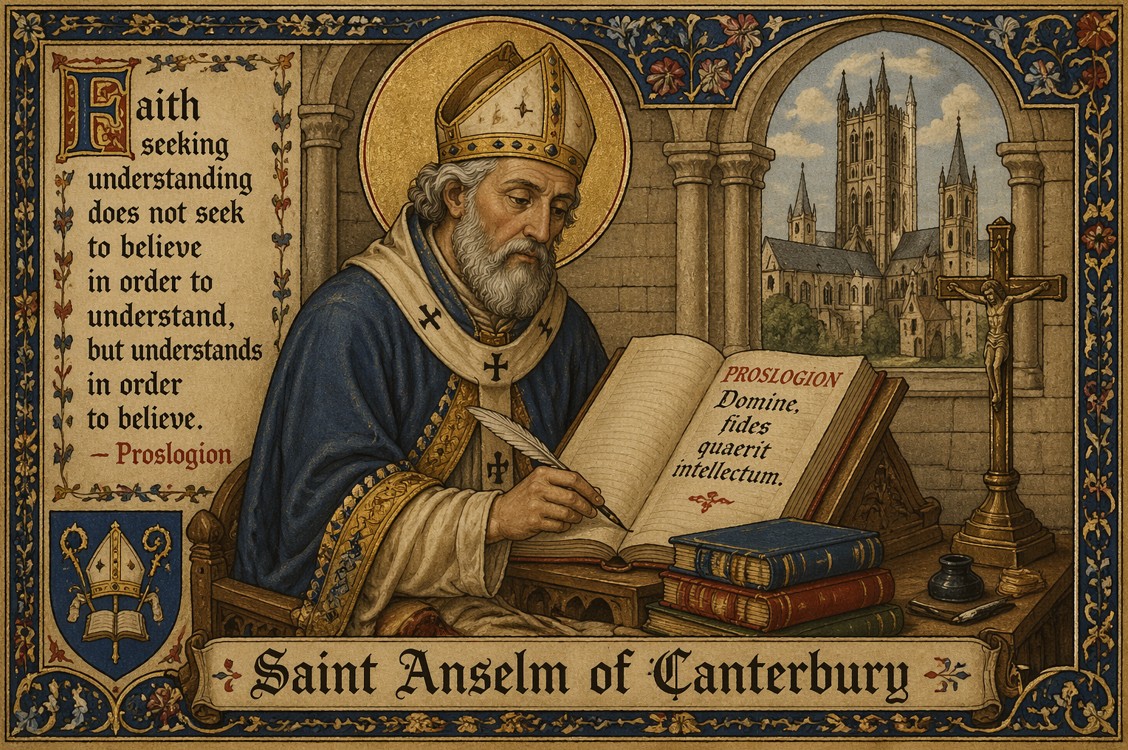
Canterbury, April 21, 2026 — Discover Saint Anselm of Canterbury, the brilliant theologian who united faith and reason. Learn about his feast day (April 21), life, philosophy, and spiritual legacy.

Feast Day: April 21
Born: c. 1033, Aosta, Italy
Died: April 21, 1109, Canterbury, England
Title: Archbishop of Canterbury, Doctor of the Church


Known for: Founding Scholasticism, ontological argument for God’s existence
Patron of: Theologians, philosophers
What happens when someone loses their faith—and then rediscovers it?
Saint Anselm did not begin as a perfect saint.
As a young man, he desired religious life, but family opposition forced him into a different path.
After his mother’s death, he drifted.
For a time, he lived without direction or deep faith.
But something inside him remained restless.
He was searching for truth.
At age 23, Anselm made a bold choice.
He left everything behind.
Crossing mountains and countries, he entered a Benedictine monastery in Normandy.
There, his life transformed.
He became known for:
Deep prayer
Intellectual brilliance
A passion for understanding God
His journey shows that faith is not always immediate—but it can be rediscovered with even greater depth.
Anselm was not just a monk.
He was a thinker who changed Christian theology forever.
He asked a powerful question:
Can we understand God through reason?
His answer led to one of the most famous ideas in philosophy—the ontological argument.
He attempted to show that God’s existence could be understood through logic and reason alone.
Because of this, he became known as the “Father of Scholasticism.”
His work shaped centuries of Catholic thought.
Despite his intellectual gifts, Anselm did not seek power.
Yet he was chosen to lead.
He became:
Prior of his monastery
Abbot of Bec
Archbishop of Canterbury in 1093
Each role brought greater responsibility.
But also greater challenges.
Anselm’s greatest trials came not from study—but from conflict.
As Archbishop, he defended the Church’s independence against powerful rulers.
He faced:
Disputes with King William II
Conflicts with King Henry I
Exile for standing firm in his beliefs
These struggles were part of a larger historical conflict over who held authority—the Church or the state.
Anselm refused to compromise.
Because of his convictions, Anselm was exiled more than once.
He lost position, comfort, and security.
But he never lost his faith.
Even in exile, he continued writing and teaching.
His works, including Cur Deus Homo (“Why God Became Man”), helped deepen the Church’s understanding of salvation.
His hardships became part of his witness.
Saint Anselm’s legacy is unique.
He did not separate faith from intellect.
Instead, he showed that:
Faith seeks understanding
Reason can lead to God
Truth is both spiritual and intellectual
This approach became the foundation of medieval theology and philosophy.
His life offers powerful insights:
Faith and reason are not enemies—they work together
Struggles can strengthen conviction
Truth is worth defending, even at great cost
It is never too late to return to God
In a world that often separates faith from reason, his message is more relevant than ever:
Belief is not blind—it can be understood
Intellectual questions can lead to deeper faith
Standing for truth requires courage
He speaks to both the mind and the soul.
This April 21, the feast of Saint Anselm of Canterbury invites us to reflect:
What if seeking truth could bring us closer to God?
He doubted.
He searched.
He discovered.
And through that journey, he became one of the greatest thinkers in the history of the Church—proving that faith, when pursued deeply, can transform both the mind and the soul.
To know about more saints please visit the spiritual section.
By Catholic Connect Reporter
_______________________________
Saint Anselm of Canterbury, April 21 saint feast day, Catholic philosopher saints, Doctor of the Church Anselm, ontological argument explained, scholasticism founder Catholic, medieval theology saints, Saint Anselm biography



© 2026 CATHOLIC CONNECT POWERED BY ATCONLINE LLP