- 05 May, 2026

May 5, 2026: The ‘Station of the Cross’ is one of the spiritual practices of the Catholic Church during the holy season of Lent. During the season, the faithful in the diocese of Dibrugarh, the place of my priestly ministry, flock in a big number, almost hundred percent to their churches for it. This practice in the Church, began with Pope Innocent XI who granted permission in 1686 to the Franciscans to erect stations within their churches, allowing them the same indulgences as a physical pilgrimage to the Holy Land. Pope Benedict XIII extended this privilege to all the faithful. Pope Clement XII permitted all churches worldwide to have stations in 1731. Later Pope Benedict XIV in 1742 further encouraged and urged that every church in the world have the stations of the Cross. At every ‘Station of the Cross’ there is a refrain, “We adore you, O Christ, and we bless you! Because by your cross and resurrection you have redeemed the world.”


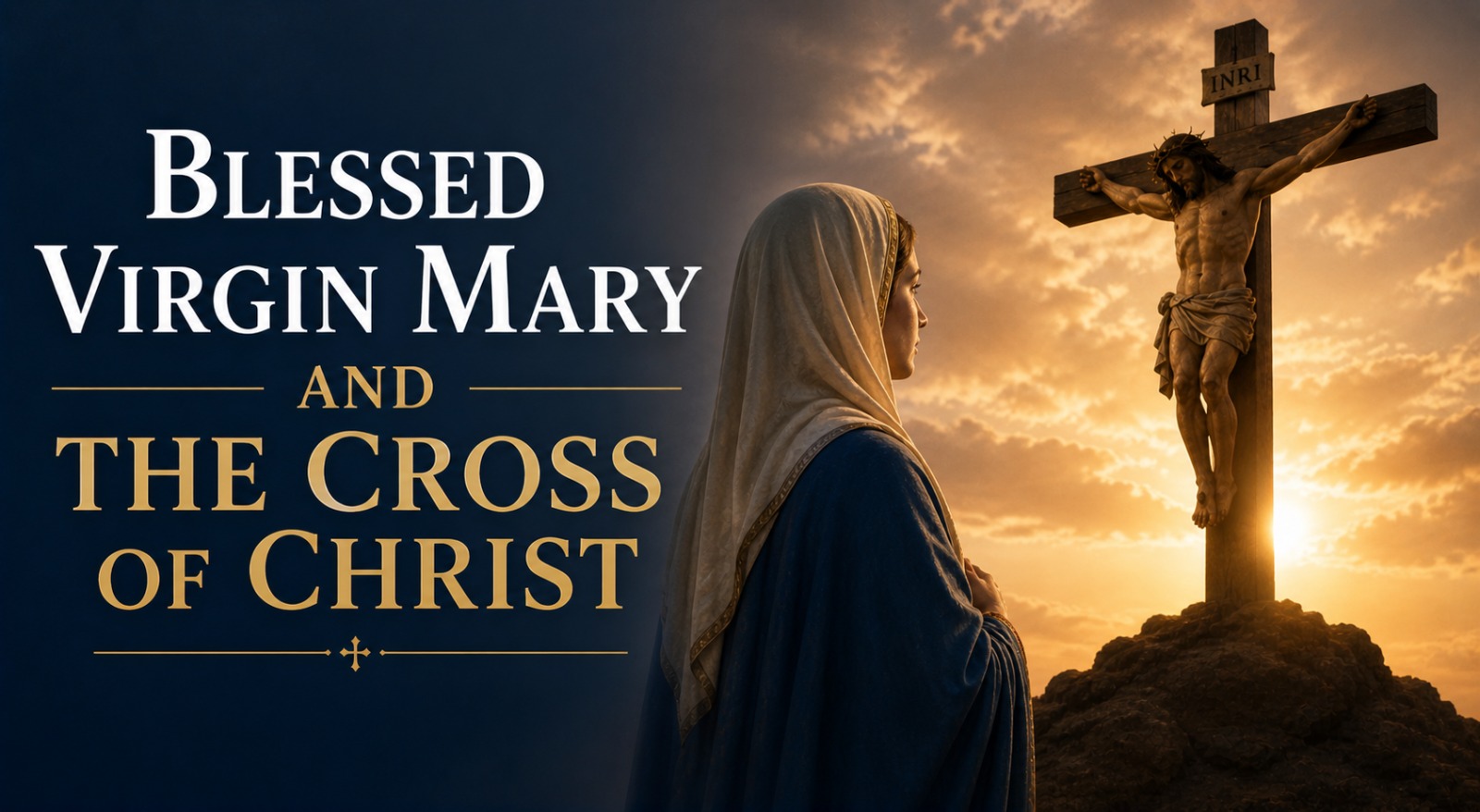
This indeed, is the fact that “Jesus himself bore our sins in his body on the tree, so that we might die to sins and live for righteousness.” (1Pet. 2: 24) However, it was made possible by the single ‘fiat’ of the Blessed Virgin Mary of Nazareth. After clarifying her stand to the message of the angel Gabriel, she said, “I am the handmaid of the Lord, let it be done to me as you have said.” (Lk. 1: 28) Instantly, “The Word was made flesh, and dwelt among us, full of grace and truth.” (Jn. 1: 14) Thus the Virgin Mary facilitated the redemptive sacrifice of Jesus on the cross. In this article I wish to elucidate the Virgin Mary’s role along the cross in the redemption of the world.
Bearing Jesus: A hymn for the Holy Week from the Stanbrook Abbey Hymnal reads, “O Cross of Christ, immortal tree, on which our Saviour died. The world is sheltered by your arms. That bore the Crucified.” Before the cross could bear his body, Jesus bore his cross like Isaac in the Old Testament (Gn. 22: 6), and went out of the city of Jerusalem to what is called the Place of the Skull, in Hebrew, Golgotha. There he was crucified there. (Jn. 19: 17-18) The cross bore the body of Jesus for three hours from 12 noon to 3pm. And thus the cross, originally a instrument of shameful execution, was sanctified and transformed into a symbol of salvation and divine victory. On the other hand, Mary, full of grace (Lk. 1: 28) too bore him in her womb for nine months, from March 25 and brought him forth on December 25. Thus for the salvation of the world both, the Blessed Virgin Mary and the cross bore the body of Jesus; the former was preserved from sin and the latter was made holy by the one whom they bore.


Five Wounds: The five Wounds of Jesus are the specific injuries he sustained during his crucifixion, venerated in Christian tradition to represent his passion and sacrifice. They are the wounds from nails on the right hand, left hand, right foot and left foot and the spear wound on his right side. From his pierced side, writes St. John, the evangelist, immediately there flowed out blood and water. (Jn. 19: 34) The CCC 1225 and 766 establish that the blood and water from Christ’s side symbolize the birth of the Church and her sacraments, particularly Baptism and the Eucharist. Our Blessed Mother Mary too participated in the passion of Christ as she stood by the cross of Christ, (Jn. 19: 25) fulfilling the prophecy of Simeon in Luke 2: 35 that ‘a sword shall pierce your heart.’
The Seven Sorrows: The seven sorrows of our Blessed Mother include the prophecy of Simeon, the flight into Egypt, the loss of Jesus in the Temple, her meeting with Jesus on the way to Calvary, the Crucifixion, receiving Jesus’ body and the burial. These represent the intense spiritual suffering, the ‘martyrdom of the soul,’ of the Virgin Mary. However, the fifth and sixth sorrows - the crucifixion and the removal from the cross - directly correspond to the physical wounds of Jesus, where Mary, as the “Queen of Martyrs,” shared in his suffering.
In conclusion we can say with St. Theodore the Studite that it is the tree on which the Lord, like a great warrior with his hands and feet and his divine side pierced in battle, healed the wounds of our sins, healed our nature that had been wounded by the evil serpent. However, as promised, it was made possible by the help of the second Eve, the Blessed Virgin Mary whose offspring, Jesus, crushed the evil one. (Gn. 3: 15)
By Fr. William Horo


© 2026 CATHOLIC CONNECT POWERED BY ATCONLINE LLP