- 21 June, 2026

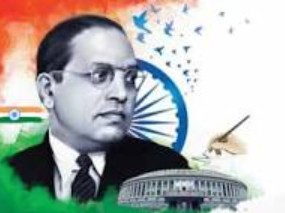
New Delhi, April 14, 2026: Every year on April 14, India celebrates the birth anniversary of B. R. Ambedkar—a towering figure of justice, dignity, and human rights. While Ambedkar Jayanti is often seen as a social or political observance, for Christians in India it can become something deeper: a moment of spiritual reflection and honest self-examination.


Ambedkar’s life and legacy raise a profound question to the Church: Are we truly living the Gospel we proclaim?
Dr. Ambedkar was not merely a political reformer; he was a profound seeker of truth. In 1935, he famously declared that although he was born a Hindu, he would not die a Hindu. This marked the beginning of nearly two decades of intense study of world religions, as he searched for a faith that could offer equality, dignity, and rationality for himself and his people.
Among the religions he studied deeply was Christianity. Ambedkar engaged seriously with the life and teachings of Jesus Christ and was deeply moved by His message of compassion, justice, and solidarity with the marginalized.


Historical accounts suggest that Ambedkar not only studied Christianity intellectually but also considered embracing it. He interacted with Christian leaders, attended church services, and at certain points even explored the possibility of baptism. His openness to Christianity reveals that he was not opposed to Christ’s message—in fact, he admired it.
Despite this engagement, Ambedkar ultimately chose not to convert to Christianity. His decision was shaped not by a rejection of Christ, but by concerns about the lived reality of religion in India.
He observed that caste distinctions often persisted even within Christian communities. For someone whose life mission was the complete annihilation of caste, this was deeply troubling. He feared that conversion alone might not guarantee true social equality or dignity for Dalits.
Ambedkar’s critique was, in many ways, prophetic. It exposed a painful contradiction: while the Gospel proclaimed equality, its practice sometimes fell short.
After years of study, Ambedkar found in Buddhism a path that aligned fully with his vision. He saw it as rational, ethical, and rooted in human dignity. Importantly, he viewed it as a tradition free from caste hierarchy and capable of fostering social transformation.
On October 14, 1956, in Nagpur, he formally embraced Buddhism, along with more than 500,000 followers—one of the largest mass conversions in history. This moment was not merely religious; it was a powerful declaration of human dignity and self-respect.
While Dr. Ambedkar eventually converted to Buddhism and was highly critical of caste across religions, there remain significant connections between his legacy and the mission of the Catholic Church—especially in the Indian context.
The Catholic Church’s social teaching emphasizes the inherent dignity of every human person, created in the image of God. Ambedkar’s lifelong struggle to uplift Dalits and eradicate caste-based discrimination resonates deeply with this core belief.
Both Ambedkar and the Church have stood against the “social scourge of untouchability.” Across India, Catholic institutions—through education, healthcare, and social outreach—serve many of the same marginalized communities for whom Ambedkar fought.
Ambedkar famously championed education as the primary means of empowerment. The Church, too, has long recognized education as a path to dignity and transformation, building schools and institutions that serve the poor and excluded.
The principles Ambedkar upheld—Liberty, Equality, and Fraternity—are not foreign to Christianity. They echo the moral vision of the Gospel and Catholic Social Teaching, which calls for a just and compassionate society.
Modern Catholic groups in India increasingly recognize Ambedkar’s contribution to social justice and often join in honoring his legacy. His vision continues to inspire movements within the Church that seek to confront inequality and build inclusive communities.
Ambedkar Jayanti offers the Church in India a meaningful opportunity for reflection.
It invites us to ask:
Ambedkar’s life serves as a mirror, revealing both the strengths and the shortcomings of our witness as Christians.
The persistence of caste discrimination—even in subtle forms—reminds us that the work of justice is not complete. Dalit Christians continue to seek dignity, representation, and equality within the Church.
This is not merely a social issue; it is a Gospel issue.
Ambedkar’s legacy challenges the Church to renew its commitment to authenticity—to ensure that its structures, communities, and attitudes reflect the radical inclusiveness of Christ.
The connection between Ambedkar Jayanti and the Catholic Church lies in a shared commitment: the defense of human dignity and the pursuit of a just, egalitarian society.
Ambedkar did not simply critique religion; he called it to be better. His life remains a powerful reminder that faith must be lived, not merely professed.
For Catholics in India, his legacy is both a challenge and an invitation—
a challenge to confront uncomfortable truths,
and an invitation to embody the Gospel more fully.
In the end, perhaps the most fitting way to remember him is this:
Ambedkar did not reject Christ; he challenged Christians to live like Christ.
By Catholic Connect Reporter
© 2026 CATHOLIC CONNECT POWERED BY ATCONLINE LLP